
RFQ Farm Produce: To Buying and Selling Through Structured Requests for Quotation
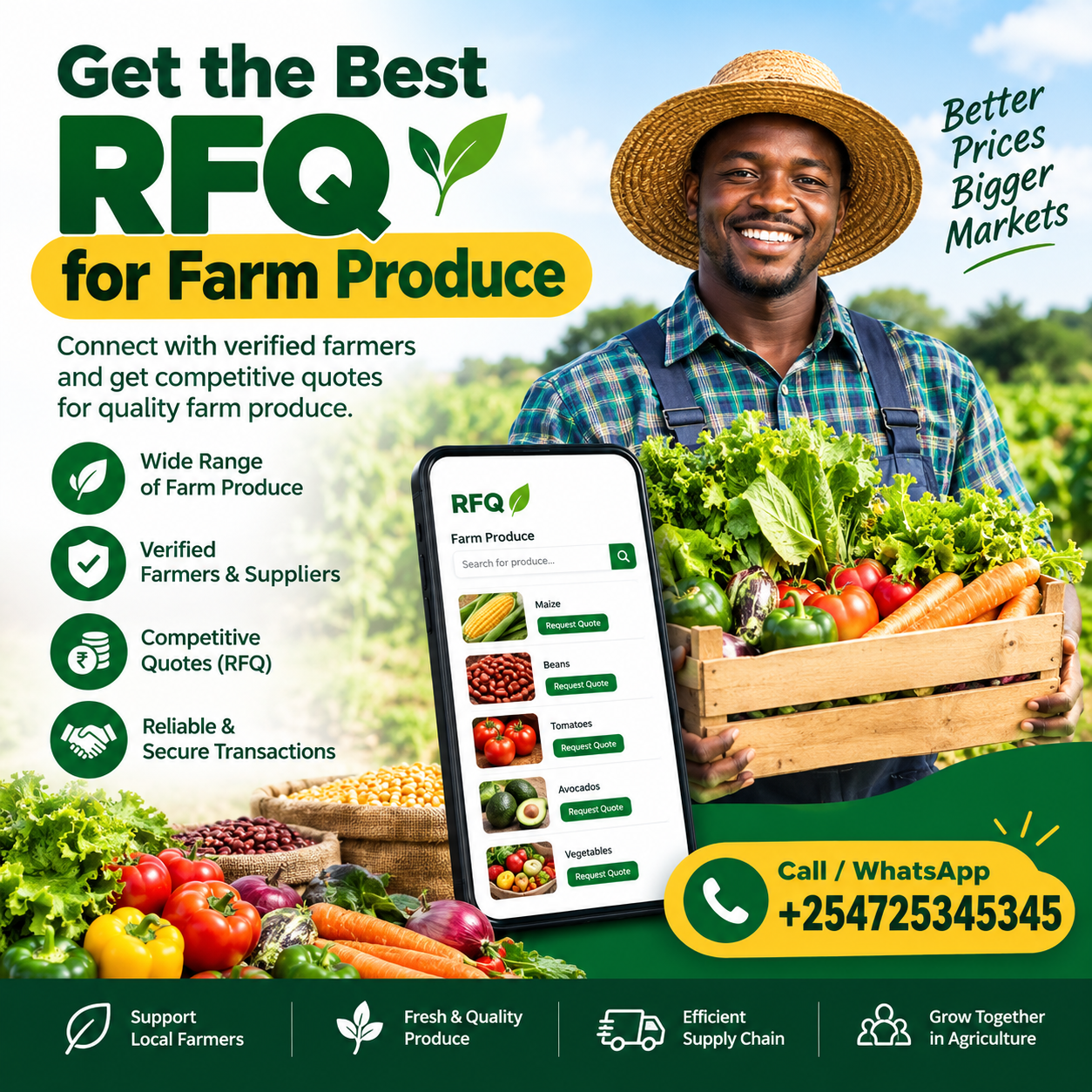
An RFQ farm produce process exists to solve the oldest problem in agricultural trade: the price that was never really discovered. For generations, farm produce changed hands on whatever number was spoken first — a buyer called a farmer and named a figure, or a farmer met a trader and accepted one, and whichever party had less information absorbed the difference. No specification was written, no alternative was compared, no record was kept, and no one could ever say whether the deal was good, bad, or ordinary. The Request for Quotation — the RFQ — is the formal answer to that informality: a written invitation to named suppliers to quote against a defined requirement, so that prices can be compared honestly, awarded fairly, and defended afterwards to anyone who asks.
Stand in any market yard or produce office in this region and you will meet both kinds of buyer. One phones three familiar farmers, takes the first acceptable number, and fills the order — fast, friendly, and permanently unable to prove that the price was competitive. The other writes down what is actually needed — commodity, grade, quantity, delivery date, packaging, terms — sends it to a shortlist of capable suppliers, receives written quotations against the same requirement, and awards on evidence. The first buyer’s margin depends on luck and loyalty; the second buyer’s margin is engineered. Structured RFQ farm produce sourcing is the discipline that separates them, and it is rapidly becoming the standard expectation of every serious counterparty in the chain.
What has changed is not the produce but the formality arriving around it. Processors must document procurement for their own auditors and their export customers; hotel groups and caterers face franchise and quality audits that examine how suppliers were selected; institutional buyers — schools, hospitals, relief programmes, county governments — operate under procurement rules that require competitive quotations above defined thresholds; and exporters increasingly need a paper trail from purchase order back to competitive sourcing. Meanwhile, on the supply side, farmer groups, aggregators, and commercial farms have grown capable of responding professionally — if someone asks them properly. The RFQ farm produce meeting point between that formal demand and that capable supply is one of the quiet structural shifts reshaping African agricultural trade.
The cost of skipping the discipline is specific and recurring. The buyer who never competitively quotes pays last season’s price plus whatever the market quietly added, and calls it inflation. The buyer with one supplier per commodity has no fallback when that supplier’s crop fails, and negotiates every renewal from weakness. The buyer whose sourcing lives in phone calls and memory cannot answer the auditor, the investor, or the new manager who asks the only question that matters: how do we know these are good prices? Every one of those exposures is removed by a working RFQ farm produce routine — which is why procurement professionals treat it not as paperwork but as the core of their margin.
This guide examines RFQ farm produce sourcing in full: why the timing is no accident, why structured buying decides everything, what an RFQ actually is, the elements that separate a quotation process that works from one that merely generates paper, the benefits buyers and suppliers report, who needs the discipline most, what each commodity category demands, the comparison method that reveals true cost, and — on both sides of the transaction — exactly how to run it and how to win it. By the end, buying and selling farm produce becomes a documented process rather than a conversation remembered differently by everyone involved.
Why the Timing Is No Accident
The timing of this shift is no accident. Agricultural procurement has been formalising from both directions at once — from above, as institutional rules, audit standards, and traceability requirements reached down into everyday buying; and from below, as digital tools made it practical to run a structured quotation process with suppliers who a decade ago could only be reached by telephone and served only by trust. The modern RFQ farm produce market was created by that collision: buyers who must document competition meeting suppliers organised enough to answer.
Three forces deepened the shift. E-procurement norms have spread from government into the private sector, so that competitive quotation is now the expected default above even modest thresholds rather than an occasional ceremony. Food-safety and traceability regimes have made supplier selection part of the compliance file — a buyer who cannot show how a supplier was chosen inherits that supplier’s every failure undocumented. And mobile connectivity has finally reached the farms and aggregation points where produce actually originates, which means the RFQ farm produce opportunity set now includes thousands of capable suppliers who were previously invisible to any structured process.
The supply side professionalised in parallel. Farmer marketing groups learned to respond to written enquiries with written offers; aggregation platforms gave small producers the consolidated volumes that formal buyers require; and a generation of young farm managers arrived fluent in the language of specifications, validity periods, and award letters. The result is a market that has quietly stratified: buyers running disciplined RFQ farm produce processes trade with suppliers who can meet them, and both sides leave the informally traded remainder behind — along with its unpredictable prices and unresolvable disputes.
Why Structured Buying Decides Everything
Produce margins are thin, and thin margins are decided by price discovery. Between two buyers selling identical products into identical markets, the one who systematically quotes before buying routinely holds a two-to-five percent cost advantage on raw materials — which, in produce, is frequently the entire profit. This is the quiet arithmetic behind RFQ farm produce discipline: not bureaucracy, but the repeated harvesting of the price gap that always exists between the first number spoken and the best number available.
Reliability is the second dividend. A buyer who has quoted five suppliers for a requirement holds, as a by-product, a live map of who can supply what, when, and at what quality — which is precisely the information needed the day a primary supplier’s crop fails or a sudden order arrives. Buyers who run regular RFQ farm produce cycles describe this supplier map as their most valuable asset in disruption: the fallback list already exists, already priced, and already contactable, while unstructured buyers start their search during the emergency.
Defensibility completes the case. Every procurement decision eventually faces a question — from an auditor, an owner, a board, a donor, or a successor — about why that supplier and that price. The buyer with a written requirement, dated quotations, and a stated award rationale answers in minutes; the buyer without them answers with confidence, and confidence is not a document. In an era when RFQ farm produce records increasingly feed audits, certifications, and financing files, the process that produces them pays for itself in defensibility alone.
There is also a fairness dividend that matters more than it first appears. Structured quotation gives suppliers who lack connections a genuine path to contracts — the well-written requirement read by ten capable bidders beats the private phone call to one well-connected cousin, every time. Markets that adopt RFQ farm produce discipline consistently widen their supplier bases, and wider supplier bases mean better prices, better continuity, and better quality for everyone buying.
What RFQ Farm Produce Actually Is
At its core, RFQ farm produce sourcing is a three-stage commercial instrument. Stage one: the buyer issues a written request defining exactly what is required — commodity, grade, quantity, delivery schedule, packaging, delivery terms, and the deadline and format for responses. Stage two: invited suppliers respond with written quotations priced against that identical requirement. Stage three: the buyer evaluates the responses against criteria known in advance and awards, in writing, to the quotation that best meets the need. Simple in outline — and in that simplicity lies its power, because a process simple enough to run weekly is a process that actually runs.
The distinction from its neighbours matters. A tender is a heavier instrument for larger, longer contracts, with sealed bids and formal evaluation committees; a request for proposal invites solutions rather than prices; a spot negotiation is a single conversation about a single load. The RFQ farm produce middle ground — lighter than a tender, firmer than a phone call — is exactly suited to produce, where volumes recur weekly, specifications are objective, and speed matters. It is the workhorse instrument of produce procurement, and it deserves to be engineered like one.
What elevates the practice today is the digital layer. Modern RFQ farm produce platforms let a buyer define a requirement once, dispatch it to a prequalified supplier list in minutes, receive structured responses in one place, compare them on a single screen, and convert the winner into a purchase order without retyping a line. Every quotation is timestamped, every revision is versioned, and the whole cycle — request, responses, evaluation, award — archives itself as the audit trail. The paper version of the same process required a clipboard, a spreadsheet, and a tolerance for retyping; the digital version requires a phone, which is why adoption is accelerating fastest among buyers who run many small requirements rather than one large one.
The daily workflow shows the design intent. Monday morning: the buyer issues the week’s requirement — two tonnes of grade-one tomatoes, delivered Thursday, crates specified, delivered-to-premises — to eight prequalified suppliers. Tuesday: quotations land, structured identically, each timestamped and valid for seventy-two hours. Wednesday morning: the buyer compares on one screen — price, validity, delivery capability, quality history — awards to the best compliant offer, and the purchase order goes out with the award notice. By Thursday, the delivery arrives against a specification everyone saw in writing — and the entire RFQ farm produce cycle, from requirement to delivery, exists as records no memory-based process ever produced.
The intelligence layer is what turns the tool into a market instrument. Platforms aggregating many RFQ farm produce cycles build price histories per commodity, per supplier, and per season — so the buyer issuing this month’s requirement already knows the range last month’s quotations fell in, which suppliers consistently quote inside it, and whose prices drift upward between awards. Suppliers see the mirror image: their win rates, their price position against awarded bids, and the specifications they repeatedly fail. Both sides stop trading in the dark.
Core Elements That Matter
Not every quotation process deserves the name. When building an RFQ farm produce routine, these are the elements that genuinely separate a process that discovers prices from one that merely collects paper.
The Written Specification
Everything begins with the requirement, and vague requirements produce quotations that cannot be compared. Commodity and variety, grade and sizing, freshness and maturity standards, packaging and crate counts, and the quantity tolerance permitted — a serious RFQ farm produce specification states each of them in words short enough for a supplier to quote against without a phone call. Buyers who invest an hour in specification templates recover it in every cycle thereafter, because the quotations arrive comparable rather than conversational.
Volume and Delivery Schedule
Produce pricing is volume-and-timing pricing: two tonnes delivered on one day quotes differently from half-tonnes across a month, and Friday delivery quotes differently from Monday. The requirement must state the quantity, the split, the delivery window, and the recurrence — one-off or weekly — so suppliers can price the logistics honestly. RFQ farm produce requirements that omit schedule force every bidder to guess, and guessed logistics are where quotations quietly stop being comparable.
Delivery Terms Stated Upfront
Who pays transport, where title passes, and what happens on rejection — these must be written into the request, in terms both sides understand, because a quotation that excludes transport is simply a different price wearing the same number. Mature RFQ farm produce practice uses clear delivery terms — farm-gate, delivered-to-store, delivered-to-shelf — applied consistently across every cycle, so that the comparison across suppliers and across months stays honest without translation.
Response Window and Format
Fresh produce moves fast, so the window must be short but real: forty-eight to seventy-two hours is typical for weekly requirements, with a stated format — price per unit, validity period, delivery confirmation — that structures every response identically. A disciplined RFQ farm produce window also protects both sides from the failure modes of haste: suppliers get genuine time to check stock and transport, and the buyer receives responses complete enough to award on rather than chase.
Evaluation Criteria Stated in Advance
The award rule should be written before the quotations arrive: lowest compliant price, or best combined score of price, quality history, delivery reliability, and payment terms. Stating the criteria in the request is what makes the process fair in appearance and fact — suppliers compete against the rule, not against favouritism, and the buyer’s eventual award carries its own justification. RFQ farm produce processes that evaluate on published criteria build supplier trust that no informal negotiation can earn, and trust shows up in the next cycle’s pricing.
Supplier Prequalification
Quotation quality is decided before the request is sent. The buyer’s standing list — suppliers verified for licences and legitimacy, capacity appropriate to the requirement, quality track record, and delivery capability — is what turns a quotation exercise from guesswork into procurement. Serious RFQ farm produce buyers maintain the list as a living asset: additions trialled on small requirements, underperformers rotated out, and new categories qualified as new requirements emerge.
Digital Submission and Records
Where responses arrive, everything downstream follows. Structured digital submission — identical fields for every bidder, timestamped on receipt, versioned if revised — is what makes comparison instant and disputes impossible, and it is the single upgrade that most improves a RFQ farm produce routine’s yield. The archive of issued requirements and received quotations accumulates into the buyer’s price history and the supplier’s performance record, compounding in value with every cycle.
Competitive Dynamics and Award Transparency
Competition only disciplines prices if it is visible. Telling bidders how many were invited, notifying every participant of the award, and giving unsuccessful bidders a factual reason — price, validity, or capacity — are the practices that keep suppliers returning to the process rather than abandoning it. RFQ farm produce cycles run with visible awards consistently attract deeper and better-priced competition over time, because suppliers invest effort where the game is honestly refereed.
Contract Conversion
The award is not the finish; the contract is. The winning quotation should convert directly into a purchase order carrying the specification, the price, the schedule, and the acceptance terms — signed or confirmed digitally — so that the delivery arrives against a document rather than a memory. Buyers who run their RFQ farm produce process through to a clean PO close the loop that informal buying never closes, and the quality claims and payment terms that follow all rest on paper both sides have seen.
Alerts and Cycle Management
Produce procurement runs on calendars — planting seasons, harvest windows, market days, payment cycles — and the process must carry its own schedule: requirements issued on rhythm, windows closed on time, quotations chased before expiry, awards notified same-day. Platforms with built-in reminders turn the RFQ farm produce cycle into a routine that runs itself, which is the difference between a discipline practised for years and one abandoned after the first busy month.
The Benefits Buyers and Suppliers Report
The first benefit buyers report is the end of price guesswork. With every requirement quoted competitively, the buyer holds dated evidence of the market range for every commodity purchased — and the savings compound quietly, cycle after cycle, from the gap between the old first-offered price and the newly awarded one. Operations running disciplined RFQ farm produce routines typically report input-cost reductions in their first season that exceed every software and labour cost of running the process many times over.
The second is the supplier map. Every cycle deepens the buyer’s live knowledge of who can supply what, at what quality, and how reliably — and when disruption arrives, the fallback list is already priced and already warm. Buyers using RFQ farm produce platforms describe supply interruptions that once stalled operations for a week now resolved the same afternoon, because the alternatives were one screen away.
The third is defensibility. Requirements written, quotations timestamped, criteria published, awards documented — the buyer’s entire sourcing history is audit-ready as a by-product of normal work, not assembled retrospectively under pressure. For processors, institutions, and any buyer facing scrutiny, the RFQ farm produce archive converts the audit from an event into a file retrieval.
The fourth is quality leverage. Written specifications attached to competitive quotation give the buyer something informal buying never had: a contractual definition of quality that survives the delivery. Rejections stop being arguments and become references to a document the supplier quoted against — and RFQ farm produce buyers consistently report quality improving within a season, because suppliers grade to the specification once the specification is real.
On the supplier’s side, the first benefit is access. Structured, published requirements are the first procurement channel in history that does not require connections — a capable farmer group with a written offer competes on equal terms with an established trader. Suppliers who build their sales around RFQ farm produce opportunities consistently widen their buyer bases beyond the three customers they could reach by phone, and wider demand means better prices and steadier volumes.
The second supplier benefit is professionalism that pays. Responding to written requirements forces the disciplines that formal buyers pay premiums for — accurate grading, honest capacity statements, reliable delivery commitments — and those disciplines compound into a track record. Suppliers with RFQ farm produce response histories hold documentation that unlocks exactly the contracts their informally trading competitors cannot qualify for.
The joint benefit is the compounding relationship. Buyer and supplier who trade through repeated cycles accumulate shared specification language, reliable rhythms, and mutual knowledge that makes every subsequent quotation faster and every delivery smoother. Partnerships built through RFQ farm produce processes over multiple seasons operate with an efficiency neither side can purchase new — because the one input that cannot be bought retroactively is trading history.
Who Needs It Most
Processors and manufacturers sit at the front of the queue. A juice line, a canning operation, or a drying facility buys by the tonne on a schedule, and its raw-material cost is decided by the quality of its price discovery — which is why processors were the earliest serious adopters of RFQ farm produce sourcing and remain its most disciplined practitioners.
Hospitality groups and institutional caterers follow close behind. Hotels, lodges, restaurant chains, airlines, hospitals, and schools buy produce steadily across dozens of properties and kitchens, and their procurement rules increasingly demand competitive quotation at defined thresholds. Group purchasing organised around RFQ farm produce cycles delivers them contract pricing, consistent specification across properties, and the audit trail their own governance requires — three things spot buying has never provided.
Exporters and wholesale distributors need quotation discipline as the foundation of their margin. They buy what they later sell, often on forward commitments, and a three percent error in purchase price is a three percent error in profit — the discipline of quoting five sources before every major purchase is what separates trading houses from gambler’s stalls. For this constituency, RFQ farm produce routines are not best practice; they are the profession itself.
Institutional and development buyers — government bodies, county programmes, relief agencies, school feeding schemes — operate under procurement frameworks that mandate competitive quotation, and produce is among the largest categories they purchase. The RFQ farm produce files they generate are simultaneously compliance documents and public money protected; procurement officers who build efficient produce-quotation routines deliver both at once.
Farmer groups, co-operatives, and aggregators stand on the supply side of the same instrument. Groups that monitor buyer requirements, respond with disciplined written offers, and build award histories graduate from marginal sellers to contracted suppliers — and the aggregators who run their own downstream RFQ farm produce buying from member farms extend the same discipline into the fields where the produce actually grows.
Finally, the growing mid-scale commercial farm — large enough to sell formally, new to formal procurement — finds in structured quotation the fastest available education in market pricing. Nothing teaches a farm manager the real value of an onion crop faster than writing offers against real requirements, and nothing builds a commercial network faster than RFQ farm produce responses that arrive complete, on time, and exactly to specification.
Commodity by Commodity: What Each Category Demands
Grains and pulses — maize, beans, rice, groundnuts — are the volume category, and their requirements live on objective specification: moisture content, aflatoxin limits where relevant, foreign matter, and bag weights. These are the easiest commodities to quote structurally, because quality is testable on delivery, which is why RFQ farm produce discipline typically begins here and spreads outward.
Fruit — avocado, mango, citrus, banana — adds maturity and shelf-life discipline to the specification: maturity indices, counts per crate, defect tolerances, and variety confirmation. Buyers quoting fruit through structured RFQ farm produce requirements learn quickly that the specification is the transaction — because fruit quality is decided in the field weeks before the quotation, and the written requirement is what reaches back into the orchard.
Vegetables — tomato, onion, cabbage, leafy lines — are the speed category: short shelf lives, fast-moving prices, and delivery windows that forgive nothing. The successful RFQ farm produce practice here is cadence — short windows, weekly rhythm, and evaluation fast enough that quotations still describe produce that will exist on delivery day.
Roots and tubers — potato, sweet potato, carrot — sit between the volume and freshness categories, with curing, sizing, and storage condition joining the specification. Buyers who quote them structurally typically discover that supplier storage capacity, not farm-gate price, is the real differentiator — and their RFQ farm produce requirements evolve to ask about storage precisely because the delivered quality taught them to.
Eggs, dairy, and other animal products complete the short-cycle set, where cold chain, freshness dating, and food-safety handling join the standard specification. The buyers who quote these categories well are the ones whose requirements name the handling standards explicitly — because RFQ farm produce discipline, applied to perishables, is ultimately a food-safety instrument as much as a pricing one.
The Comparable Price: The Number That Changes Everything
The single most clarifying exercise in produce procurement is computing what a quotation actually costs delivered — not the number on the offer, but the total: unit price, packaging, transport, rejection risk, validity expiry, and payment terms, assembled on one line per bidder. Buyers who normalise every RFQ farm produce response to a single comparable figure discover that quotations which looked cheapest frequently are not — and that the discipline of true comparison is worth more than any single negotiation.
The second discipline is weighting quality where it belongs. Two quotations for the same grade rarely carry the same delivered reality, and the buyer’s quality history per supplier — rejection rates, grade drift, shelf-life at arrival — is the data that turns the comparison from arithmetic into procurement. Mature RFQ farm produce evaluation scores price and history together, published as criteria in advance, so the award reflects total value rather than the lowest number that survived the journey least well.
The third is the time dimension. A quotation’s validity period is part of its price — a number valid for seventy-two hours is a different instrument from one valid for a fortnight — and buyers who track awarded prices against their own RFQ farm produce history across seasons gain the market intelligence that turns every future cycle from discovery into confirmation.
Phone Calls vs Structured RFQs
Informal buying is fast, friendly, and blind. The phone call produces a number with no specification behind it, no comparison beside it, no record under it, and no way to revisit it when the delivery disappoints — and its true cost is paid in every negotiation conducted from weakness, every audit answered with memory, and every supply failure met with a search that starts from zero. The RFQ farm produce alternative costs perhaps thirty extra minutes per cycle and repays them in the first comparison, because the quotation that arrives in writing against a written requirement is a different commercial object from a number remembered over the phone.
The deeper difference is compounding. Informal buying produces nothing that carries forward; structured quotation produces an archive that grows more valuable with every cycle — price histories, supplier records, specification libraries — until the buyer’s market knowledge itself becomes the competitive asset. Operations that migrated from calls to RFQ farm produce routines consistently describe the same threshold: the moment they answered a hard question from their own records in minutes, and realised the old way had never actually known anything at all.
Records, Traceability and Financing
Documentation has become the hinge of produce trade. Certification schemes, retail audit programmes, institutional funding, and export inspections all ask the procurement question — how were your suppliers chosen, at what prices, against what specifications — and the buyer whose RFQ farm produce archive answers in minutes holds a qualification that records-poor competitors cannot produce under deadline. The quotation file, once compliance overhead, is now market access.
Financing follows the same logic. Lenders and trade financiers price risk on visibility — confirmed sourcing, documented prices, auditable supplier selection — and buyers with structured procurement histories borrow against their produce programmes on terms informal traders never see. The RFQ farm produce record trail, accumulated as a by-product of disciplined buying, is precisely the evidence file that agricultural credit officers are trained to look for.
How to Run an RFQ Step by Step
Begin with the requirement, written properly: commodity, grade, quantity, schedule, packaging, delivery terms, response deadline, format, and the evaluation rule — on one page, in plain language. Buyers who maintain standing templates for their recurring RFQ farm produce requirements issue a complete request in fifteen minutes, and the completeness is what makes every downstream step clean.
Then dispatch to the prequalified list, close the window on time, and evaluate on the published criteria with every response normalised to delivered cost. Award in writing the same day, notify every bidder, convert the winner to a purchase order, and file the whole cycle. Two hours of disciplined RFQ farm produce work per requirement is the full price of the margin, the map, and the audit trail — and the operations that pay it weekly are the ones whose procurement looks professional from any angle anyone examines it.
How to Respond as a Supplier
Read the requirement before quoting, and quote only what you can deliver exactly: the specification, the schedule, and the terms are the contract you are offering to sign. Suppliers who win repeatedly through RFQ farm produce processes share one habit — they answer the document as written, flag any deviation explicitly rather than silently, and never submit a price that depends on hope.
Then build the response as a sales document: your capacity evidence, your quality history, your delivery confirmation, and your validity stated plainly. Price competitively but honestly, because the process repeats — and suppliers who win a cycle on an undeliverable price lose the next ten cycles of credibility. The consistent RFQ farm produce winners are rarely the cheapest bidders; they are the ones whose quotations arrive complete, on time, every time, until awarding them becomes the buyer’s easiest decision.
The Future of Structured Produce Sourcing
The technology is still accelerating. Platforms are joining quotation cycles to live harvest data, so requirements reach the fields where the produce actually is; evaluation is beginning to weight verified quality records automatically; and smallholder groups are gaining the digital tools to respond as professionally as any trading house. The buyers and suppliers building their RFQ farm produce histories now are assembling the market intelligence and the trading reputations that the next decade of formal produce commerce will assume as standard — and neither can be bought retroactively at any price.
Frequently Asked Questions
What is the difference between an RFQ and a tender for farm produce? A tender is the heavier instrument — sealed bids, formal committees, long contract periods — suited to large multi-season supply contracts. An RFQ is the light, fast version suited to produce’s weekly rhythms: same written discipline, same fair comparison, a fraction of the administration, and a RFQ farm produce cycle that can run every single week without exhausting anyone.
How many suppliers should be invited to quote? Enough for genuine competition, few enough for quality responses — typically four to eight prequalified suppliers per requirement. Below four, competition is thin; above eight, response quality drops and evaluation slows. Serious RFQ farm produce practice keeps a deeper bench qualified in the background and rotates it in when primaries waver.
How do you compare quotations fairly when quality differs between suppliers? Normalise every response to delivered cost against the written specification, then weight price with each supplier’s documented quality and delivery history — criteria stated in the requirement before quotations arrive. Buyers who evaluate their RFQ farm produce cycles on published, consistent rules report that the fairness itself becomes a competitive advantage in attracting better suppliers.
How long should a response window be for fresh produce? Forty-eight to seventy-two hours for routine weekly requirements — long enough for suppliers to verify stock and transport, short enough that quotations describe produce that will still exist at delivery. Perishable categories trend toward the shorter end, and mature RFQ farm produce programmes tune the window per commodity rather than applying one rule to everything.
Can smallholder suppliers realistically win structured quotations? Yes — and increasingly they do, because structured quotation removes the connections barrier that informal buying imposed. Farmer groups that respond completely, to specification, on time, compete on equal terms with established traders, and buyers actively seeking dependable RFQ farm produce supply from organised smallholders report that the discipline of the process matters more than the size of the farm behind it.