
Phytosanitary Certificate for Exports: The Export Passport Every Kenyan Consignment Needs in 2026
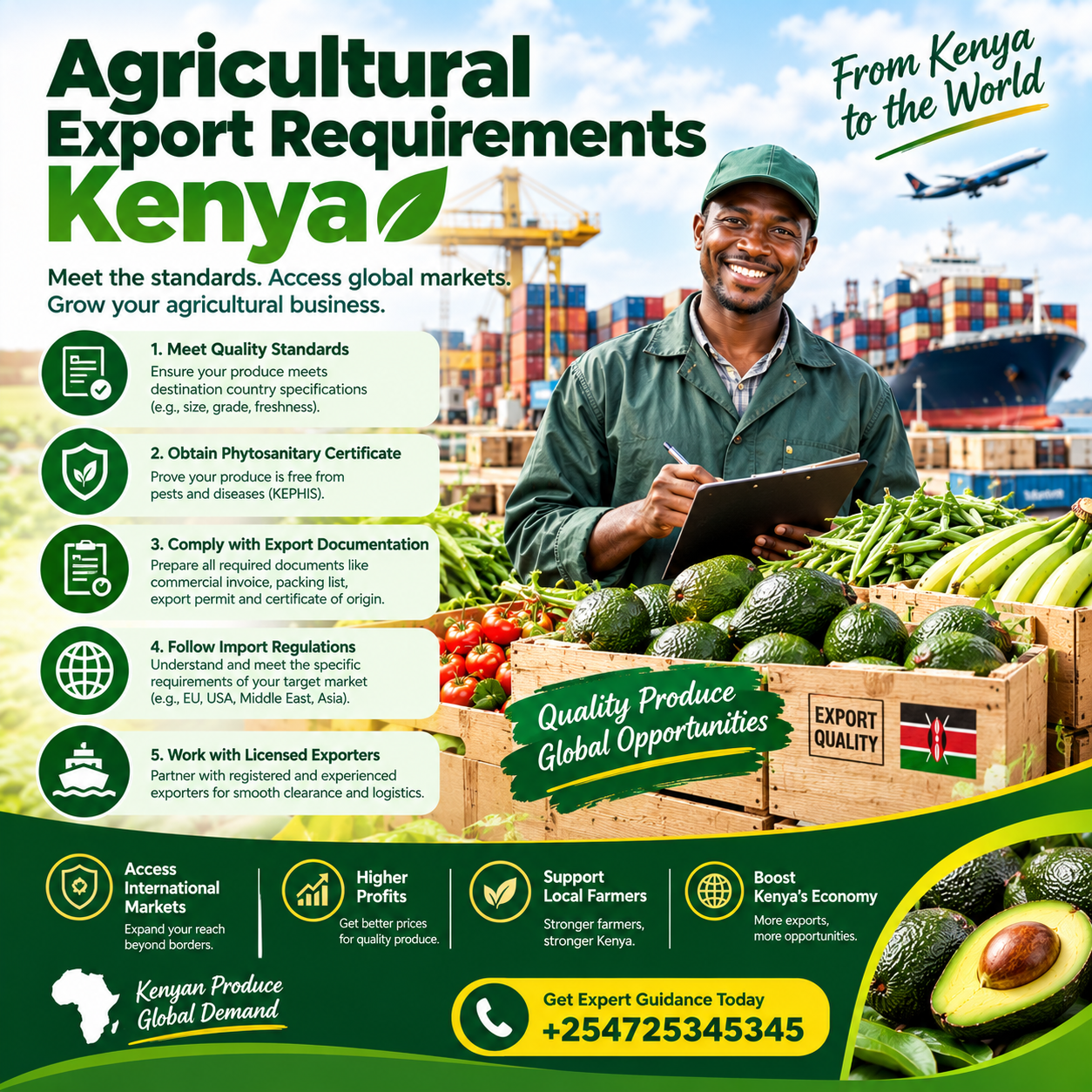
A phytosanitary certificate for exports is the official document that declares your produce has been inspected, found free of regulated pests, and meets the plant health requirements of the country it is entering. It is the single most important piece of paper in fresh produce trade — the document without which no consignment of avocados, beans, mangoes, or flowers legally leaves Kenya. Buyers in Dubai, London, and Rotterdam all ask for it before anything else, and every successful consignment in the trade guides on this site began with a properly issued phytosanitary certificate for exports.
The document is small but carries enormous weight. Issued by KEPHIS — Kenya’s national plant protection organization — it represents a government-to-government declaration that the fruit or vegetables in your container meet the importing country’s plant health rules. When it is correct, your produce clears in hours; when it is wrong, your container sits at a port while margins bleed.
This guide is the complete document-level guide for exporters. We explain what the certificate is, why the global system demands it, and what it actually contains. We also cover the application process, the inspection that precedes it, destination-specific requirements, the document chain it travels in, the costs, the mistakes that cause rejections, and where the system is heading digitally.
By the end, you will understand every dimension of the phytosanitary certificate for exports — enough to manage the process confidently, brief your staff properly, and answer any buyer’s questions about it. One honest note before we begin: procedures, fees, and destination requirements evolve constantly, so confirm current specifics directly with KEPHIS and the importing country’s authorities before every season — that verification habit is what separates exporters whose phytosanitary certificate for exports arrives on time from those whose containers wait.
What Is a Phytosanitary Certificate?
A phytosanitary certificate for exports is an official document issued by the national plant protection organization of the exporting country — in Kenya’s case, KEPHIS. It certifies that the plants or plant products in a specific consignment have been inspected according to official procedures and are substantially free from quarantine pests. It also declares the consignment conforms to the phytosanitary requirements of the destination country.
The certificate is government-to-government by design. When your certificate lands in Dubai or London, it is read by the importing country’s plant protection authority — not just by a customs officer — because it is a declaration between official systems. That inter-governmental character is what gives the phytosanitary certificate for exports its legal weight.
The certificate is consignment-specific. Each shipment is inspected and certified individually, with the certificate referencing that exact consignment — its contents, quantity, origin, and destination. You cannot certify produce in bulk and ship it piecemeal across months; that per-consignment rule is the integrity core of the phytosanitary certificate for exports.
The system behind it is global. The International Plant Protection Convention — a treaty administered under the FAO with over 180 contracting parties — sets the standards that national certificates follow. That treaty framework is why a phytosanitary certificate for exports issued in Nairobi is recognized in Dubai, London, and every trading capital on earth.
What the certificate is not matters too. It is not a quality certificate, not a food safety guarantee in the residue sense, and not a substitute for the other documents in your consignment file. It speaks specifically to plant health — and understanding that boundary is the first lesson in using the phytosanitary certificate for exports correctly.
Why the System Exists: The Plant Health Logic
Countries protect their agriculture the way they protect their borders. A single invasive pest arriving in a shipment can devastate crops, trigger eradication programs costing millions, and permanently alter a region’s farming. That stakes-level reality is why every legal consignment of fresh produce must travel with a phytosanitary certificate for exports.
The certificate is the mechanism of trust between nations. Importing countries cannot inspect every farm in every origin, so they rely on the exporting country’s official system to inspect, certify, and stand behind its declarations. That trust chain is what allows the wholesale movement of produce between nations — and it depends entirely on the integrity of every phytosanitary certificate for exports issued along the way.
Kenya has skin in the game too. Rejections abroad damage the reputation of Kenyan produce collectively, and importing countries respond to repeated failures with tighter restrictions on the whole origin. That national stake is why the discipline around the phytosanitary certificate for exports is enforced as seriously at home as abroad.
For the exporter, the certificate is simultaneously a legal requirement and a market credential. Operating without it is unlawful, and operating with a clean history of it is a commercial asset buyers verify. That dual character — compliance and reputation in one document — is the full meaning of the phytosanitary certificate for exports in modern trade.
Who Issues It in Kenya
KEPHIS is the issuing authority. As Kenya’s national plant protection organization, it holds the legal mandate to inspect export produce and issue the certificates that destination countries require. Every legitimate phytosanitary certificate for exports bears KEPHIS’s official endorsement.
The issuing process sits within the wider export system. Exporters registered for plant product exports, operating approved packhouses, apply for inspection of each consignment as it is prepared. Only after the inspection passes does KEPHIS issue the phytosanitary certificate for exports that authorizes shipment.
The system connects to your status as an exporter. The registration and packhouse approval covered in our KEPHIS certified exporters guide are the prerequisites that make you eligible to apply for certificates in the first place. That chain — registration, approval, inspection, certification — is the complete pathway behind every phytosanitary certificate for exports.
Exporters do not issue certificates to themselves, and neither do agents. The document is meaningful precisely because it comes from the official authority rather than from anyone in the commercial chain. That independence is what makes the phytosanitary certificate for exports trustworthy to every customs and plant health authority on earth.
What the Certificate Contains
The certificate identifies the exporter and the importer. Names, addresses, and the declared consignment details appear at the top, connecting the document to the specific trade it covers. That identification block is the opening of every phytosanitary certificate for exports.
The produce description follows in precise terms. Botanical names, product descriptions, quantities, weights, packaging types, and the declared origin all appear exactly as inspected. Precision at that level is what allows destination authorities to match the consignment against the phytosanitary certificate for exports that accompanies it.
The treatment and inspection declarations come next. Where treatments — fumigation, cold treatment, hot water dips — were required, they are recorded with their details; and the inspection statement declares the consignment was examined and found free of quarantine pests. Those declarations are the substantive heart of every phytosanitary certificate for exports.
The destination and additional declarations complete the document. The certificate names the country of destination and carries any additional declarations that the importing country specifically requires — a detail that varies market by market. Those destination-specific elements are what make each phytosanitary certificate for exports tailored rather than generic.
The security features close the loop. Official stamps, signatures, and increasingly electronic verification systems confirm the document is genuine. That authenticity layer is what allows a phytosanitary certificate for exports to be trusted at any border on the planet.
When You Need One — and When You Don’t
Fresh produce exports always require it. Avocados, beans, mangoes, vegetables, flowers, herbs, and any unprocessed plant product leaving Kenya travel under the certificate — without exception. That universal requirement is the legal baseline for every consignment arranged by KEPHIS certified exporters.
Some products carry different rules. Processed foods that no longer present pest risk — canned, deep-frozen, or heavily transformed goods — may fall outside the certificate requirement, though rules vary by product and destination. Confirming your specific product’s status with KEPHIS is the verification habit of exporters deciding whether they need a phytosanitary certificate for exports.
The destination determines the details, but rarely the requirement itself. Markets differ in the additional declarations, treatments, and inspection standards they impose, yet virtually all require the certificate’s presence. That near-universality is what makes mastering the phytosanitary certificate for exports a core competency rather than a market-specific chore.
Domestic trade does not require it. Produce sold within Kenya moves without plant health certificates — which is precisely what distinguishes the export trade’s documentation discipline. That boundary is the first lesson new staff at exporters learn about the phytosanitary certificate for exports.
The Step-by-Step Application Process
Step one begins with your status. Registered exporters with approved packhouses are eligible to apply — the prerequisites covered in our KEPHIS certified exporters guide. That foundation is what makes an application for a phytosanitary certificate for exports possible in the first place.
Step two is booking the inspection. As your consignment is packed and ready, you apply to KEPHIS for pre-shipment inspection, booking against your flight or vessel schedule. Timing that booking correctly — after packing, before departure — is the scheduling discipline behind every on-time phytosanitary certificate for exports.
Step three is the inspection itself. A KEPHIS inspector examines the consignment — the produce, the packaging, the documentation trail — against the destination’s plant health requirements. Passing that inspection is the substantive prerequisite for the phytosanitary certificate for exports to be issued.
Step four is issuance and attachment. Once the inspection passes and any fees are settled, the certificate is issued and travels with the consignment’s document file. That completion step is when your phytosanitary certificate for exports becomes the export passport it exists to be.
Confirm current procedures, fees, and timelines directly with KEPHIS. Application channels, processing windows, and charge structures evolve with system modernization, and exporters who work from current information move fastest. That verification habit is the operational rhythm of exporters who never miss a shipment window on their phytosanitary certificate for exports.
What Inspectors Check Before Issuing
Inspectors verify the consignment against its documents. Contents must match declarations — the produce, quantities, and packaging on the application must physically match what is presented. That document-to-box consistency is the first check behind every phytosanitary certificate for exports.
Inspectors examine the produce itself. They look for quarantine pests, signs of infestation, disease symptoms, and contamination — sampling and examining at a level the untrained eye misses. That expert examination is the substantive assurance inside every phytosanitary certificate for exports.
Inspectors verify traceability. The consignment’s link to documented sources — farms, packhouses, and treatment records — must be complete and consistent. That traceability check is what connects the certificate to the supply-chain disciplines covered in our guides to GlobalG.A.P certified farms Kenya and their record systems.
Packhouse condition matters at inspection too. Hygiene, sorting standards, and the general state of the facility inform the inspector’s assessment of the consignment. That facility review is why exporters treat every day as inspection day — the culture behind the cleanest phytosanitary certificate for exports histories.
Destination-Specific Requirements
Every market writes its own plant health rules. The EU, the UK, the Gulf states, and other destinations each maintain lists of regulated pests, required treatments, and additional declarations for Kenyan produce. Confirming the destination’s current requirements before packing is the first discipline behind every phytosanitary certificate for exports.
The EU carries the most demanding framework. Strict regulated-pest lists, documentation requirements, and evolving traceability rules — including deforestation-linked documentation covered in our trade guides — make European consignments the benchmark for compliance depth. Exporters serving that market treat the phytosanitary certificate for exports as one layer of a deeper compliance stack.
The Gulf and UK each run their own regimes. The Middle East markets covered in our produce guide and the British system covered in our UK guide impose their own declarations and inspection expectations. Exporters serving multiple destinations maintain a requirements file per market — the organized way to manage every phytosanitary certificate for exports variant.
Treatments are destination-specific too. Some markets require fumigation, cold treatment, or hot water dips for certain produce before certification. Knowing which treatments your destination demands — and building them into your schedule and costs — is the technical planning behind every phytosanitary certificate for exports issued without delays.
The Document Chain Around It
The certificate is the star, but it travels in a constellation. Every consignment also carries the certificate of origin, the commercial invoice, the packing list, and the transport document — the core set covered in our trade guides. That complete file is what customs and plant health authorities on both ends expect alongside every phytosanitary certificate for exports.
The certificate of origin connects to trade agreements. Preferential access under agreements like the Kenya–UK economic partnership depends on origin documentation that matches the produce declarations. That alignment between documents is what unlocks the duty advantages enjoyed by exporters holding every phytosanitary certificate for exports.
Consistency across the file is the clearance currency. Weights, quantities, descriptions, and dates must agree across every document, because mismatches are the most common cause of border delays. That cross-document discipline is what separates consignments that clear in hours — the practical reward for exporters who manage the whole chain around their phytosanitary certificate for exports.
Costs and Timelines
The cost picture has several layers. Inspection fees, certificate charges, any required treatments, and the logistics of scheduling all belong in the consignment budget. Model the full per-consignment cost of the phytosanitary certificate for exports rather than the certificate fee alone.
Timelines reward early booking. Inspections must fit between packing completion and departure, and busy seasons compress the windows that exist. Exporters who book inspections the moment consignments are ready never gamble their flights on a phytosanitary certificate for exports arriving late.
Confirm current fees and processing windows directly. Charges and timelines shift with policy and system modernization, and quoting from stale information is how exporters miscalculate landed costs. That verification habit is the financial discipline behind every accurately costed phytosanitary certificate for exports.
The cost is trivial against what it protects. A rejected or delayed consignment costs the produce, the freight, the buyer relationship, and sometimes the market itself. Against that exposure, the price of a properly managed phytosanitary certificate for exports is among the smallest insurance premiums in commerce.
Common Mistakes That Cause Rejections
Mistake one is the mismatch between document and consignment. Declarations that disagree with what the inspector finds — wrong quantities, wrong produce, wrong origin — void the certification on the spot. Absolute accuracy between application and reality is the first commandment of every phytosanitary certificate for exports.
Mistake two is pest presence at inspection. Live insects, disease symptoms, or contamination discovered during inspection stop certification immediately — and the problem began at the farm or packhouse, not the airport. Upstream pest management is the true prevention behind every clean phytosanitary certificate for exports.
Mistake three is residue and treatment failures. Produce failing destination treatment requirements, or carrying residues beyond limits, creates rejections that surface at the destination rather than at departure. That is why the strongest exporters pair every phytosanitary certificate for exports with documented spray discipline from their supplying farms.
Mistake four is late or rushed applications. Compressing inspection into the final hours leaves no room to fix what inspection finds, and missing a flight or vessel is the expensive result. Calendar discipline — inspections booked with real margins — is the operational protection behind every on-time phytosanitary certificate for exports.
When Rejections Happen: The Response Protocol
A failed inspection is recoverable if handled correctly. The consignment is held, the findings are communicated, and the exporter’s task is correction rather than argument. Understanding that recovery path is part of professionally managing the phytosanitary certificate for exports.
The response depends on the finding. Treatable issues — a repack, a cleaning, an additional treatment — can bring the consignment back for re-inspection, while contaminated produce may require disposal or re-routing. Matching the response to the finding is the judgment exporters develop around every phytosanitary certificate for exports that comes back.
Learn from every failure. Each rejected consignment traces to a fixable upstream cause — a farm, a packhouse practice, a documentation gap — and fixing it prevents the next rejection. That learning loop is what turns a difficult phytosanitary certificate for exports experience into a permanently stronger export operation.
Repeated failures carry national consequences. Origins that repeatedly export problems face tightened restrictions, and every exporter shares the reputation those failures damage. The collective stake is why the industry treats the discipline of the phytosanitary certificate for exports as everyone’s responsibility.
The Digital Future: E-Phyto
The paper certificate is going digital. The IPPC’s electronic phytosanitary certification system — ePhyto — allows certificates to travel between national systems digitally, authenticated without physical documents. That modernization is reshaping the future of every phytosanitary certificate for exports — properly phrased: the future of every phytosanitary certificate for exports issued worldwide.
The benefits are practical and immediate. Digital certificates travel faster than paper, resist loss and forgery, and verify instantly at destination. Exporters serving markets connected to ePhyto experience clearance that is faster and cleaner — the operational reward of the digital phytosanitary certificate for exports — properly phrased: the digital phytosanitary certificate for exports.
Adoption is progressing market by market. As more trading partners connect, exporters will manage certification through systems rather than couriers and stamps. Staying current with that transition is part of the professional discipline of everyone who relies on the phytosanitary certificate for exports — properly phrased: everyone who relies on the phytosanitary certificate for exports in their trade.
Confirm the current state directly. Which destinations accept electronic certification, and what Kenya’s system supports, evolves continuously. Exporters who verify rather than assume move through the transition smoothly — the same habit that governs every phytosanitary certificate for exports — properly phrased: every phytosanitary certificate for exports they obtain.
Who Needs to Master This
Exporters of fresh produce belong at the front. Anyone moving avocados, beans, mangoes, vegetables, herbs, or flowers internationally manages the certificate on every single consignment. That frequency makes fluency in the phytosanitary certificate for exports — properly phrased: fluency in the phytosanitary certificate for exports — a core professional skill.
Packhouse managers and export clerks need the literacy too. The people preparing consignments and applications are the ones whose accuracy decides whether certificates arrive clean. Training ground staff on the phytosanitary certificate for exports — properly phrased: training them on the phytosanitary certificate for exports process — is the internal investment that pays weekly.
Freight forwarders and agents complete the circle. Partners who understand the certification rhythm book inspections, coordinate documents, and prevent the timing failures that sink consignments. Choosing such partners is part of the operational wisdom behind every smoothly certified phytosanitary certificate for exports — properly phrased: behind every smoothly certified consignment.
Even buyers benefit from understanding it. Importers covered across our trade guides verify certificates at destination, and knowing the issuing process makes those checks faster and fairer. That shared literacy is what makes the whole chain around the phytosanitary certificate for exports — properly phrased: around the phytosanitary certificate for exports — function smoothly.
Frequently Asked Questions
What is a phytosanitary certificate, in simple terms?
It is the official government document declaring that a consignment of plants or plant products was inspected and found free of regulated pests, and meets the destination country’s plant health requirements. Think of it as the export passport for fresh produce. That government-issued status defines every phytosanitary certificate for exports — properly phrased: every phytosanitary certificate for exports issued worldwide.
Who issues it in Kenya?
KEPHIS, the Kenya Plant Health Inspectorate Service, inspects export consignments and issues the certificates through its national plant protection organization mandate. The prerequisite is registered exporter status and an approved packhouse, as covered in our KEPHIS certified exporters guide. That institutional chain is what stands behind every phytosanitary certificate for exports issued from Kenya.
How long does it take to get one?
Inspection and issuance must fit between packing completion and your departure, so timelines depend on booking discipline and seasonal demand — confirm current processing windows directly with KEPHIS. Exporters who book inspections the moment consignments are ready never miss flights on their phytosanitary certificate for exports — properly phrased: never miss flights waiting for certification.
What happens if my consignment fails inspection?
The consignment is held, findings are communicated, and the response follows the finding — treatable issues return for re-inspection after correction, while serious contamination may require disposal. Every failure traces to an upstream cause worth fixing permanently. That recovery-and-learn discipline is part of professionally managing every phytosanitary certificate for exports — properly phrased: every phytosanitary certificate for exports application.
Does it guarantee my produce will be accepted abroad?
It guarantees the consignment was inspected and met requirements at departure — but destination authorities conduct their own checks, and residues, treatments, and documentation mismatches can still cause problems on arrival. The certificate is necessary, not sufficient, which is why it travels with the full compliant chain covered in our trade guides. That layered understanding is what separates exporters who treat the phytosanitary certificate for exports — properly phrased: the phytosanitary certificate for exports — as one part of a complete system.
How is this different from the KEPHIS certified exporters guide on this site?
That guide covers the exporter’s regulatory status — registration, licensing, and packhouse approval — while this one zooms into the per-consignment document that status makes possible. Read together, they cover the standing and the document. The strongest exporters hold both: the status detailed in the KEPHIS guide, and daily fluency in the phytosanitary certificate for exports — properly phrased: in the phytosanitary certificate for exports process itself.
Is the certificate going digital?
Yes — the international ePhyto system is replacing paper certificates between connected countries, bringing faster transmission, better authentication, and easier verification. Confirm which of your destinations are connected and how Kenya’s system supports them. That transition is the direction of travel for every phytosanitary certificate for exports — properly phrased: every phytosanitary certificate for exports issued in the coming years.
Where should I start if I want the certificate plus wider business visibility?
Start with registered exporter status through KEPHIS and the Horticultural Crops Directorate, and manage your wider holdings — property, rentals, and other agribusiness assets — on the same documented, digital footing through platforms such as rentaldesk.co.ke. Pairing certification fluency with that broader visibility takes you from shipping consignments to running a fully documented export enterprise — inspection by inspection, consignment by consignment.