
Agricultural Commodities Marketplace: Trading Africa’s Farm Commodities Digitally
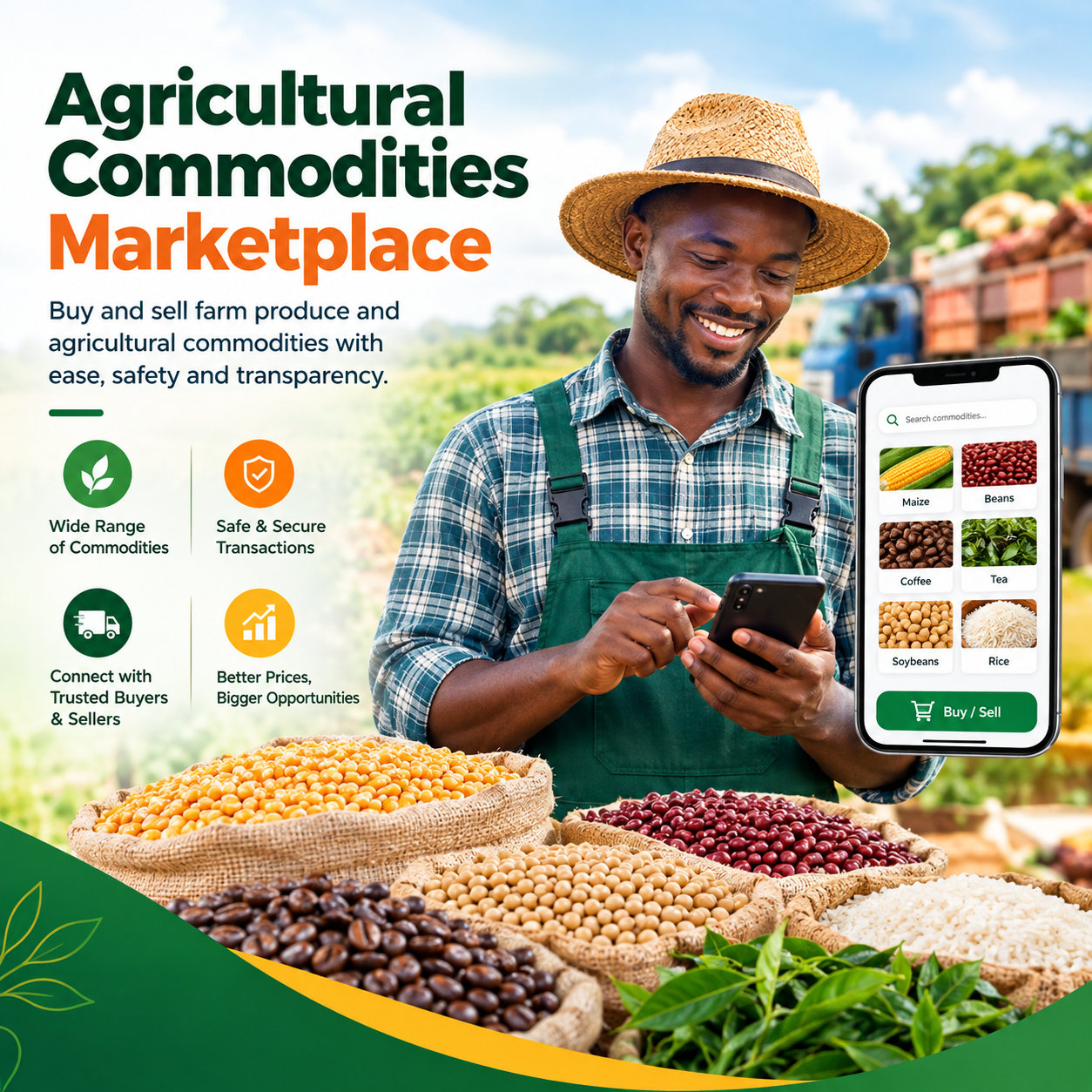
An agricultural commodities marketplace is the invisible infrastructure behind one of the largest flows of value on the African continent — the trade in maize, coffee, cocoa, sesame, beans, groundnuts, rice, and dozens of other staple and cash commodities that move from farms to millers, processors, traders, and exporters every single day.
For generations, this trade ran on fragmented informal networks: brokers with privileged information, prices that swung wildly between harvest and planting seasons, quality disputes settled by whoever had more leverage, and millions of smallholders forced to sell their entire harvest at once, at the worst prices of the year.
A well-run agricultural commodities marketplace replaces that chaos with the same structures that transformed financial markets — standardized grades, transparent prices, verified counterparties, secure clearing and settlement, and storage systems that let sellers choose when to sell instead of dictating whether they can sell at all.
This guide is the complete handbook for understanding and using an agricultural commodities marketplace, whether you are a farmer or cooperative looking to sell at better prices, a trader building a book, a miller or processor securing raw material, an exporter sourcing volume, or a financier backing commodity trade.
You will learn what a commodities marketplace actually is and how it differs from other agricultural platforms, why Africa’s commodity trade needed this model, which features and contract types matter, how grading and warehouse receipts work, who the participants are, which commodities trade best, how the regional landscape compares, and exactly how to start — all explained step by step, with no jargon left undefined.
What Is an Agricultural Commodities Marketplace?
An agricultural commodities marketplace is a digital trading platform where standardized, graded, storable farm commodities are bought and sold in bulk between verified commercial parties — with the platform providing the rules, the quality standards, the payment protection, and often the storage that make large-scale trade possible between strangers. The defining word in that sentence is commodities: goods that are fungible, meaning one tonne of Grade A maize is functionally identical to another, regardless of which farm produced it. Fungibility is what allows commodities to be traded by specification rather than by inspection — a buyer can purchase 200 tonnes of graded sesame sight unseen, because the grade itself is the guarantee.
This is what separates an agricultural commodities marketplace from every other kind of farm trading platform, and its core functions include:
- Standardized contracts — defined quantities, grades, and delivery terms that both sides understand before negotiating.
- Certified grading — independent inspection that converts physical produce into a verified, tradeable grade.
- Certified storage — warehouses where deposited commodities are weighed, sealed, and tracked, often represented by a digital warehouse receipt.
- Price discovery — live order books, published reference prices, and historical data that make the true market price visible to everyone.
- Clearing and settlement — escrow-backed payment flows that release funds only when the trade terms are met.
- Trade-transfer mechanics — the ability to change ownership of stored goods without physically moving them, which is the quiet superpower of commodity trade.
- Data and analytics — seasonal price curves, volume trends, and demand signals that inform planting, buying, and financing decisions.
In short, an agricultural commodities marketplace is part exchange, part warehouse network, part clearinghouse, and part data provider — a single system of rules and infrastructure that lets commodity trade happen at industrial scale with industrial confidence.
How an Agricultural Commodities Marketplace Differs from Other Farm Platforms
The African agri-digital space now includes several kinds of platforms, and precision about the differences matters because the mechanics of trade differ fundamentally between them.
A consumer marketplace sells small quantities to individuals — a bag of onions, a crate of eggs — with same-week delivery and retail pricing. A fresh-produce platform moves perishables on weekly cycles where speed of matching is everything and shelf life dictates the deal. An agricultural commodities marketplace operates in a third dimension entirely: storable, standardized goods traded in tonnes, where the produce can sit in a certified warehouse for months, change hands several times, and be delivered long after the original sale — because the goods, not the clock, define the trade.
It also differs from general B2B platforms in structure. On a general B2B platform, buyers and sellers negotiate bespoke deals about specific, individualized goods — this farmer’s tomatoes, that cooperative’s avocado crop. On an agricultural commodities marketplace, trade happens against specifications and grades: a buyer does not buy “Mekonnen’s coffee” but “Grade 3 washed arabica, 90 kg bags, certified warehouse, Addis Ababa.” That abstraction — produce traded as a standardized instrument rather than a personal transaction — is what allows commodities to be priced transparently, financed by banks, and cleared through escrow systems that treat every trade identically.
The practical consequence is enormous: when goods are standardized and stored, they can be bought and sold repeatedly without ever moving, financed against warehouse receipts, and delivered exactly when the buyer’s production schedule needs them. A general platform digitizes the deal; an agricultural commodities marketplace digitizes the goods themselves.
Why Africa’s Commodity Trade Needed Its Own Agricultural Commodities Marketplace
Africa produces staggering volumes of the world’s staple commodities, yet captures a fraction of their value — and the structural reasons explain why the marketplace model arrived when it did. Understanding them makes clear what an agricultural commodities marketplace actually fixes.
The harvest trap. In the traditional system, nearly every farmer sells at the same time — immediately after harvest, when supply peaks and prices trough. Maize prices in many African markets routinely swing by 50 percent or more between the post-harvest low and the pre-harvest high, and farmers lacking storage sell into the low every single year. A marketplace with certified storage and warehouse receipts lets farmers hold grain safely and sell into the high season instead — converting the calendar from an enemy into a tool.
The information wall. A farmer in a rural district traditionally had no idea what maize was fetching in the capital that morning, which is precisely the gap brokers profited from. When an agricultural commodities marketplace publishes live prices and closed-trade data, the information asymmetry collapses — and with it, the broker premium that information asymmetry supported.
The quality chaos. Informal grain trade has no shared definition of quality, so every deal becomes a negotiation about the specific bag in front of you, with disputes settled by power rather than evidence. Standardized grading — moisture content, aflatoxin limits, purity percentages — is what makes remote, escrow-protected, finance-able trade possible, and it is the single most important function a commodity marketplace performs.
The financing void. Banks cannot lend against a heap of maize in an unverified shed. They can lend against a warehouse receipt issued by a certified facility — a document representing a specific quantity and grade of sealed, insured grain. By pairing trade with certified storage, an agricultural commodities marketplace creates the collateral that unlocks credit for producers, traders, and aggregators who have never had access to it.
Africa has proven the model works. Ethiopia’s commodity exchange brought order and transparency to coffee and sesame trade at national scale; Zambia’s agricultural exchange formalized maize trade across a whole region; warehouse receipt systems in Kenya, Uganda, Tanzania, and Ghana have demonstrated that stored, graded grain is bankable collateral. The task of the modern agricultural commodities marketplace is to generalize those successes — connecting regions, digitizing the mechanics, and opening participation to every serious producer and buyer with a phone and a willingness to trade by the rules.
Key Features of a Modern Agricultural Commodities Marketplace
Not every platform using the word “commodity” actually delivers commodity-grade infrastructure. These are the features that define a genuine agricultural commodities marketplace, and they are what to verify before committing a season’s production or a company’s procurement budget:
- Verified participants. Identity, business registration, and — for institutional traders — licenses and references, checked before accounts can trade. The exchange’s entire credibility rests on who it lets in.
- A certified warehouse network. Facilities where commodities are received, weighed, graded, sealed, and tracked, with insurance and audit trails. Storage is what turns a commodity into a tradeable instrument.
- Independent grading and inspection. Accredited labs and inspectors applying published grade standards — moisture, purity, aflatoxin, defect counts — so that a grade means the same thing to every trader on the platform.
- Live order books and price data. Visible bids and offers, published reference prices, and historical trade data that together create genuine price discovery.
- Escrow-based clearing. Buyer funds held by the platform and released against verified delivery or receipt transfer — the mechanism that makes trade between strangers safe.
- Warehouse receipt trading. Digital receipts representing stored goods that can be sold, transferred, or financed without moving the underlying commodity.
- Integrated logistics. Transport booking, aggregation, and delivery coordination attached directly to orders.
- Embedded finance. Receipt-backed lending, input credit, and invoice discounting built on the platform’s transaction data.
- Dispute resolution. Documented evidence trails — listings, inspections, messages, delivery confirmations — with a formal arbitration process.
- Multichannel access. Web and mobile for commercial users, USSD and field agents for rural participants, so an agricultural commodities marketplace includes the farmers it exists to serve rather than excluding them by design.
The platforms that combine all of these functions are rare and valuable; the platforms that skip them are listings boards wearing the vocabulary of exchanges.
How an Agricultural Commodities Marketplace Works: The Life of a Trade
The clearest way to understand the model is to follow a single trade from field to settlement. Here is the lifecycle on a mature agricultural commodities marketplace:
- Deposit and grading. A seller delivers 30 tonnes of maize to a certified warehouse on the network. The facility weighs it, an accredited inspector grades it against the published standard — say Grade A, 13.5% moisture, aflatoxin below 10 ppb — and the platform issues a digital warehouse receipt representing exactly that quantity and grade.
- Listing and offering. The receipt is listed on the marketplace: Grade A maize, 30 tonnes, specific warehouse, asking price or open to offers. Because the goods are graded and sealed, buyers do not need to visit — the grade and the warehouse’s integrity do the work that physical inspection once did.
- Matching and negotiation. A miller searching for 100 tonnes filters the order book by grade, location, and price, then bids on this receipt alongside offers from other sellers. On an agricultural commodities marketplace, this step replaces weeks of phone-based sourcing with minutes of structured search.
- Escrow payment. The buyer funds escrow. The seller sees secured funds and releases the receipt for transfer.
- Ownership transfer. The platform transfers the warehouse receipt to the buyer, escrow releases funds to the seller, and the warehouse updates its ledger — the 30 tonnes now belong to the miller, still sitting in the same sealed bay.
- Delivery or holding. The miller either books transport to withdraw the grain for immediate milling or holds the receipt as inventory, financing it against the warehouse receipt if useful, and withdraws in weekly tranches as the production schedule requires.
- Rating and records. Both parties rate the transaction; the completed trade feeds the platform’s price history and each party’s performance record — the data spine on which every future agricultural commodities marketplace trade, credit line, and negotiation is built.
Notice what the receipt-transfer model changes: the commodity moved zero kilometers during the sale, no cash changed hands on trust, quality was never in dispute, and the buyer timed delivery to its own production needs. That is the machinery of commodity trade working as designed.
Grading and Standardization: The Language of Every Agricultural Commodities Marketplace
Grading is the grammar of commodity trade — without it, nothing else works. When you sell on an agricultural commodities marketplace, your produce is not sold as “maize”; it is sold as a defined grade with measurable parameters, and every commercial decision on the platform — price, financing, delivery, dispute resolution — references that grade.
Grade standards vary by commodity but share a common architecture:
- Moisture content — the single most important parameter for storable grains, determining shelf life and mold risk.
- Purity and foreign matter — the percentage of the lot that is actually the commodity, versus stones, chaff, and other grains.
- Aflatoxin and safety limits — hard regulatory ceilings for human and animal consumption, critical for maize and groundnuts.
- Defect counts — broken, discolored, or insect-damaged kernels as a percentage of the lot.
- Size and count specifications — for cashew (W180 through W320), coffee bean screens, sesame purity, and bean counts.
- Variety and processing method — for coffee (washed, natural) and specialty categories where origin and process carry price.
The discipline works in both directions. Sellers who grade honestly build reputations that compound into better prices and faster sales; sellers who grade opportunistically are identified quickly by inspection data and pushed out by the rating system. Buyers, meanwhile, can trade remotely with confidence because the grade — verified by an independent inspector at a certified facility — is contractually binding. This is precisely why an agricultural commodities marketplace invests so heavily in inspection capacity: the grade is the product. Learn to read grade sheets, and you have learned to trade; refuse to learn them, and the platform’s protections cannot fully reach you.
Price Discovery: How an Agricultural Commodities Marketplace Sets Fair Value
Price is the heart of commodity trade, and transparent price discovery is the feature that most distinguishes an agricultural commodities marketplace from the informal systems it replaces.
The mechanics are simple and powerful. Sellers post offers; buyers post bids; trades close at prices both sides accepted; and every closed trade feeds a public price history. Within months, the platform accumulates something the informal market never had: a continuous, volume-weighted record of what each grade actually fetched, by week and by region. That record does three transformative things.
First, it anchors negotiation. When both a miller and a cooperative can see that Grade A maize traded at a certain range last week, negotiation becomes arithmetic rather than theater — and the party with the least information loses least often, which in African agriculture usually means the farmer stops losing most often.
Second, it reveals seasonality. Price curves visible on an agricultural commodities marketplace show precisely when the post-harvest trough and pre-harvest peak occur for each commodity, letting farmers with storage time their sales and letting processors time their buying. Entire planting decisions improve when the season’s expected price curve is visible at planting time.
Third, it enables basis pricing — the professional trader’s method of quoting local prices as the reference market price plus or minus a transport-and-quality differential. Once participants on an agricultural commodities marketplace trade on basis, price risk becomes manageable, forward contracts become quotable, and finance becomes willing — because everyone can see the reference everyone else is pricing against.
Warehouse Receipts: The Hidden Engine of an Agricultural Commodities Marketplace
If grading is the grammar of commodity trade, the warehouse receipt is its currency — and it deserves its own explanation, because it is the mechanism most unfamiliar to new participants yet the one that changes producer economics most.
A warehouse receipt is a digital document, issued by a certified facility on the marketplace network, that attests: this warehouse holds exactly X tonnes of commodity, graded Y, sealed and insured, owned by Z. On an agricultural commodities marketplace, that receipt is not paperwork — it is a working financial instrument, and it does four jobs at once:
- It enables deferred selling. The farmer deposits at harvest — when prices are lowest — receives a receipt, and sells weeks or months later into the seasonal high. The receipt guarantees the grain’s safety and condition while it waits.
- It is collateral. Banks and financiers lend against receipts because the underlying commodity is verified, insured, and legally segregated. A receipt representing 20 tonnes of graded soybeans is collateral a rural branch can actually accept.
- It is tradeable. Ownership of stored goods changes through receipt transfer, so commodities can be bought and sold repeatedly without a single truck moving — cutting logistics cost out of every intermediate trade.
- It is an inventory tool. Processors and traders hold receipts as stock-in-waiting, withdrawing physical goods in tranches matched to production schedules — inventory management that informal trade cannot offer.
The prerequisites are non-negotiable: warehouses must be certified, insured, and audited; weighing and sealing must be trustworthy; the receipt must be legally recognized as evidence of ownership. Where those foundations hold — and an agricultural commodities marketplace lives or dies by them — the warehouse receipt converts perishable, risky, seasonally dumped harvests into storable, bankable, strategically sellable assets. No other single innovation does more for producer incomes.
Contract Types on an Agricultural Commodities Marketplace
Commodity trade runs on a small set of contract structures, and knowing them tells you how to position yourself on the platform regardless of which side you trade from.
Spot contracts. Immediate trade at current prices — goods already graded and stored, or delivering now. Spot is the marketplace’s daily heartbeat: the miller topping up inventory, the cooperative clearing shelved stock, the trader closing a position. Most volume on an agricultural commodities marketplace is spot trade, and it is where new participants should learn the mechanics.
Forward contracts. Agreements to deliver a defined quantity and grade at a future date and an agreed price — made months before harvest. For producers, forwards lock in a known price and a known buyer before planting costs are incurred; for buyers, they secure supply and hedge against seasonal spikes. Platforms support forwards with escrowed deposits and performance records that make commitments enforceable in practice, not just on paper.
Recurring supply programs. Standing monthly deliveries against a framework agreement — the processor’s workhorse. The platform tracks each call-off against the master agreement, so volumes delivered, quality variances, and payment status accumulate into an auditable record.
Receipt transfers. As described above — sale of already-stored goods by transferring the warehouse receipt, with the buyer free to hold or withdraw at will.
Each structure answers a different risk. Spot answers immediacy; forwards answer uncertainty; programs answer consistency; receipts answer liquidity and financing. Sophisticated participants on an agricultural commodities marketplace blend all four — selling spot into strong markets, contracting forwards to fund planting, running programs for their anchor buyers, and holding receipts as strategic inventory.
Who Trades on an Agricultural Commodities Marketplace?
The participant mix defines a marketplace’s liquidity, and each player arrives with distinct motives.
Producers and cooperatives. Commercial farms and farmer groups sell graded produce directly into the order book, time their sales with storage, and build the transaction histories that unlock finance. For a cooperative aggregating hundreds of smallholders, an agricultural commodities marketplace account turns collective volume into collective bargaining power.
Aggregators and traders. The professional middle of the market — buying from dispersed producers, adding grading and logistics, selling into larger orders. Traders are the marketplace’s liquidity providers: they take the other side when producers need to sell and when buyers need to purchase, and they profit from the spread between regions and seasons. A functioning agricultural commodities marketplace treats traders as essential infrastructure, not villains.
Millers and processors. The volume anchors. Flour millers, oil pressers, feed manufacturers, roasters, and dairies source raw material against production schedules, using forwards and programs for certainty and spot for flexibility.
Institutional buyers. Food manufacturers, relief agencies, school-feeding programs, and brewery groups purchasing standardized commodities against tenders and specifications — where documented sourcing is a compliance requirement as much as a commercial one.
Exporters. Buying graded, documented, stored commodities for international shipment — where the platform’s inspection records feed directly into export certification.
Financiers and insurers. Banks lending against receipts, insurers underwriting stored stock and cargo, and invoice-discounters advancing against confirmed institutional orders.
Warehouse and logistics operators. The physical layer — certified stores, transporters, and clearing agents — earning volume from the trade they enable.
This diversity is deliberate: an agricultural commodities marketplace works because producers, traders, processors, and financiers each need the others, and the platform prices nothing and hoards nothing — it only structures the meeting.
Commodities You Can Trade on an Agricultural Commodities Marketplace
Commodity trade concentrates in storable, gradeable goods with deep institutional demand — and Africa’s range here is exceptional.
Grains and cereals. Maize is the continent’s staple commodity and the volume king of any regional agricultural commodities marketplace — traded by millers, feed producers, relief agencies, and traders across every East and Southern African market. Wheat, rice, sorghum, and millet follow, each with defined grades and deep processing demand.
Oilseeds. Soybeans for crushing and feed, sunflower for oil, groundnuts for food and oil (with aflatoxin discipline as the gate), and sesame — one of Africa’s great export commodities, flowing from Ethiopia, Sudan, Nigeria, and Tanzania to buyers across Asia and the Middle East. Oilseeds reward platforms with strong export links and rigorous grading.
Pulses and beans. Pigeon peas, kidney beans, cowpeas, and chickpeas trade actively to regional processors and international markets — India’s demand for pulses alone anchors an enormous trade flow, and an agricultural commodities marketplace serving pulses connects smallholder production to that deep, price-transparent demand.
Cash crops. Coffee and cocoa trade through both structured exchanges and certified direct channels, with grading, cupping, and origin data carrying the price. Cashew nuts in raw and kernel form, cotton lint through regulated channels, and sugar round out the category.
Specialty and emerging commodities. Gum arabic, dried hibiscus, shea, desiccated coconut, and increasingly digital-first categories like insect protein and cassava derivatives — each adding depth to what a modern agricultural commodities marketplace can offer.
The unifying test for any commodity’s platform fit: Is it storable? Is it gradeable by measurable parameters? Is there repeat institutional demand? Where all three hold, exchange-style trade thrives.
The Regional Landscape for Every Agricultural Commodities Marketplace
Commodity digitization has developed at different speeds across Africa’s regions, shaped by policy history, warehouse infrastructure, and staple-crop economics.
East Africa is the proving ground. Ethiopia’s national exchange demonstrated at scale that structured commodity trade could formalize coffee and sesame markets and lift producer prices. Kenya’s warehouse receipt system and its dense mobile-money rails, Uganda’s and Tanzania’s grain and pulse flows, and Rwanda’s organized agriculture make the region the natural first home for any ambitious agricultural commodities marketplace — and the cross-border corridors between these markets give regional trade real depth.
West Africa brings commodity scale: Nigeria’s domestic grain demand is a market unto itself, while Ghana, Côte d’Ivoire, and Senegal anchor cocoa, cashew, groundnut, and sesame flows. The region’s challenge is logistics across vast distances, so winning marketplace models anchor around major demand centers and certified warehouse clusters, then extend along proven trade corridors.
Southern Africa has the continent’s most sophisticated exchange heritage — South Africa’s derivatives market has traded agricultural commodities for decades — alongside Zambia’s agricultural exchange, which formalized regional maize trade. The opportunity for a new agricultural commodities marketplace here is connecting that sophistication with the smallholder systems of Malawi, Mozambique, and Zimbabwe, where maize and pulses trade remains largely informal.
North Africa runs intensive, import-dependent grain economies — Egypt among the world’s largest wheat importers — with digitization strongest in procurement and import logistics rather than smallholder trade.
The continental frontier is AfCFTA: as customs regimes simplify, the marketplace that handles cross-border documentation, settlement, and settlement-currency friction will capture flows that historically died at every border post — the single largest growth opportunity in the category, and the reason regional ambition is now a design requirement for any serious agricultural commodities marketplace.
Payments, Clearing, and Settlement on an Agricultural Commodities Marketplace
Money mechanics are where commodity trade historically collapsed, and where the marketplace earns its commission. The core architecture has three layers.
Escrow and clearing. Every trade’s funds move through the platform: the buyer’s payment is held by the marketplace, released only when the trade terms are verified — receipt transferred, delivery confirmed, quality matched to grade. This single mechanism neutralizes the commodity trade’s two oldest fears simultaneously: the seller’s fear of unpaid deliveries and the buyer’s fear of paid-for-nothing. On an agricultural commodities marketplace, clearing is not a feature bolted onto trade; it is the trust layer that makes trade between strangers possible at all.
Settlement rails. Mobile money for smaller trades and rural participants; bank transfers and increasingly real-time payment systems for institutional volumes; multi-currency handling where cross-border trade demands it. Settlement speed matters commercially — sellers with fast, certain payment can turn capital faster, and platforms compete on settlement cycles the way banks once competed on branch hours.
Finance attached to settlement. The clearing record is a credit file. Invoice discounting converts a confirmed institutional order into immediate cash for the seller; receipt-backed lending lets stored goods fund themselves; input credit for producers is repaid directly from platform proceeds. An agricultural commodities marketplace with deep finance integrations effectively functions as a commodity bank — one whose every customer has a perfectly documented business history.
The professional discipline that ties it together: payment milestones tied to verified events, always. Deposit against contract, balance against receipt transfer or delivery confirmation, final release on inspection where required. Every mature marketplace enforces this rhythm automatically — and that enforcement, more than any single feature, is what separates commodity infrastructure from a payment-enabled listings page.
Logistics: The Physical Layer Beneath Every Agricultural Commodities Marketplace
Software cannot store grain, and every serious marketplace eventually measures itself against physical reality. Three pillars hold the physical layer up.
The warehouse network. Certified facilities in producing regions and demand centers — the anchors of the entire model. Their integrity (weighing, sealing, insurance, audits) is the platform’s credibility made physical, and an agricultural commodities marketplace is only as strong as the facilities its receipts represent.
Transport integration. Booking haulage as part of the order — from three-tonne trucks for withdrawal runs to long-haul fleets for cross-border delivery — with return-load matching that cuts freight costs by filling otherwise empty return legs. For low-margin commodities, transport efficiency is often the difference between profitable and unprofitable trade.
Aggregation points. Collection centers in farming clusters where dispersed smallholder volumes are combined into truck-scale lots before moving to certified warehouses — solving the first-mile problem that keeps most of Africa’s grain out of structured trade.
When these pillars hold, the marketplace’s promise becomes physical: goods that can be deposited once, traded many times, and delivered exactly when needed — the logistics footprint of an agricultural commodities marketplace measured not in kilometers traveled but in tonnes stored securely and trades settled cleanly.
Risk Management on an Agricultural Commodities Marketplace
Commodity trade carries real risks, and a professional marketplace answers each with a structural control rather than a promise.
Quality risk — goods not matching their grade. Controlled by independent grading at deposit, binding grade specifications in every contract, and dispute evidence drawn from inspection records. On an agricultural commodities marketplace, the grade sheet is the arbiter: disputes become document comparisons rather than shouting matches.
Counterparty risk — default by either side. Controlled by escrow (buyer funds secured before goods move), performance deposits on forward contracts, and public performance histories that make defaulting expensive in future access.
Price risk — the market moving against a held position. Managed with the platform’s own tools: forward contracts to lock prices, warehouse receipts to time sales, and transparent curves to plan. Producers who use an agricultural commodities marketplace‘s pricing data and deferral options consistently capture better seasonal averages than those selling into the harvest trough.
Storage risk — loss, damage, or fraud at warehouses. Controlled by certification, insurance, audits, and legally robust receipts. This is the risk that ruins marketplaces when neglected, so leading platforms treat warehouse oversight as their most important operating expense.
Market integrity risk — manipulation, wash trading, misinformation. Controlled by trade reporting, position transparency, and published closing prices. Trust in the numbers is the entire product; an agricultural commodities marketplace that allows its price data to be doubted has lost the one asset it cannot repurchase.
None of these risks is unique to digital trade — every one is worse in informal channels, without records, escrow, or recourse. The marketplace’s contribution is not risk elimination but risk structure: known risks, known controls, known evidence.
How to Choose the Right Agricultural Commodities Marketplace
Platform selection is a season-defining decision. Run candidates through this checklist before committing:
- Warehouse network where you trade. A marketplace without certified storage near your production or consumption zones cannot serve you, whatever its website promises. Verify actual facility locations before anything else.
- Grading credibility. Who inspects, under what standards, and are the standards published? The grade is the product — an agricultural commodities marketplace with vague or self-declared grading will cost you in disputes.
- Real liquidity. How many active bids and offers in your commodity and region this month — not registered users, but closed trades? Liquidity is the difference between a market and a vacancy sign.
- Payment protection depth. Escrow as default, documented clearing rules, and settlement speed you can verify from user feedback.
- Finance integrations. If you need receipt-backed lending or invoice discounting, confirm the partnerships are live products with real users, not press releases.
- Fee structure. Commissions on completed trades are normal; heavy upfront charges without service are not. Weigh every fee against what the platform delivers per trade.
- Support and dispute record. Ask for resolution statistics. A platform that publishes how it resolves disputes is telling you it expects to be judged — the posture of a serious agricultural commodities marketplace.
How to Start Trading on an Agricultural Commodities Marketplace
For sellers:
- Register and verify — identification, business or cooperative documents, and location details, completing verification before the season so you trade from day one.
- Deposit strategically. Deliver to a certified warehouse, insist on proper grading, and hold the receipt rather than rushing to sell — the whole point of the agricultural commodities marketplace model is that you now own the timing of your sale.
- Sell into strength. Use the price curves, offer into the order book, and accept escrowed payment. Complete your first trades flawlessly — your rating is your future access to better buyers and finance.
For buyers:
- Define specifications — grade, quantity, warehouse location, delivery timing — so every quote compares like-for-like.
- Start spot, then contract. Learn the mechanics with small spot purchases, then move to forwards and programs for your recurring needs. Buyers who build clean histories on an agricultural commodities marketplace get priority allocation when supply tightens — the quiet dividend of reliability.
Common Challenges — and How the Sector Answers Them
Honesty about friction makes the model credible. Liquidity takes time to build — new marketplaces answer by anchoring around one commodity and one corridor with real density, then expanding. Trust in warehouses is earned through certification, insurance, audits, and time — which is why an agricultural commodities marketplace that has operated cleanly for seasons is worth a premium over a newcomer’s promises.
Digital literacy gaps are answered with USSD access, field agents, and patient onboarding. Side-selling on forward contracts is answered with performance economics — deposits, premiums for reliability, and access benefits that make loyalty pay better than opportunism. None of these is trivial; none is unsolved; and every one of them is worse in the informal system the marketplace replaces.
The Future of the Agricultural Commodities Marketplace
The trajectory points toward deeper integration and wider reach. Expect the average agricultural commodities marketplace of the coming decade to operate as continental infrastructure: cross-border trade with unified documentation under AfCFTA, satellite-verified warehouse stocks, AI-driven price forecasting that tells producers what to plant and when to sell, full warehouse-receipt finance rails connecting platforms to national banking systems, and sustainability premiums attaching to the same data trails that document every trade. Agriculture remains the largest yet least digitized sector of most African economies — precisely the combination that produces decade-long growth stories. The producers, traders, and buyers who build verified histories and warehouse relationships now will hold positions that latecomers cannot simply buy.
Frequently Asked Questions
What is the difference between a commodity marketplace and a regular farm marketplace? A commodity marketplace trades standardized, graded, storable goods by specification — often through warehouse receipts, so goods can be sold without moving. A regular farm marketplace trades specific, individualized goods directly from sellers to buyers, usually perishables on short cycles. The commodity model enables transparent pricing, deferred selling, and receipt-backed finance; the direct model suits fresh, fast-moving produce.
Do I need a large volume to participate as a seller? No. Aggregation points and cooperative accounts let smallholders combine volumes to meet trade lots, and many platforms list parcels as small as one tonne. What matters most is meeting grade standards consistently — quality, not size, determines success on a commodity platform.
How does payment protection actually work? Buyer funds are held in escrow by the platform and released only when the trade terms are verified — receipt transfer confirmed, delivery accepted, or inspection passed. Neither side can take value without the other receiving theirs, which is why trade between strangers is safe on a structured marketplace and dangerous in informal channels.
Can I sell my produce months after harvest instead of immediately? Yes — that is the core purpose of warehouse receipts. Deposit at harvest into a certified warehouse, receive a receipt for the graded quantity, and sell whenever the price curve favors you. The receipt guarantees condition while you wait, and it can also serve as loan collateral in the meantime.
What happens if a buyer claims the goods don’t match the grade? The independent grading report from deposit becomes the deciding evidence, since the grade was certified before the goods were ever listed. Disputes are resolved by comparing delivery condition and inspection records against the binding specification — document comparison, not negotiation by leverage.
Which commodities are best for a first-time trader? Storable, heavily graded staples with active order books — maize, beans, soybeans, or sesame depending on your region. Deep liquidity means fast execution and tight spreads while you learn, before graduating to cash crops like coffee or cashew where quality nuances carry more pricing complexity.
Is cross-border trading possible through these platforms? Increasingly, yes. Platforms operating in trade corridors handle export documentation, customs coordination, and multi-currency settlement, and AfCFTA implementation is steadily widening these flows. For traders with regional ambitions, choosing a marketplace with cross-border capability today avoids a painful migration later.
How do warehouse receipts support financing? Because a receipt represents verified, insured, sealed commodities in a certified facility, lenders accept it as collateral. This lets producers and traders borrow against stored stock — funding operations or holding inventory through the seasonal price curve rather than selling into the harvest trough.