
KEPHIS Certified Exporters: The Complete Guide to Kenya’s Export Credential in 2026
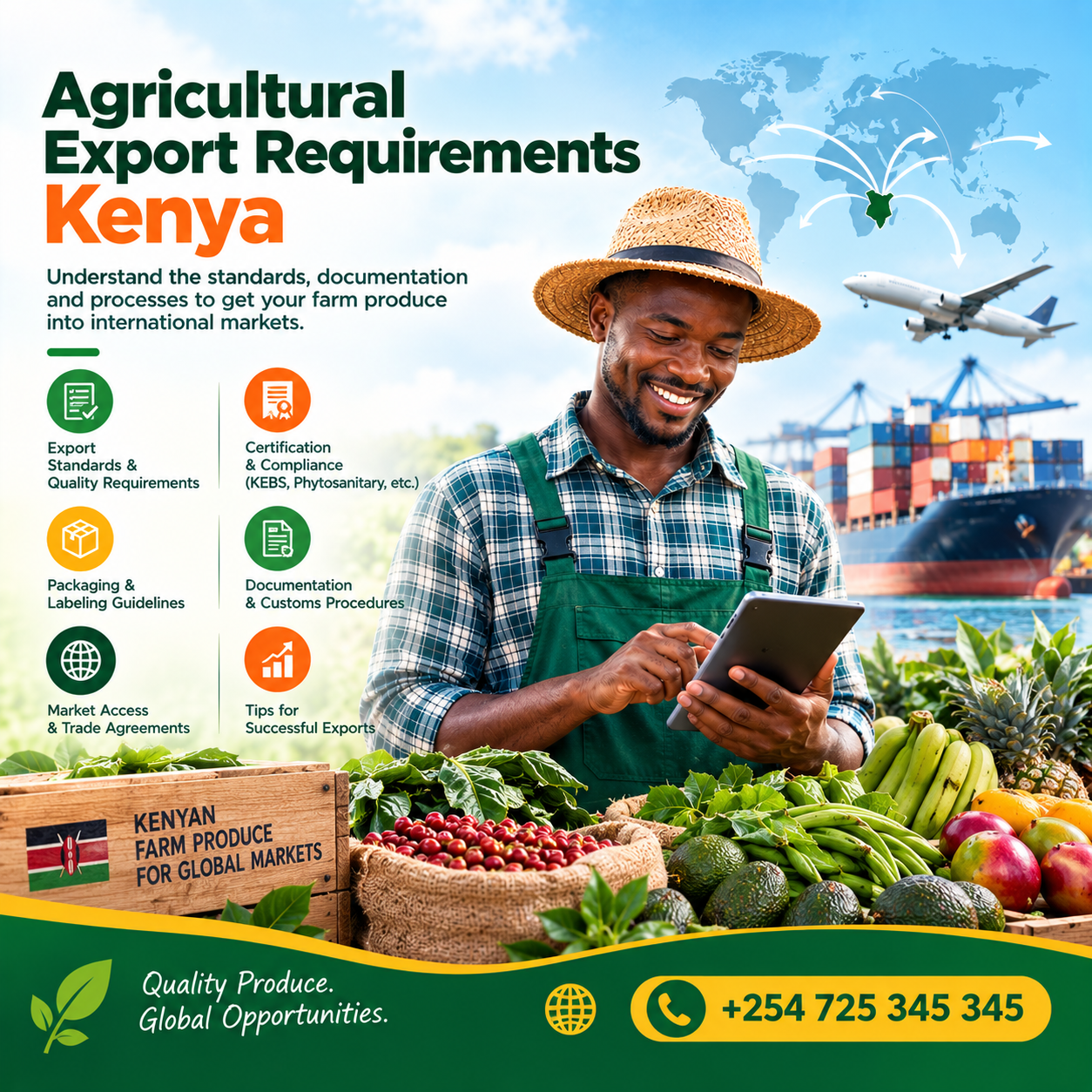
KEPHIS certified exporters are the licensed, inspected, and registered businesses through which Kenya’s fresh produce legally reaches the world. Behind every carton of avocados landing in Dubai, every box of beans reaching London, and every consignment of mangoes clearing a Gulf port stands a chain of official verification — and KEPHIS, the Kenya Plant Health Inspectorate Service, is the institution at its center. For anyone building an export business from Kenyan soil, becoming one of the KEPHIS certified exporters is not paperwork; it is the license to exist in the trade.
The market uses the phrase loosely, and this guide fixes that. Export registration in Kenya actually sits across two institutions: KEPHIS handles plant health, inspections, and the phytosanitary certificates that accompany every legal consignment, while the Horticultural Crops Directorate under the Agriculture and Food Authority handles the horticulture trade license. When buyers and trade guides speak of KEPHIS certified exporters, they mean businesses that carry the full combined status — registered, licensed, inspected, and documented.
This guide walks the complete journey from the exporter’s side. We explain what KEPHIS is, what the registration involves, and what inspections and certificates actually verify. We also cover packhouse standards, how international buyers verify exporters, the costs and timelines, the mistakes that stall applications, and how certified exporters turn their status into commercial advantage.
By the end, you will have a practical plan for joining the ranks of KEPHIS certified exporters — at whatever scale your operation supports. One honest note before we begin: procedures, fees, and regulatory structures evolve, and the division of roles between institutions occasionally shifts with policy. Confirm every current requirement directly with KEPHIS and the Horticultural Crops Directorate before you commit — that verification habit is what separates exporters who register smoothly from those who chase moving requirements.
What KEPHIS Actually Is
KEPHIS is the government agency responsible for plant health and the quality of agricultural inputs in Kenya. Established in the 1990s under Kenya’s plant protection and seed legislation, it inspects produce for export, certifies phytosanitary status, registers exporters of plant products, and guards the country against pest introductions. That mandate is what makes KEPHIS the gatekeeper standing between Kenyan farms and the fresh produce importers Middle East and other buyers worldwide.
The agency’s work spans the whole export journey. It approves packhouses, inspects produce before shipment, issues the phytosanitary certificates that destination countries require, and maintains registries that buyers abroad consult. Every legal consignment leaving Kenyan airports and ports travels with documentation that KEPHIS certified exporters have obtained through that system.
It helps to separate KEPHIS’s role from its neighbors. The Horticultural Crops Directorate under the Agriculture and Food Authority licenses the horticulture trade itself, while certification schemes like GlobalG.A.P are private standards audited by independent bodies. The full professional status that the market calls KEPHIS certified exporters combines all three layers — regulation, licensing, and voluntary certification.
The registries are the buyer-facing face of the system. KEPHIS maintains records of registered exporters and approved packhouses, and international buyers use those registries to verify the counterparties they deal with. Being findable and clean in those registries is the practical meaning of being among KEPHIS certified exporters.
The agency’s authority is legal, not advisory. Shipping produce without the required inspections and certificates is unlawful, and consignments get seized, rejected, or returned when the chain is broken. That enforcement reality is why serious trade begins with proper status among KEPHIS certified exporters.
Why Buyers and Markets Demand It
Destination countries legally require it. Every consignment of fresh produce entering the UAE, the UK, the EU, or the Gulf states must arrive with a phytosanitary certificate issued by the origin country’s plant protection authority. Only shipments arranged through KEPHIS certified exporters carry that document — which makes the status the legal doorway to every market covered in our trade guides.
Buyers verify exporters through the registries. The verification checklists in our guides to the UK fruit trade and the Middle East produce market all begin with registry confirmation — because an unregistered counterparty is a liability, not a supplier. That verification culture is what gives commercial weight to KEPHIS certified exporters.
The certificate protects the buyer’s own license. Importers are legally responsible for what lands on their shores, and documented, inspected origin is their defense. Sourcing from KEPHIS certified exporters is therefore the buyer’s compliance strategy as much as the exporter’s market entry.
Reputation compounds at the national level too. Kenya’s standing in premium markets depends on the integrity of its export chain, and every properly certified consignment defends it. That collective stake is why the industry treats the discipline of KEPHIS certified exporters as everyone’s business.
What KEPHIS Does for Exporters
Function one is exporter registration. Businesses dealing in plant products for export register with the relevant authorities, providing their company details, premises, and the commodities they intend to trade. That registration is the entry step on the path to becoming one of the KEPHIS certified exporters.
Function two is packhouse approval. Export packhouses — where produce is sorted, graded, packed, and documented — are inspected against standards covering hygiene, traceability, and handling before they are approved for export use. That approval is what physically distinguishes the facilities of KEPHIS certified exporters from domestic traders.
Function three is pre-shipment inspection. Produce destined for export is inspected to confirm it meets plant health requirements and is free from regulated pests and diseases. Those inspections are the quality gate that every consignment from KEPHIS certified exporters passes before it flies or sails.
Function four is the phytosanitary certificate. After inspection, KEPHIS issues the official certificate that destination countries’ plant health authorities require — the single most important document in fresh produce trade. That certificate is the export passport carried by every consignment from KEPHIS certified exporters.
Beyond those four, the agency also provides traceability support, export advisories, and the pest risk analysis that opens new markets. Those services evolve as trade agreements and destination regulations change, which is why KEPHIS certified exporters maintain constant contact with the system rather than treating it as a one-time formality.
The Step-by-Step Path to Exporter Status
Step one is establishing the business properly. Register the company, secure the premises, and obtain the horticulture trade license through the Horticultural Crops Directorate under the Agriculture and Food Authority. That licensing layer is the trade-side foundation beneath every application to become one of the KEPHIS certified exporters.
Step two is registering with KEPHIS as an exporter of plant products. The registration captures the business, its commodities, and its intended markets, placing it within the official export system. That registration is what begins the formal relationship between the business and the plant health authority behind KEPHIS certified exporters.
Step three is preparing the packhouse. Build or upgrade the facility to export standard — hygiene, sorting lines, traceability systems, cold storage where required — and request inspection. Facilities of that standard are what inspectors expect to find at the premises of KEPHIS certified exporters.
Step four is passing inspections and building the documentation system. Approval processes confirm the premises, the handling, and the records meet the required standards before export activity begins. Only then does the business operate fully within the community of KEPHIS certified exporters.
Confirm every current requirement at each step. Fees, forms, and institutional responsibilities have shifted with policy reforms over the years, and applications built on outdated information stall in the system. Up-to-date verification is the operating habit of efficient KEPHIS certified exporters.
Packhouse Standards: What Inspectors Look For
Hygiene leads the inspection. Clean lines, washing facilities, worker sanitation, and pest-free environments are checked physically, not just on paper. Facilities that meet those standards are the working signature of KEPHIS certified exporters.
Traceability is the second pillar. Inspectors verify that produce can be traced from carton to plot — through batch records, grower documentation, and input histories. That traceability thread is what connects the packhouse systems of KEPHIS certified farms and exporters to the certification standards covered in our GlobalG.A.P guide.
Handling and cold-chain infrastructure complete the review. Sorting lines, grading stations, cold rooms where the produce requires them, and proper storage demonstrate the capacity to protect quality after harvest. That infrastructure is what buyers implicitly audit when they visit the packhouses of KEPHIS certified exporters.
Documentation discipline holds everything together. Records of sources, inputs, inspections, and dispatches must be live, complete, and immediately available. Auditors and inspectors treat the state of those files as the truest picture of how KEPHIS certified exporters actually operate.
The Phytosanitary Certificate: The Export Passport
The phytosanitary certificate is the consignment’s legal identity. Issued by KEPHIS after inspection, it declares that the produce meets the plant health requirements of the destination country. That document is what every customs authority in the world expects from KEPHIS certified exporters.
The certificate is consignment-specific. Each shipment is inspected and certified individually — produce cannot be certified in bulk and shipped piecemeal across months. That per-consignment discipline is the integrity system behind every KEPHIS certified exporters consignment.
Destination requirements shape the certification. Different countries impose different pest concerns and declarations, and the certificate must match the importing country’s specific plant health rules. Knowledge of those destination requirements is the technical literacy that experienced KEPHIS certified exporters carry into every market they serve.
The certificate also travels with consequences. False declarations, mismatches between certificate and contents, and expired documentation all create seizures, rejections, and national-level reputational damage. That seriousness is why the certification process behind KEPHIS certified exporters is enforced strictly at every stage.
How Buyers Verify Exporters
Verification step one is the registries. Importers consult KEPHIS and Horticultural Crops Directorate records to confirm that a counterparty is genuinely registered and approved. That registry check is the first screen every buyer applies to自称 — properly phrased: the first screen every buyer applies to anyone claiming to be among KEPHIS certified exporters.
Verification step two is the documents. Buyers request sample phytosanitary certificates, packhouse details, and license copies from previous legitimate consignments. Exporters with clean histories produce those instantly, which is the practical hallmark of genuine KEPHIS certified exporters.
Verification step three is the references. Existing buyers, freight forwarders, and industry associations can all confirm whether an exporter’s consignments move cleanly and legally. That reference network is the reputation layer surrounding established KEPHIS certified exporters.
Exporters should run the verification on themselves. Checking your own registry status, certificate history, and packhouse records before a buyer does prevents small administrative gaps from becoming lost contracts. That self-audit habit is the professional discipline of mature KEPHIS certified exporters.
Traceability, Residues, and the Compliance Wave
Destination compliance is tightening globally. Maximum residue limits, deforestation-related documentation, and traceability requirements are reshaping what exporters must prove about their produce. The exporters prepared for that wave are precisely the KEPHIS certified exporters whose records already run deep.
Residue compliance begins at the farm. Spray records, pre-harvest intervals, and approved-input discipline on supplying farms determine whether produce passes destination testing. That farm-side rigor is why the strongest KEPHIS certified exporters work closely with certified growers, as covered in our GlobalG.A.P guide.
Traceability documentation is becoming the trade language. Plot maps, batch records, and grower identity now accompany produce into premium markets as standard. Building that documentation into the packhouse system is what future-proofs the consignments of KEPHIS certified exporters.
The direction of travel favors documented operators. Every regulatory development — in Europe, the Gulf, or Britain — increases the value of exporters whose records are complete and whose chains are verifiable. That trajectory is the strategic case for investing in full status among KEPHIS certified exporters now rather than later.
Costs and Timelines
The honest cost picture has layers. Company and trade licensing, KEPHIS registration, packhouse construction or upgrade, inspection fees, and the ongoing documentation investment all belong in the budget. Businesses planning to join the KEPHIS certified exporters should model the full setup cycle, not the registration fee alone.
Timelines depend on the starting point. A business with premises, capital, and organized systems can move to export-ready status within months, while packhouse construction extends the journey considerably. That variance is why serious applicants to KEPHIS certified exporters confirm current procedures and fees directly with the authorities first.
The return arrives through market access. Registered exporters can legally serve the premium markets where prices and volumes reward professional operations — access that unregistered traders simply cannot sell into. That access-driven return is the financial case behind every year’s growth in the ranks of KEPHIS certified exporters.
Common Mistakes That Stall Applications
Mistake one is building the packhouse before understanding the standards. Facilities constructed without reference to inspection requirements need expensive retrofits, while businesses that consult the authorities first build it right once. Pre-application consultation is the efficiency habit of smooth journeys to KEPHIS certified exporters status.
Mistake two is splitting the institutions incorrectly. Applicants who misunderstand the division between KEPHIS and the Horticultural Crops Directorate register with the wrong body first and lose months navigating correction. Understanding the two-layer system is the knowledge that accelerates every application from future KEPHIS certified exporters.
Mistake three is weak sourcing documentation. Exporters who cannot document where their produce comes from — farms, growers, and inputs — fail traceability checks that modern markets demand. Building documented grower networks is the supply-side preparation of successful KEPHIS certified exporters.
Who Should Pursue Exporter Status
Horticulture traders scaling beyond domestic markets belong at the front of the queue. Anyone moving avocados, beans, mangoes, or vegetables toward international buyers needs the registered, inspected, certified status as the entry language. That orientation test is the first question for every candidate aspiring to KEPHIS certified exporters.
Farmer groups and cooperatives expanding into direct export form the second audience. Producer organizations that already aggregate produce can register and export collectively, capturing more value than the informal chain offers. That cooperative path is how many of the growing smallholder-linked KEPHIS certified exporters emerged.
Agribusiness investors diversifying their holdings complete the list. Investors with multiple enterprises — farms, trade, and property — increasingly standardize professional status across everything they operate, managing the property side through platforms like rentaldesk.co.ke. Registered export status is one layer of that fully documented enterprise.
Real Scenarios from Real Businesses
Picture a Nakuru avocado trader whose informal exports ended at a seized consignment. After proper registration, packhouse approval, and inspection, his fruit now clears Mombasa and Nairobi with certificates that Gulf buyers verify online in seconds. That turnaround is the classic arc of businesses joining the KEPHIS certified exporters.
Picture a women’s group in Kirinyaga aggregating French beans for export. Through cooperative registration and a shared approved packhouse, the group now sells directly to a European importer at prices the middleman chain never paid them. Collective status like that is how KEPHIS certified exporters emerge from smallholder structures.
The Road Ahead
The trajectory favors registered operators. Digital documentation, tightening destination regulations, and traceability demands are concentrating trade into the hands of exporters whose records are complete. That direction is the strategic case for joining KEPHIS certified exporters now rather than later.
Systems are digitizing alongside. Electronic certification, digital registries, and platform-verified trade data are streamlining what once required queues and paper. Exporters who build disciplined digital records today will move fastest as those systems mature — and those with wider property or agribusiness interests can carry the same discipline across their portfolio through platforms such as rentaldesk.co.ke.
Frequently Asked Questions
What does “KEPHIS certified exporter” actually mean?
It is the market shorthand for an exporter holding the full combined status — registered with KEPHIS for plant products, licensed by the Horticultural Crops Directorate for the horticulture trade, with an approved packhouse and the ability to obtain phytosanitary certificates. Confirm the current institutional division directly with KEPHIS and AFA, since structures evolve. That combined status is what the market means by KEPHIS certified exporters.
How do I register as an exporter?
Establish the business, obtain the horticulture trade license through the Horticultural Crops Directorate, register with KEPHIS for plant product exports, and prepare your premises for inspection — confirming current procedures and fees directly with both institutions at each step. That two-institution path is the journey every one of the KEPHIS certified exporters has completed.
How long does the process take?
A business with premises, capital, and organized systems can reach export-ready status within months, while packhouse construction and system building extend the timeline considerably. Start with direct consultation with the authorities, because accurate first applications move fastest. That preparation discipline is what separates quick registrations among KEPHIS certified exporters from stalled ones.
Can buyers verify my status?
Yes — KEPHIS and directorate registries, certificate histories, and packhouse records are all verifiable, and serious international buyers check every one of them before contracting. Keeping your registry details current and your documents organized is part of ongoing professionalism. That verifiability is the commercial value of being among KEPHIS certified exporters.
How is this different from GlobalG.A.P certification?
KEPHIS status is the legal regulatory requirement for exporting from Kenya, while GlobalG.A.P is a private voluntary standard demanded by premium buyers and retail programs. The strongest exporters hold both — regulatory status for legality, GlobalG.A.P for market access — as covered in our certification guide. That layered positioning is what distinguishes the leading KEPHIS certified exporters in every market.
How is this different from the trade guides on this site?
The avocado, produce, UK, and coffee guides cover markets, buyers, and strategies from the trading side, while this one covers the regulatory foundation that makes any of those trades legal and possible. Read together, they form the complete exporter’s library. Every market strategy in those guides assumes the status detailed in this guide to KEPHIS certified exporters.
What documents does my first consignment need?
The core set includes the KEPHIS phytosanitary certificate, the certificate of origin, the commercial invoice, the packing list, and the transport document — with destination-specific requirements confirmed per market. The full document workflow is covered in our market-specific guides, and all of it flows from your status among KEPHIS certified exporters.
Where should I start if I want export status plus wider business visibility?
Start with direct consultation with KEPHIS and the Horticultural Crops Directorate, and manage your wider holdings — property, rentals, and other agribusiness assets — on the same documented, digital footing through platforms such as rentaldesk.co.ke. Pairing export status with that broader visibility takes you from trading informally to running a fully documented enterprise — consignment by consignment, season by season.