
Connect with Verified African Farmers: To Building Direct Farm Partnerships Across Africa
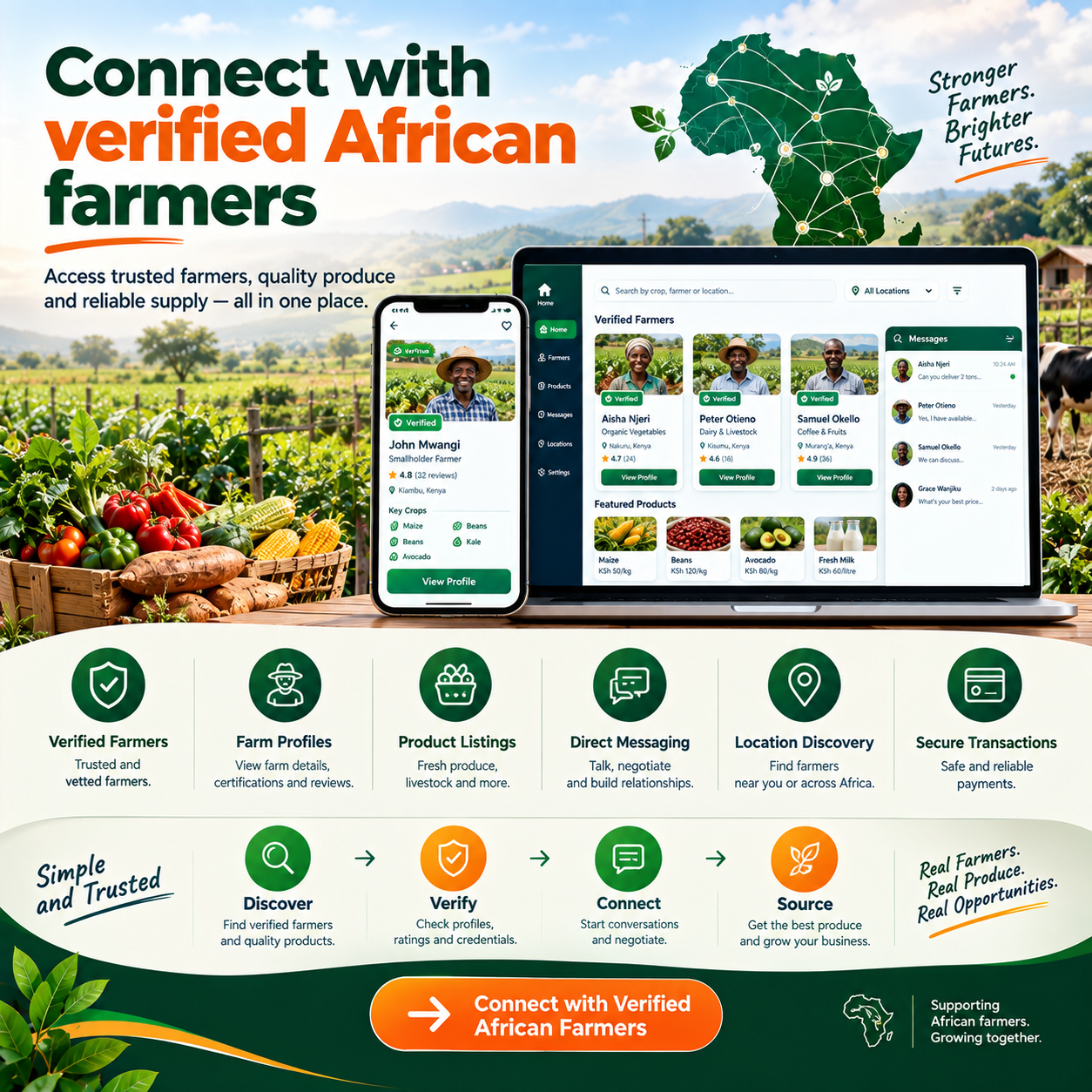
Connect with verified African farmers and you gain something the global food system has promised for decades but rarely delivered: a direct, trusted line to the people who actually grow the world’s food. For most of modern history, the distance between a food buyer and an African farmer has been measured in layers — brokers, commission agents, aggregators, and middlemen of every description — each adding cost, each adding opacity, and each ensuring that neither side truly knew the other.
The farmer could not tell you who bought his maize or at what price it finally retailed; the buyer could not tell you which farm the produce came from or whether the farmer was fairly paid. Today, that wall is coming down. Digital verification systems, mobile connectivity, and structured agricultural platforms now make it genuinely practical for buyers anywhere in the world to connect with verified African farmers — to know exactly who they are dealing with, see their farms and credentials, agree terms face to face even across continents, and build relationships that span seasons instead of single transactions.
This guide is the complete handbook for doing exactly that. It explains what verification actually means and why it matters, who benefits from these direct connections, which channels work and which waste your time, how to make the connection step by step, how to build relationships that endure, and how both sides — farmers and their new partners — profit when middle layers disappear.
Whether you are a food importer, a restaurant group, a roaster chasing single-origin lots, an NGO building supply chains, or a diaspora buyer wanting to invest back home, everything you need to connect with verified African farmers successfully is laid out in the sections that follow.
What Does It Mean to Connect with Verified African Farmers?
To connect with verified African farmers means establishing a direct, documented, and trusting business relationship with a farmer whose identity, farm, production capacity, and track record have been independently confirmed — typically through a digital platform, a cooperative, or a field-verified program. It is the difference between buying produce from a market stall and buying it from a named person whose farm you have seen, whose practices you understand, and whose reliability you can check against real history.
The word “verified” is doing the heavy lifting in that phrase, and it is worth pausing on. Verification is not a badge someone buys; it is a process someone passes. When you connect with verified African farmers through a credible channel, several things have already happened on your behalf:
- Identity verification — the farmer’s legal identity, registration, and contact details are confirmed, so you know exactly who you are dealing with.
- Farm verification — the farm itself is located, mapped, and often physically inspected; its size, crops, and production methods are on record.
- Capacity verification — what the farmer can actually supply, at what grade, in what season, is established before you ever place an order.
- Track record — past transactions, delivery performance, and buyer ratings are visible, replacing hearsay with history.
This is why the modern approach to connect with verified African farmers is so much more than networking. It is structured trust-building, and it converts one of agriculture’s oldest problems — trading with strangers — into a solvable engineering problem.
Why It Matters: The Case for Choosing to Connect with Verified African Farmers
The strongest argument for making the effort to connect with verified African farmers is the quality of what you get on both sides of the exchange.
For buyers, verification attacks risk at its root. The catastrophic failures of agricultural sourcing — containers of substandard goods, money paid into the void, quality that drifts season to season — almost always trace back to the same failure: buying through unverifiable channels. When you connect with verified African farmers instead, every layer of protection improves. Specifications are agreed with the person who will actually fulfill them. Quality claims can be traced to a specific farm and a specific harvest. Disputes have evidence attached. And the relationship itself becomes an asset — a farmer who knows your standards and your calendar delivers better, year after year, than any anonymous supplier ever could.
For farmers, direct verified connections are equally transformative. The traditional chain trapped farmers at the bottom: no information about real market prices, no relationship with the people who consumed their produce, and no bargaining power beyond the farm gate. When buyers connect with verified African farmers directly, the economics change fundamentally. Farmers see real prices, capture the margins that brokers once absorbed, receive payment faster and more securely, and — just as importantly — gain visibility. A verified farmer with a transaction history becomes creditworthy, insurable, and investable in ways that an informal seller never can.
There is also a system-level benefit worth naming. Food traceability regulations in major markets, from the EU onward, increasingly demand documented origin — not just “African produce” but named farms, named practices, named harvests. Supply chains built when buyers connect with verified African farmers meet these requirements as a natural byproduct, while chains built through informal brokering scramble to retrofit compliance after the fact.
Who Should Connect with Verified African Farmers?
The channel is far broader than most people assume, and each type of connector uses it differently.
Food importers and wholesale distributors use verified farmer connections to build supply programs — seasonal volumes contracted directly with named producers, priced transparently, and traceable end to end. For this group, choosing to connect with verified African farmers is a procurement modernization decision with direct margin impact.
Specialty buyers — coffee roasters, chocolate makers, tea brands, spice merchants — are the most visible users. Their entire value proposition depends on origin stories, cupping quality, and ethical sourcing, which makes the decision to connect with verified African farmers not a preference but the core of the business model. Direct relationships let them select specific lots, reward quality with premiums, and market authenticity that competitors cannot fake.
Hospitality and institutional buyers — hotel groups, restaurant chains, airlines, caterers — connect to secure consistent quality for menus, increasingly with sustainability and provenance commitments attached.
Cosmetics and wellness brands sourcing shea, baobab, moringa, and essential oils connect with verified producer groups to guarantee purity and to tell credible sourcing stories on their labels.
Development organizations, NGOs, and impact investors connect with verified farmers to design interventions, channel finance, and measure outcomes — where verification is the difference between real impact and reported impact.
Diaspora buyers and agripreneurs are a fast-growing segment: people investing back home who want to connect with verified African farmers to fund production, contract harvests, or build agribusinesses with family-level trust and professional structure.
Researchers, input suppliers, and financial institutions round out the ecosystem — each needing verified counterparties for pilots, product distribution, and lending programs respectively.
What “Verified” Actually Means: The Anatomy of Trust
When you set out to connect with verified African farmers, understanding the verification stack helps you evaluate whether a channel is serious or superficial.
Level one: identity. The baseline — legal identity confirmed through national ID, business registration where applicable, and location details. Every credible attempt to connect with verified African farmers starts here, because no deeper trust can be built on an anonymous counterparty.
Level two: farm and capacity. The farm is geolocated and mapped; its acreage, crops, irrigation status, and production history are recorded. Field agents or inspection partners physically validate what the profile claims. This is where superficial listings fall apart — it is easy to claim 10 hectares; it is much harder to fake a geotagged, agent-verified farm.
Level three: practice and certification. Depending on the market, verification extends to GlobalG.A.P., organic status, Rainforest Alliance, Fairtrade, or food-safety certifications, with certificate numbers checkable against issuing bodies. Buyers who connect with verified African farmers at this level can filter for compliance before the first conversation, saving weeks of due diligence.
Level four: performance. The deepest layer — transaction history, delivery reliability, quality consistency, and dispute record, accumulated across seasons. This is the layer that turns a verified profile into a trusted partner, and it is why the smartest buyers who connect with verified African farmers start early and build history deliberately: the fourth layer is earned over time, and it cannot be bought.
The Best Channels to Connect with Verified African Farmers
Not all channels deliver the same depth of verification or relationship. Here are the six that work, ranked roughly by structure.
1. Verified digital agricultural platforms. The modern default and the recommended starting point for almost everyone. A structured platform lets you connect with verified African farmers with the verification stack already built in: profiles pre-vetted, farms geolocated, certifications on file, communications documented, and payments protected. The platform’s whole business depends on verification quality, so it does the unglamorous work you would otherwise have to do yourself.
2. Cooperatives and farmer groups. Cooperatives aggregate hundreds of smallholders under one accountable structure, with the group’s leadership, records, and history providing the verification layer. For buyers wanting volume and shared governance, choosing to connect with verified African farmers through cooperative unions offers scale with structure — though you should still verify the cooperative itself, not just accept its claims.
3. Exporters with outgrower networks. Established export companies manage networks of contracted smallholders and handle quality, logistics, and compliance. Connecting through them means the farmer relationship is real but intermediated — a good middle option for buyers who want verified supply without managing many individual relationships.
4. Field programs and farmer registries. Government boards, development agencies, and NGO programs maintain verified farmer registries for their projects. These can be excellent, well-inspected pools when your goals align with the program’s — another structured way to connect with verified African farmers with an existing verification layer.
5. Trade fairs and origin visits. Nothing replaces standing on the farm. Origin trips and trade exhibitions create the human relationships that digital connections then formalize. Many of the best buyer–farmer partnerships began face to face and were subsequently structured through platforms.
6. Referrals and existing networks. Other buyers, agronomists, and local partners can point you toward reliable farmers — but treat referral as the start of verification, never the end. Even the warmest introduction deserves the same checks you would apply when you connect with verified African farmers through any other channel.
How to Connect with Verified African Farmers: The Step-by-Step Process
Here is the practical sequence, from first search to standing partnership.
Step 1: Define what you need before you search. Product, grade, volume, season, certifications, and price band — written down before first contact. Buyers who connect with verified African farmers with a clear specification get matched with the right farmers quickly; buyers who “want to see what’s out there” burn everyone’s time, including their own.
Step 2: Choose your channel and shortlist. Pick the channel that matches your volume and structure needs, then shortlist five to ten verified farmer profiles or groups whose location, crops, certifications, and capacity fit your specification. A good platform lets you filter precisely when you connect with verified African farmers — by crop, county, certification, rating, and season.
Step 3: Verify independently. Cross-check identity documents, validate certificate numbers with issuing bodies, confirm farm locations, and read transaction histories. On structured platforms this layer is pre-built, which is precisely why buyers who connect with verified African farmers there skip weeks of work — but for any off-platform contact, do this yourself without exception.
Step 4: Open the conversation properly. Introduce yourself, your volumes, your standards, and your timelines honestly, and ask about the farmer’s capacity, other buyers, and constraints. The best connections form when both sides treat the first conversation as the start of a relationship, not an interrogation — a courtesy that costs nothing when you connect with verified African farmers and pays back for years.
Step 5: Order samples and test. Ask for samples, evaluate against your standards, and lab-test where relevant. Keep the approved reference sample — it becomes the quality benchmark for everything that follows.
Step 6: Agree terms in writing. Volumes, grades, prices, delivery windows, payment terms, and quality tolerances — documented in the platform or in a simple written agreement. Writing protects both sides, and it is standard practice among buyers who connect with verified African farmers professionally.
Step 7: Transact safely. Use protected payment — escrow through the platform, or staged payments tied to delivery milestones. Never send full prepayment through informal channels to a counterparty you have just begun to connect with verified African farmers — the protection exists precisely so you never have to take that risk.
Step 8: Deliver feedback and grow the relationship. Pay on time, give honest feedback on every delivery, rate transparently, and — when the partnership works — move to forward contracts and seasonal programs. The compounding value of choosing to connect with verified African farmers lives almost entirely in the repeat relationship.
Building Relationships That Last: The Human Side of the Connection
Transaction mechanics get you started; relationship craft is what makes the connection valuable. The buyers who connect with verified African farmers and stay connected share several habits.
Communicate like a partner, not a boss. Share your forecasts, explain your quality rejections with specifics, and ask about the farmer’s challenges — weather, inputs, labor, cash flow. Farmers invest disproportionately in buyers who treat them as collaborators, and the difference shows up in harvest allocations during short-supply seasons. When demand exceeds supply, the buyers who connect with verified African farmers and treat them well are the ones who still get product.
Respect the calendar. African agriculture runs on seasons, and farmers plan planting months before harvest. Buyers who communicate requirements before planting season get first position in a farmer’s production plan; buyers who inquire only at harvest get whatever is left. Planning your outreach around planting cycles is one of the highest-leverage habits when you connect with verified African farmers.
Pay fast, every time. Nothing builds loyalty like a buyer whose money arrives when promised. In agricultural communities, payment reputation travels fast — in both directions.
Visit when you can. Even one farm visit transforms the relationship. You learn the realities of production, the farmer learns your standards firsthand, and both sides build the trust that carries deals through difficult seasons.
Diversify respectfully. Farmers diversify their buyers to manage risk; buyers who connect with verified African farmers usually do the same. Both sides should communicate openly about it — reliability matters more than exclusivity, and honesty about portfolio strategy prevents the resentment that secrecy breeds.
What Farmers Gain When Buyers Connect with Verified African Farmers
It is worth understanding the farmer’s side of the exchange, because partnerships flourish when both sides see the value clearly.
Better prices through market transparency. A farmer with direct buyer relationships sees real market prices and negotiates against them, capturing margins that brokers once absorbed. Buyers who connect with verified African farmers typically pay better net prices than the farm gate — while still paying less than the layered informal chain — because the savings from removing intermediaries are genuinely shared.
Faster, safer payment. Escrow and platform payments replace the farmer’s oldest fear — delivering produce and waiting endlessly for money.
A financial identity. Every verified transaction builds the farmer’s data trail: volumes, prices, reliability. Lenders, insurers, and input suppliers read that history and extend terms that informal sellers can never access. This is among the most valuable long-term effects when you connect with verified African farmers — you are, in effect, helping build their credit file with every trade.
Planning confidence. Forward contracts let farmers invest in seed, fertilizer, and labor for a known buyer at a known price — converting farming from speculation into planning.
Dignity and recognition. Less quantifiable, deeply important: a verified farmer with a professional profile, a rating, and named buyers is recognized as the businessperson they are. The platforms that make it easy to connect with verified African farmers understand that respect is not decoration — it is retention.
The Regional Landscape: Where and How to Connect Across Africa
Africa is not one market, and the smartest connectors match their approach to each region’s structure.
East Africa — Kenya, Uganda, Tanzania, Rwanda, Ethiopia — offers the densest verification infrastructure, thanks to years of mobile money penetration and strong cooperative systems. Kenya’s horticulture and coffee sectors are exceptionally export-literate; Ethiopia’s coffee identity is unmatched. Buyers who connect with verified African farmers in East Africa find deep benches of experienced, already-certified producers.
West Africa brings scale in cocoa, cashew, shea, and grains across Ghana, Côte d’Ivoire, Nigeria, and Senegal. Cooperative unions are the strongest connection vehicles here, and buyers who connect with verified African farmers through unions gain immediate access to aggregated volume and shared governance.
Southern Africa pairs South Africa’s commercialized agriculture with smallholder systems in Zambia, Malawi, and Mozambique — offering everything from structured contract farming to emerging producer programs.
North Africa — Egypt, Morocco, Tunisia — runs intensive, export-oriented systems with sophisticated grower networks, strongest in citrus, olives, and vegetables.
The continental picture matters too: AfCFTA is steadily lowering barriers between African markets, meaning a connection built in one country increasingly becomes a gateway to regional supply — another reason to connect with verified African farmers early and grow the network organically.
Commodities and the Connection: What Each Crop Type Needs
Different commodities reward different connection styles, and matching your approach to the crop improves outcomes.
Perennial cash crops — coffee, cocoa, tea, macadamia, avocado — reward the deepest connections: multi-year relationships, farm visits, quality premiums, and financing support. Buyers who connect with verified African farmers in perennial crops and invest across seasons consistently secure the best lots, because trees respond to care and care responds to committed buyers.
Annual horticulture — vegetables, beans, peppers, tomatoes — rewards speed and communication: weekly volumes, tight specifications, rapid feedback loops. Connection platforms with strong messaging and order tracking serve this category best.
Grains and pulses — maize, beans, sesame, groundnuts — reward aggregation: connecting with farmer groups and cooperatives that can assemble truckload volumes from many smallholders.
Livestock and dairy need verification plus inspection support — weights, health records, cold chain — and reward connectors who bring technical partnership alongside purchasing.
Specialty ingredients — shea, baobab, essential oils, honey, spices — reward provenance storytelling, where the verified farm itself becomes part of the product’s market value. Few categories benefit more when brands connect with verified African farmers and tell the story transparently.
The Technology That Makes the Connection Work
Behind every smooth modern connection sits a stack of technologies doing quiet, essential work.
Mobile money is the payment rail — near-universal across East and West Africa — meaning buyers who connect with verified African farmers can settle payments in minutes rather than weeks, with full records.
Geolocation and mapping anchor farm verification: geotagged farms, field boundaries, and satellite imagery that validates acreage and crop claims.
USSD and basic-phone access keep the connection inclusive, so farmers without smartphones can still list, communicate, confirm deliveries, and receive payments — an inclusion feature that dramatically widens the pool of farmers you can reach.
Data and AI matching increasingly connects buyers to farmers automatically — matching your specification to profiles whose location, certification, and history fit, and flagging seasonal availability before you ask. Buyers who connect with verified African farmers on data-rich platforms discover that the platform often knows which farmer suits them before the first search.
Traceability tools — digital logs, batch codes, and increasingly blockchain-backed records — document the journey from farm to destination, turning the connection itself into the compliance asset.
Contract Farming: Turning Connections into Commitments
The deepest expression of the connection is the forward contract: agreeing today on volumes, grades, and prices for harvests months away. When you connect with verified African farmers and graduate to contract farming, both sides gain planning power that spot trading can never offer.
For the farmer, a contract means a guaranteed market before planting — the confidence to invest in certified inputs and better practice. For the buyer, it means supply certainty, price stability, and the traceability that modern markets increasingly demand. Structured platforms make these contracts enforceable in practice: inputs financed against the contract, deliveries tracked against schedule, payments released per delivery, and performance recorded on both sides. Side-selling — the farmer selling your contracted volume to a higher bidder — is deterred not by legal threats but by platform economics: performance history determines access to credit, premiums, and preferred buyers. On every mature platform where buyers connect with verified African farmers, keeping promises simply pays better than breaking them.
Financing the Partnership: How Connections Unlock Capital
Verified connections do something remarkable: they make agricultural finance flow. A lender’s core problem has always been information — it cannot see the farm, the history, or the buyer. When you connect with verified African farmers and transact transparently, the resulting data solves the lender’s problem, and capital follows:
- Input financing lets farmers receive seed and fertilizer at planting, repaid from harvest sales to you.
- Working-capital credit supports aggregators and farmer groups managing your volumes.
- Warehouse receipt finance lets farmers store and sell later at better prices, with the stored produce as collateral.
- Invoice and contract finance converts your signed purchase agreement into immediate cash for the farmer’s operations.
Buyers who connect with verified African farmers and commit to volumes become, in effect, the anchor on which an entire financing structure is built — one of the most underappreciated forms of value a direct connection creates.
Common Challenges — and How to Navigate Them
Honesty about friction makes the opportunity credible. These are the real challenges and the working answers.
Digital literacy gaps. Many excellent farmers are not experienced app users. Platforms answer with field agents, USSD access, and onboarding support; buyers should allow onboarding time when they first connect with verified African farmers in new regions — patience here is an investment, not a cost.
Trust on both sides. Farmers have been burned by buyers too — unpaid deliveries, vanishing contracts. Verified systems with escrow, written terms, and public ratings protect both directions of trust, which is why structured channels outperform informal introductions for everyone serious enough to connect with verified African farmers properly.
Quality consistency. First deliveries may not match samples exactly. The answer is feedback: specific, respectful, and documented, with the reference sample as the shared benchmark. Consistency improves fastest with buyers who communicate precisely.
Logistics and distance. Rural farms are far from paved roads and ports. Aggregation points, shared transport, and realistic delivery windows solve most of it; unrealistic promises solve nothing.
Seasonality and side-selling. Contracts, deposits, and loyalty premiums manage the temptation of spot markets — mechanisms that every mature platform builds in, and every buyer should expect when they connect with verified African farmers at commercial scale.
Language and communication. French, Swahili, Amharic, and dozens of local languages cross the continent. Patient communication, translation support on platforms, and simple written terms bridge the gap easily — and the effort is repaid in relationship depth.
None of these challenges is unique to verified connections; every one of them is worse in the informal system, only without data, protection, or support. That comparison is exactly why adoption keeps rising.
How to Choose the Right Platform to Connect with Verified African Farmers
Platform selection shapes everything downstream. Run candidates through this checklist:
- Verification depth. Ask exactly what is verified — identity only, or farm, capacity, and certification too? Superficial verification is a logo, not a safeguard. The platform you use to connect with verified African farmers should show its verification process, not just its badge.
- Farmer density and fit. How many verified farmers in your crops, regions, and volumes — and are they active, or listed-and-dormant?
- Payment protection. Escrow and milestone payments as defaults, not upgrades.
- Logistics support. Aggregation, transport booking, and cold chain where your product needs it.
- Communication tools. Documented messaging, translation, and multilingual support — the connective tissue of the relationship.
- Fees and alignment. Commission on completed trades is healthy; heavy upfront charges with thin service are not. Judge cost against what the platform actually delivers every time you connect with verified African farmers.
- Support quality. Test response speed before you need it urgently — the truest test of professionalism on any platform where you plan to connect with verified African farmers.
The Future of Direct Farm Connections
The direction of travel is unmistakable. Verification will deepen — satellite monitoring, AI-assisted farm audits, and digital identity systems will make farmer profiles richer and more trustworthy every year. Matching will automate: buyers will describe what they need and platforms will surface the right farmers instantly. Finance will embed itself ever deeper into the connection, until a verified transaction history functions as a full credit file. Traceability regulation will convert verified connections from competitive advantage into market-access requirement in premium markets. And as the generation of digitally native young farmers grows, direct connections will become the default channel for agricultural trade rather than the innovation. The buyers and organizations that connect with verified African farmers now — building profiles, histories, and trust while the field is still early — will hold relationship assets that latecomers cannot simply purchase.
Frequently Asked Questions
How do I know a farmer is genuinely verified? Ask what the verification process covered. Genuine verification includes confirmed identity, a geolocated and inspected farm, documented capacity, and checkable certification numbers — not just a badge. Platforms let buyers connect with verified African farmers only after this work is done, and independent checks (certificate databases, registry lookups) are always available to you as a second layer.
Can small buyers connect directly, or is this for large importers only? Small buyers are welcome and increasingly common. Farmer groups and aggregators assemble volumes from many smallholders, and consolidation services make even pallet-scale orders practical. Starting small is recommended — prove the relationship, then grow.
What is the fastest way to start? The fastest reliable route is a verified digital platform: search by crop and region, filter by certification and rating, message shortlisted farmers, order samples, and transact through escrow. Most buyers who connect with verified African farmers this way complete their first transaction within a few weeks.
How do payments work across borders? Through escrow held by the platform, mobile-money-linked payouts to farmers, or bank transfers against delivery milestones — always tied to verified events, never to promises.
What if the first delivery does not match the sample? The reference sample, the written specification, and the platform’s message record form the evidence base. Resolutions range from price adjustment to replacement. This is exactly why professionals document everything when they connect with verified African farmers — evidence turns disputes into decisions.
Do farmers want direct connections, or do they prefer brokers? Overwhelmingly, farmers want direct connections — the broker era captured their margins and kept them blind to their own markets. What farmers want alongside directness is reliability: fair terms, fast payment, and honest communication. Buyers who offer those find no shortage of farmers ready to connect with verified African farmers on professional terms.
Which certifications should I expect for fresh produce and specialty crops? GlobalG.A.P. for fresh produce into European retail, organic certifications for the organic segment, and Rainforest Alliance or Fairtrade for coffee, cocoa, and tea — always validated against the issuing body’s public database before you connect with verified African farmers on certified terms.
How long does it take to build a reliable supply relationship? The first transaction takes weeks; a reliable program takes one or two full seasons. Buyers who connect with verified African farmers, deliver feedback consistently, and pay reliably typically reach standing-program status within a year — and the relationship compounds in value from there.