
Agricultural Export Marketplace Africa:Selling African Farm Produce to the World
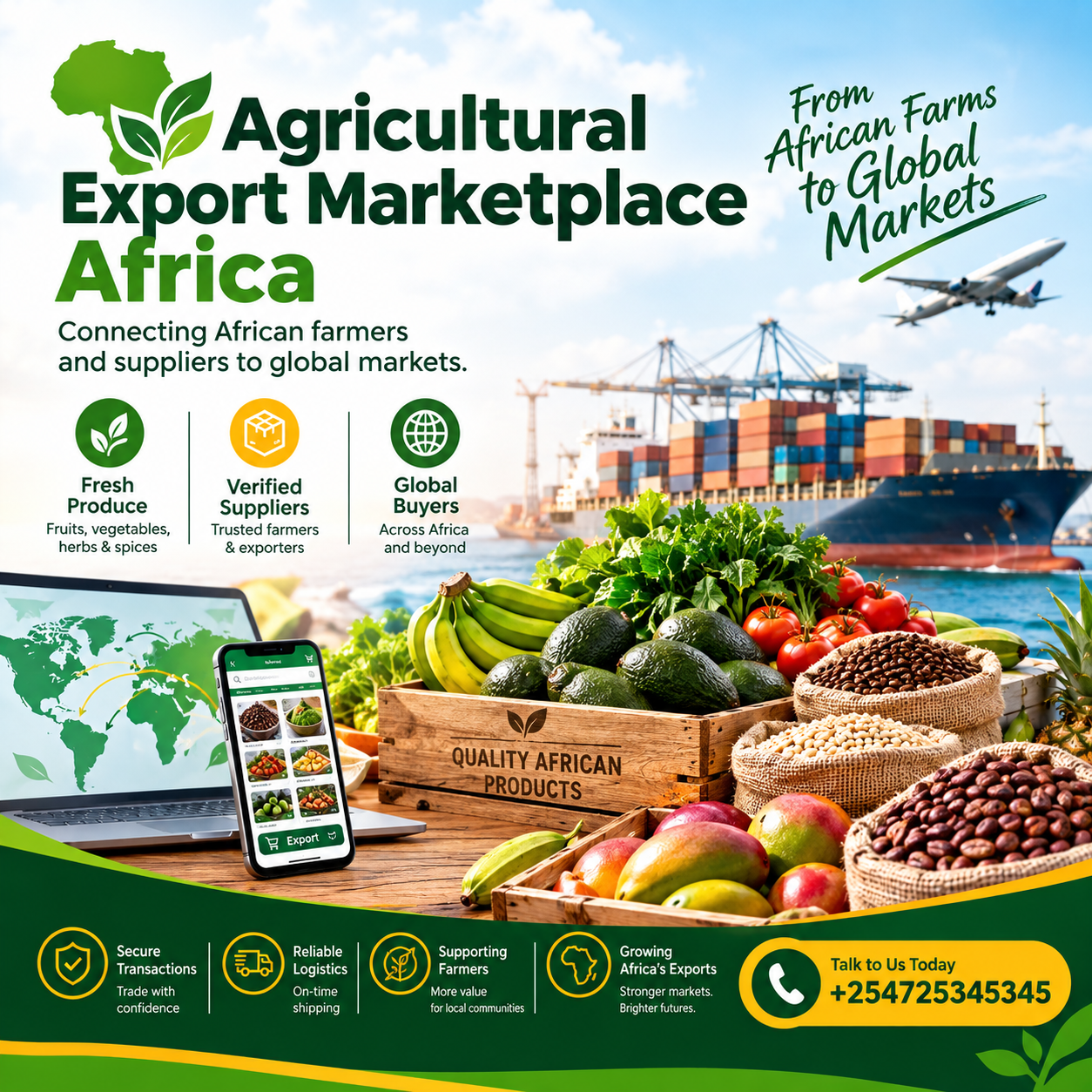
A modern agricultural export marketplace Africa is rewriting one of the oldest stories in global trade — how African produce reaches the world’s tables. For decades, African harvests have filled supermarkets in Europe, the Gulf, and Asia, yet the farmers who grew them rarely knew who bought them, at what price, or why.
Layers of brokers, commission agents, and middlemen stood between the farm gate and the foreign shelf, each taking a margin and each adding opacity to a business that runs on trust.
Digital technology is now collapsing that distance. A well-built agricultural export marketplace Africa allows a flower farm in Naivasha, a cocoa cooperative in Ghana’s Eastern Region, or a mango processor in Burkina Faso to list certified produce, negotiate with verified international buyers, book freight, and receive payment — all through one integrated system.
This guide is a complete, practical handbook for that new world of trade. Whether you are a smallholder hoping to sell your first container, an exporter digitizing an established operation, or an international buyer searching for reliable African supply, you will learn exactly how an agricultural export marketplace Africa works — the certifications required, the documents involved, the commodities in highest demand, the logistics of moving perishables across oceans, and the precise steps to begin.
The goal is simple: to turn one of the world’s greatest agricultural endowments into one of its great export businesses.
What Is an Agricultural Export Marketplace Africa?
An agricultural export marketplace Africa can depend on is a digital platform that connects African producers, cooperatives, and export companies with verified international buyers — importers, wholesalers, retail chains, food manufacturers, and food-service groups — and supports the entire export journey from listing to payment.
Where a domestic marketplace solves the problem of selling within a country, an export marketplace solves a much harder set of problems at once: meeting foreign quality standards, proving compliance through certification and documentation, arranging international freight and insurance, and building enough trust between strangers on different continents for money to change hands confidently.
The strongest platforms integrate the full trade stack:
- Verified supply listings with grades, certifications, volumes, harvest windows, and packing specifications that international buyers can act on immediately.
- Buyer verification so exporters know exactly who they are dealing with before quoting a price or shipping a single crate.
- Compliance support, including GlobalG.A.P., HACCP, organic, Fairtrade, and Rainforest Alliance guidance built into onboarding.
- Export documentation tools — phytosanitary certificates, certificates of origin, packing lists, bills of lading — coordinated in one workflow.
- Freight booking, from refrigerated airfreight for cut flowers to reefer containers for avocados.
- Escrow and trade finance, so exporters get paid on time and buyers get what they ordered.
In short, a true agricultural export marketplace Africa is not a noticeboard of offers. It is trade infrastructure: part market, part compliance office, part logistics coordinator, and part bank.
Why Africa’s Export Moment Has Arrived
The timing of the modern agricultural export marketplace Africa is no accident. Several powerful forces have converged at once. Global demand for tropical and counter-seasonal produce keeps climbing — avocados, blueberries, macadamia, cut flowers, specialty coffee, and cashew are all growth categories where Africa holds natural advantages.
European and Middle Eastern buyers are actively diversifying supply beyond traditional origins. Meanwhile, the African Continental Free Trade Area is lowering barriers within the continent itself, creating the kind of scale that makes export-grade aggregation economically viable for smaller producers for the first time.
Technology has converged too. Certification bodies, testing laboratories, cold chains, and freight forwarders are all digitizing, which means the paperwork and processes that once required physical proximity can now be coordinated remotely. A small exporter that once needed a representative office in Rotterdam to find customers can now reach fifty of them through an agricultural export marketplace Africa from a laptop in Nakuru or Kumasi.
For international buyers, the change is just as profound. An agricultural export marketplace Africa gives procurement teams something they have never truly had: a single, searchable window into African supply with verified credentials attached to every offer.
Instead of relying on trade fairs held twice a year and brokers whose incentives are opaque, buyers can compare certified suppliers, review transaction histories, and negotiate in real time. Lower search costs bring more buyers into the market — and more buyers mean stronger, fairer prices for producers.
How an Agricultural Export Marketplace Africa Works: From Farm to Foreign Shelf
The mechanics are more involved than domestic trade because exports carry regulatory weight, but the platform exists precisely to make those complications manageable. Here is the typical flow on an agricultural export marketplace Africa:
- Supplier onboarding and verification. The exporter or cooperative registers, uploads business documents, export licenses, and certifications, and passes platform vetting. Verification is what converts a listing from an advertisement into a tradeable offer.
- Listing certified produce. The supplier publishes offers with exact grades, certifications, available volumes, packing specifications, Incoterms, and availability windows. Precision at this stage prevents disputes later.
- Buyer discovery and negotiation. Verified international buyers search by product, certification, and origin, then negotiate volume, price, delivery schedules, and payment terms inside the platform. Every agreement is documented in one place — a discipline every serious agricultural export marketplace Africa enforces.
- Sampling and quality confirmation. For new relationships, samples are couriered and approved, or quality is confirmed against agreed grade standards at packing stations or through third-party inspection.
- Documentation and compliance. Phytosanitary certificates, certificates of origin, fumigation records, and quality certificates are arranged through the platform’s compliance workflows and partner laboratories.
- Freight and insurance. Air or sea freight is booked — cold trucks to the airport, reefer containers to the port, consolidation for smaller volumes — with insurance attached to the order.
- Payment and settlement. Escrow, letters of credit, or trade-finance arrangements release funds as contractual milestones are met, protecting both sides.
- Delivery, feedback, and repeat trade. The buyer confirms receipt and quality; both parties rate each other; the transaction history becomes the exporter’s reputation and credit file. Repeat trade — where the real profit in exports lives — is built on that data trail.
Key Features of a World-Class Agricultural Export Marketplace Africa
Not every platform claiming to serve export trade actually can. These are the features that separate genuine export infrastructure from a dressed-up listings page, and they are what to demand from any agricultural export marketplace Africa before you commit your season to it:
- Certification-aware profiles. The platform must track GlobalG.A.P., organic, HACCP, Fairtrade, Rainforest Alliance, and Halal or Kosher credentials per producer and per season — because international buyers filter by these before they even glance at prices.
- Grade standards aligned to destination requirements. EU supermarket specifications differ from Gulf wholesale specifications. A capable agricultural export marketplace Africa encodes these standards so both sides negotiate with the same definitions.
- Integrated freight with cold-chain guarantees. For perishables, temperature data from farm to airport to port should be visible to the buyer, not hidden in a truck driver’s memory.
- Trade-finance options. Export cycles tie up cash for weeks. Platforms that connect pre-shipment finance or invoice discounting give smaller exporters a genuine chance against established players.
- Dispute resolution with teeth. Pre-shipment inspection rights, documented quality agreements, and clear arbitration pathways are non-negotiable in cross-border trade.
- Market intelligence. Destination price data, seasonal demand forecasts, and regulatory alerts turn the platform from a meeting place into a strategic advisor for its exporters.
What Farmers and Exporters Gain from an Agricultural Export Marketplace Africa
The producer-side benefits are substantial, and they compound season after season.
Direct access to premium markets. Export prices for certified produce routinely run far above local prices. The constraint has never been demand; it has been access and compliance. By centralizing buyers, requirements, and support, an agricultural export marketplace Africa converts that constraint into an opportunity that any organized producer group can pursue.
A verifiable trade identity. Every completed shipment builds a data trail — volumes, grades, on-time performance, dispute history. On an agricultural export marketplace Africa, that history functions as the exporter’s reputation and credit file in one, unlocking larger contracts and better financing terms with each successful season.
Freedom from single-channel dependency. An exporter with one broker is a fragile exporter. Platforms diversify your buyer base across countries and market segments, so one lost client no longer threatens an entire season’s revenue.
Operational discipline that pays at home too. Meeting export standards forces grading, record-keeping, and food-safety practices that improve domestic trade as well. Producers who learn the discipline of an agricultural export marketplace Africa almost always find their local premium markets easier, not harder, to serve.
What International Buyers Gain from an Agricultural Export Marketplace Africa
The buyer side deserves equal attention, because export trade only works when both ends of the chain win.
Verified, comparable supply. Instead of months of due diligence, a buyer reviews certification records, transaction histories, and inspection reports in a single profile. Procurement teams using an agricultural export marketplace Africa shortlist qualified suppliers in days rather than seasons.
Transparent pricing. Published offers with defined grades and Incoterms make comparison real. Negotiation shifts from suspicion to arithmetic, which speeds up contracting and reduces the haggling that once consumed weeks.
Built-in compliance assurance. Documentation is generated and tracked inside the platform, sharply reducing the risk of customs delays that can turn a profitable shipment into a write-off. For many importers, this is the single biggest reason they adopt an agricultural export marketplace Africa over informal channels.
Supply reliability through data. Seasonal availability calendars and yield forecasts let buyers plan programs months in advance instead of reacting to whatever happens to be available this week.
Certifications: The Passport of an Agricultural Export Marketplace Africa
Nothing matters more in agricultural exports than certification, and any agricultural export marketplace Africa worth using treats it as a core feature rather than a footnote.
- GlobalG.A.P. is the de facto entry ticket for fresh produce into European retail, covering food safety, traceability, worker welfare, and environmental practice at farm level.
- HACCP and ISO 22000 govern food-safety management in packing houses and processing facilities.
- Organic certification under EU, USDA, and JAS standards unlocks the fastest-growing premium segment — and requires a three-year conversion window, which is exactly why platforms that help farmers plan conversion early add so much value.
- Fairtrade and Rainforest Alliance certifications matter enormously for coffee, cocoa, tea, and bananas, where ethical sourcing is a purchase requirement rather than a preference.
- Halal and Kosher certification opens the Gulf, Southeast Asian, and Israeli markets for processed foods and animal products.
- Phytosanitary compliance — pest-free areas, treatment records, and plant-health inspections — is regulated government-to-government and enforced at every border.
The practical role of an agricultural export marketplace Africa is to make this maze navigable: mapping which certifications each destination requires, connecting producers with accredited certification bodies and laboratories, tracking renewal dates, and flagging gaps before a buyer ever discovers them. Producers who treat certification as an investment rather than a cost consistently outperform, because certification is what converts a good harvest into a tradeable, premium-priced product.
Export Documentation and Logistics on an Agricultural Export Marketplace Africa
Paperwork sinks more first-time exporters than weather or prices ever do, which is why documentation support is a defining feature of a serious agricultural export marketplace Africa.
The core document set includes:
- Commercial invoice and packing list — the financial and physical description of the shipment.
- Phytosanitary certificate — issued by the national plant-protection authority after inspection, mandatory for nearly all fresh plant products.
- Certificate of origin — determining tariff treatment, increasingly valuable under AGOA and AfCFTA preferences.
- Bill of lading or airway bill — the transport contract and document of title.
- Health or veterinary certificates for animal products, fumigation certificates for grains and wood packaging, and quality and weight certificates where contracts demand them.
Modern platforms coordinate these through digital workflows linked to export promotion councils, customs systems, and freight partners. The exporter enters data once; the agricultural export marketplace Africa routes it to the right authority and tracks status in real time.
Logistics follows the same logic of coordination. Perishables move through dedicated cold trucks to airport cold rooms for airfreight — the standard for flowers, tender vegetables, and berries — or into refrigerated containers for sea freight, which has become the workhorse for avocados, citrus, and increasingly even flowers.
Consolidation matters enormously for smaller producers: by combining several exporters’ volumes into one container, a good agricultural export marketplace Africa makes full-container economics available to producers who could never fill one alone. Insurance, clear Incoterms (FOB, CIF, and EXW remain the workhorses), and pre-shipment inspection rights complete the stack.
When all these pieces live inside one system, an exporter’s job shrinks from a logistics marathon to a disciplined checklist.
High-Demand Commodities on an Agricultural Export Marketplace Africa
Different commodities carry different certification, logistics, and margin profiles. Knowing where demand concentrates helps producers aim their investments wisely.
Cut flowers and ornamentals
Kenya, Ethiopia, and Rwanda dominate this space, and it is the most airfreight-dependent, specification-sensitive category on any agricultural export marketplace Africa. Margins are excellent, cold-chain discipline is everything, and buyer relationships are built on season-long consistency rather than one-off deals.
Coffee, tea, and cocoa
The classic African export crops are being transformed by traceability demands. Specialty buyers now want farm-level data, and platforms that connect roasters and chocolate manufacturers directly to cooperatives are capturing the premium end of these markets. A transparent agricultural export marketplace Africa listing that includes altitude, variety, processing method, and cupping scores commands dramatically better prices than anonymous bulk offers.
Avocado, macadamia, and blueberries
These are the boom crops. Kenya, South Africa, Tanzania, and Morocco are planting aggressively to satisfy Northern Hemisphere counter-seasonal demand, and sea-freight technology has widened the range of viable destinations. Volume consistency and certification are the entry price, and producers who deliver both on an agricultural export marketplace Africa find themselves booked seasons in advance.
Fresh vegetables and fruits
French beans, snow peas, chillies, okra, mangoes, citrus, and grapes all trade in serious volume. Requirements vary sharply by destination — EU supermarket specifications are unforgiving — so grade accuracy in listings is the difference between growth and chargebacks.
Fish, spices, nuts, and specialty products
Nile perch and tilapia fillets, cardamom and black pepper, cashew and shea, gum arabic, honey, and dried hibiscus are the quieter success stories. These categories reward niche positioning, and an agricultural export marketplace Africa is often where specialist buyers and specialist producers find each other for the first time.
Pulses, grains, and oilseeds
Sesame, groundnuts, pigeon peas, and soybeans trade in bulk with lower perishability risk — an excellent training ground for new exporters learning documentation and freight mechanics before stepping up to perishables. Many experienced traders began exactly here, and an agricultural export marketplace Africa that serves bulk commodities well becomes the natural launchpad into higher-value categories.
Regional Strengths Across the Continent
Export readiness differs by region, shaped by climate, infrastructure, and institutional depth — and every serious agricultural export marketplace Africa tailors its offering accordingly.
East Africa
Kenya and Ethiopia anchor the region: flowers, vegetables, coffee, and tea flowing through the Nairobi and Addis Ababa hubs, with Rwanda, Uganda, and Tanzania adding volume in horticulture, fish, and grains. The density of certified producers and cold-chain infrastructure makes East Africa the most active arena for nearly every ambitious agricultural export marketplace Africa operating today.
West Africa
Cocoa from Côte d’Ivoire and Ghana, cashew from the coastal belt, shea from the Sahel, sesame from the interior, and pineapple and banana from Ghana give the region unmatched commodity depth. The opportunity for an agricultural export marketplace Africa here lies in formalizing fragmented supply and connecting cooperative groups directly to processors and importers.
Southern Africa
South Africa brings fully commercialized agriculture and deep logistics expertise; Zambia and Zimbabwe add maize, tobacco, and horticulture; Mozambique and Malawi contribute pulses, macadamia, and tea. Platforms in this region focus on linking commercial-scale surplus with buyers who need program supply, and an agricultural export marketplace Africa serving Southern Africa competes on efficiency and data rather than basic access.
North Africa
Egypt and Morocco are export powerhouses in citrus, tomatoes, potatoes, and olives, with deep, well-worn channels into Europe. Platforms serving these markets compete on sophistication — digital compliance, traceability, and documentation speed — because the producers are already export-literate.
Destination Markets: Where African Produce Goes
Understanding demand geography shapes everything from certification choices to pricing strategy on an agricultural export marketplace Africa.
The European Union and the United Kingdom remain the dominant destinations — the largest markets for flowers, vegetables, coffee, cocoa, and fruit. Standards are the strictest, but so are the premiums, and traceability requirements increasingly favor digitally documented supply chains like those an agricultural export marketplace Africa generates automatically.
The Middle East and the Gulf are the fastest-growing story: rapid population growth, high food-import dependence, and rising quality expectations. Halal certification and reliable sea and air connectivity make the Gulf a natural priority for exporters using an agricultural export marketplace Africa.
Asia — India, China, Malaysia, and the wider Southeast Asian market — is expanding from pulses and raw commodities toward premium horticulture, and its sheer scale makes it the long-term growth frontier for suppliers who can meet volume and consistency demands through an agricultural export marketplace Africa.
The United States under AGOA gives many African countries duty-free access, especially significant for processed foods, coffee, and specialty products.
Intra-African trade under AfCFTA is the sleeping giant: processed and semi-processed foods moving between African markets, with digital platforms positioned as the bridge across those corridors.
How to Choose the Right Agricultural Export Marketplace Africa
With new platforms launching constantly, selection discipline matters. Run every candidate through this checklist before committing a season’s production.
- Buyer quality, not buyer count. Ask which importers and retail programs actively source through the platform. Ten serious buyers beat ten thousand anonymous accounts on any agricultural export marketplace Africa.
- Certification and compliance support. If the platform cannot guide you through GlobalG.A.P. or handle phytosanitary workflows, it is a listings site wearing an export costume.
- Payment protection and finance. Escrow, letter-of-credit support, or trade-finance partnerships — the payment architecture should protect you from the moment you commit cargo.
- Real logistics capability. Cold chain, consolidation, freight partnerships, and insurance should be bookable today, not promised tomorrow.
- Transparent, success-aligned fees. Commissions on completed trades are reasonable; heavy upfront charges with no service behind them are not. Judge the cost of an agricultural export marketplace Africa against what it actually delivers per shipment.
- Responsive human support across time zones. Export trade runs on unforgiving deadlines; support that answers within hours is worth more than any feature list.
How to Start Selling Through an Agricultural Export Marketplace Africa: A Step-by-Step Roadmap
Step 1: Build compliance before you build listings. Register your business, secure an export license where required, and begin the certification journey appropriate to your product and target market. Every credible agricultural export marketplace Africa will ask for these credentials during onboarding — and buyers will ask for them again.
Step 2: Define your product precisely. Choose your flagship product, grade standards, packing format, and the volumes you can reliably supply. Exports reward narrow excellence over broad mediocrity.
Step 3: Create listings that answer every buyer question. Include certifications with certificate numbers and validity dates, available volumes by week, packing details, Incoterms, and photos of actual packed product. The exporters who thrive on an agricultural export marketplace Africa treat listing accuracy as a brand promise.
Step 4: Plan your first shipment for learning, not profit. Start with volumes you can execute flawlessly. A small shipment that arrives perfect builds a relationship; a large one that arrives flawed ends one.
Step 5: Nail the documents and the timeline. Work backward from the vessel or flight date, scheduling inspection, certification, and packing with buffer days. Use the platform’s document workflows so nothing is chased by phone at midnight.
Step 6: Convert one satisfied buyer into a program. The real money in exports is in season-long programs, not spot sales. Ask for feedback, adjust, and propose a standing schedule — the pathway every successful producer on an agricultural export marketplace Africa has followed.
Common Challenges — and How to Overcome Them
Honesty about difficulties is what makes the opportunity credible, so here are the real obstacles and the working answers.
Meeting standards consistently. The gap between a good harvest and an exportable one is process, not luck. Field hygiene, trained graders, and documented practices close it. Platforms increasingly embed training and pre-shipment inspection precisely because quality failures damage everyone — the exporter, the buyer, and the agricultural export marketplace Africa itself.
Finance gaps in long export cycles. Cash tied up between packing and payment can strangle a growing exporter. Trade-finance partnerships, escrow with milestone releases, and invoice discounting — now common platform features — exist for exactly this problem.
Logistics unpredictability. Freight rates swing, ports congest, and cold chains fail. Buffer planning, insurance, and consolidation options reduce the exposure that individual exporters cannot manage alone.
Price volatility and side-selling. When spot prices spike mid-contract, discipline gets tested. Fixed premiums for program loyalty, deposits, and transparent market data help keep agreements intact — a lesson every mature agricultural export marketplace Africa has engineered into its contract tools.
Regulatory shifts. Destination rules change — new pesticide limits, new labeling requirements. Platforms that push regulatory updates directly to their exporters convert a threat into a planning advantage, one more reason the modern agricultural export marketplace Africa outcompetes informal channels.
The Future of the Agricultural Export Marketplace Africa
The trajectory points toward deeper integration and higher trust. Expect the average agricultural export marketplace Africa of the coming decade to function as a complete export operating system: certification tracking, digital phytosanitary applications, blockchain-verified traceability for premium markets, embedded trade finance, and AI-driven demand forecasting that tells producers what to plant, for which destination, and when.
Carbon and sustainability premiums will increasingly attach to the same data trails that document shipments, and as AfCFTA implementation deepens, the line between “export” and “regional trade” will blur — with every agricultural export marketplace Africa serving both from a single infrastructure.
The direction is unmistakable: Africa’s share of global agricultural trade remains far below its potential, and gaps that large, backed by rising global demand and maturing digital rails, do not stay unfilled for long.
Frequently Asked Questions
How much capital do I need to start exporting through a digital platform?
Less than the traditional route, because consolidation, shared logistics, and trade finance reduce upfront burdens. A realistic starting budget covers certification costs, packing materials, and local transport to the consolidation point — while the agricultural export marketplace Africa handles buyer search, documentation workflows, and payment protection that once demanded offices and agents abroad.
Can smallholder farmers participate directly?
Directly, no; effectively, yes. Export minimums and certification costs mean most smallholders participate through cooperatives, aggregator groups, or outgrower schemes listed on the platform. The group structure shares costs and volumes while the individual farmer still captures premium export prices — the model behind most smallholder success stories on any agricultural export marketplace Africa.
How long does export certification take?
It depends on the scheme: organic conversion takes up to three years, GlobalG.A.P. implementation typically one season with proper support, and HACCP several months for a packing facility. The right time to start is before you have a buyer, not after.
What payment methods protect exporters from non-payment?
Escrow with milestone release, letters of credit, and documentary collections are the standard instruments, often combined with export credit insurance. A disciplined agricultural export marketplace Africa makes these the default rather than the exception, especially for first trades between new counterparties.
Which products should a first-time exporter choose?
Start where volumes are manageable and perishability is lower — pulses, spices, nuts, or dried products — to learn documentation and logistics, then step up to fresh produce with a proven operational team behind you.
How do platforms handle disputes over quality or quantity?
Through documented agreements, pre-shipment inspection rights, and arbitration processes. Because listings, negotiations, quality specifications, and delivery confirmations all live inside the platform, the evidence exists to resolve disputes quickly — a protection informal channels simply cannot offer, and a core reason buyers prefer trading through a structured agricultural export marketplace Africa.