
Buy Agricultural Products from Africa:Sourcing African Farm Produce
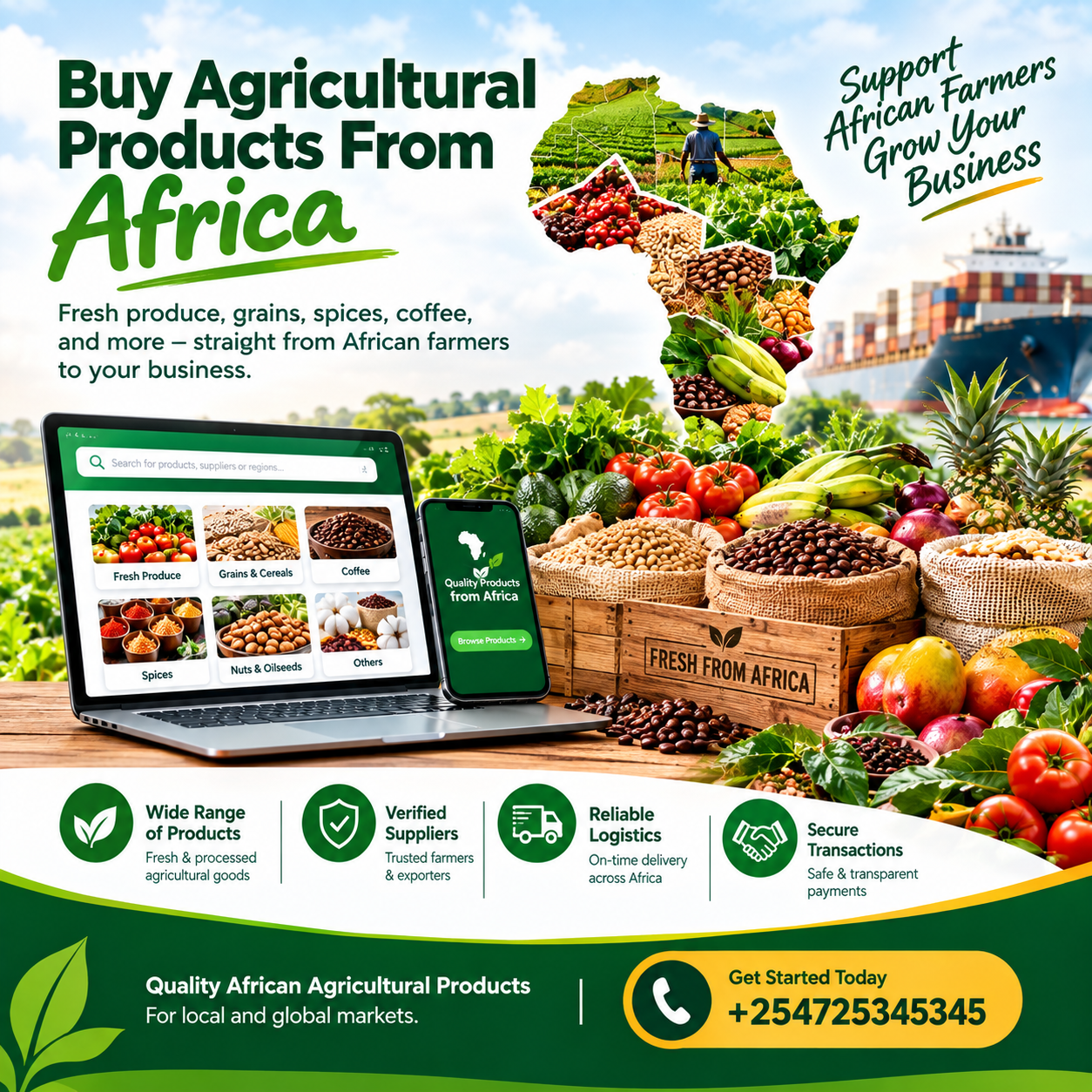
Buy agricultural products from Africa and you gain direct access to some of the world’s most sought-after foods — Ethiopian and Kenyan coffee, Ghanaian and Ivorian cocoa, Kenyan avocados and cut flowers, West African cashews, Egyptian citrus, Tanzanian cloves, and South African table grapes — often at prices meaningfully below comparable origins. For decades, tapping into this supply required a web of agents, repeated overseas trips, and insider knowledge that shut out most smaller buyers.
That era is over. Digital trade platforms, maturing certification systems, improving freight connections, and the African Continental Free Trade Area have combined to make it genuinely practical for any serious buyer — from a multinational food manufacturer to a one-person specialty import business — to buy agricultural products from Africa with verified suppliers, documented quality, secure payments, and full legal protection.
This guide is written for you, the buyer. It explains why African produce deserves a place in your supply chain, which products offer the strongest value, where each commodity is best sourced, how the buying process actually works from first inquiry to delivered container, what everything costs, how to pay safely, and how to sidestep the scams and quality failures that catch out first-time importers.
Whether your goal is a monthly container of avocados, an annual coffee program, or a diversified basket of specialty foods, everything you need in order to buy agricultural products from Africa successfully is laid out in the sections below.
Why Buy Agricultural Products from Africa?
Buyers around the world choose to buy agricultural products from Africa for five compounding reasons, and understanding them will help you position your sourcing strategy correctly from day one.
Counter-seasonal supply. Because harvest calendars in East, West, and Southern Africa run opposite to Europe and North America, African producers supply markets exactly when domestic and Northern Hemisphere sources are empty. Kenyan avocados flow from March to October, South African citrus fills the European summer gap, and Egyptian potatoes land just as Northern stocks run down. A buyer who builds Africa into the sourcing calendar converts months of empty shelves and import dependency into continuous availability.
Competitive landed pricing. Lower labor and land costs, abundant sunlight, and expanding production translate into FOB prices that frequently undercut alternative origins — sometimes dramatically. The gap has narrowed in some categories as global buyers compete for supply, but the fundamentals still favor sourcing from Africa rather than from higher-cost regions.
Origin stories that sell. Modern consumers pay premiums for provenance. Single-origin Ethiopian coffee, Ghanaian single-estate cocoa, Kilimanjaro-grown avocados, and Atlas Mountain olive oil are not just commodities — they are marketing assets. Retailers and roasters who buy agricultural products from Africa gain access to origin narratives that generic supply chains simply cannot offer.
A compliance revolution. The stereotype of informal, uncertifiable African supply is badly out of date. Certified GlobalG.A.P. acreage, HACCP-certified packhouses, organic conversion programs, and Rainforest Alliance sourcing now span the continent, and platforms that help buyers buy agricultural products from Africa surface those credentials up front so you can filter for compliance before you ever negotiate.
Radically easier access. This is the newest and most transformative reason. Where a buyer once needed agents and factory visits to even see the market, digital infrastructure now makes it possible to buy agricultural products from Africa the way you would buy from any modern supplier: search verified listings, compare certifications and prices, negotiate in writing, pay through protected channels, and track the shipment.
What Can You Buy? Africa’s Strongest Agricultural Products
Africa’s product range is enormous, but demand and export infrastructure concentrate around several proven categories. Here is what buyers most successfully source when they buy agricultural products from Africa, category by category.
Coffee. Ethiopia (the birthplace of arabica), Kenya (world-famous acidity and berry notes), Uganda (Africa’s largest producer), Tanzania, and Rwanda anchor the continent’s coffee offer. Buyers range from specialty roasters hunting 88+ cupping scores to commercial roasters securing volume at competitive prices. Green beans are the standard trade form, sold by grade — Kenyan AA and AB, Ethiopian washed and natural lots — through auctions or increasingly through direct digital channels that let roasters buy agricultural products from Africa farm by farm.
Cocoa. Côte d’Ivoire and Ghana together grow more than half the world’s cocoa, with Nigeria and Cameroon adding depth. Beyond bulk beans, growing numbers of buyers source single-origin and fine-flavor cocoa, cocoa butter, cocoa powder, and even finished craft chocolate — a value-added segment expanding fast among buyers with processing in mind.
Avocados and macadamia. Kenya (now among the world’s top avocado exporters), South Africa, Tanzania, Malawi, and Rwanda supply counter-seasonal Hass and Fuerte avocados plus premium macadamia kernels. Sea-freight technology has widened the reachable market, and these two categories are consistently among the fastest-growing for buyers who buy agricultural products from Africa.
Cashew and shea. Raw cashew nuts from Côte d’Ivoire, Ghana, Tanzania, and Nigeria feed Asian and African processing, while processed kernels and shea butter — from Ghana, Burkina Faso, and Mali — serve food, cosmetics, and personal-care buyers. Shea in particular has become a signature African ingredient for natural cosmetics brands.
Spices and herbs. Madagascar dominates vanilla and black pepper, Tanzania supplies cloves, Ethiopia offers ginger and cardamom, Egypt exports dried herbs at industrial scale, and West Africa contributes chili, hibiscus, and moringa. These are high-value, low-weight products — ideal first purchases for buyers learning to buy agricultural products from Africa because airfreight is affordable and risk per shipment is contained.
Fresh produce. Kenyan French beans, snow peas, and baby vegetables; Egyptian potatoes, onions, citrus, and strawberries; South African citrus, table grapes, apples, and stone fruit; Moroccan tomatoes; Ghanaian pineapples and bananas. Fresh produce rewards buyers who master seasonality and specification — and punishes those who don’t.
Grains, pulses, and oilseeds. Ethiopian sesame and chickpeas, Tanzanian pigeon peas, Malawian and Mozambican beans, West African groundnuts, and regional maize and rice markets all trade actively. Pulses and oilseeds are the classic training category for new buyers: storable, lower-risk, and simple to ship, which makes them a gentle entry point for anyone starting to buy agricultural products from Africa.
Flowers and ornamentals. Kenya and Ethiopia export roses, carnations, and summer flowers by air daily to Europe and the Gulf — the most logistics-intensive purchase in the catalog but also among the most profitable per kilogram.
Fish, honey, and specialty products. Nile perch and tilapia fillets from Uganda, Tanzania, and Kenya; premium honeys from Ethiopia and Zambia; gum arabic from Sudan; baobab powder, dried mango, and essential oils rounding out a specialty basket that grows every year and gives buyers ever more reasons to buy agricultural products from Africa across multiple categories.
Who Should Buy Agricultural Products from Africa?
One of the most common misconceptions is that only multinational importers can buy agricultural products from Africa. The reality is a far broader buyer landscape, and knowing where you fit helps you choose the right channel.
Importers and wholesale distributors are the volume backbone. They buy agricultural products from Africa in container loads, hold inventory, and resell to processors, packers, and retail — and they care most about price, reliability, and paperwork that clears customs without surprises.
Food and beverage manufacturers — chocolate makers, coffee roasters, juice processors, bakery groups, snack manufacturers — buy raw materials against fixed formulations. Their priority is specification consistency: the cocoa butter profile, the bean grade, the fruit brix level must land in the same range every month of the year.
Retail chains and specialty stores increasingly buy directly, sourcing private-label produce, single-origin coffee programs, and ethical supply chains with traceability they can market. For them, the decision to buy agricultural products from Africa is part procurement and part brand strategy.
Food service groups — hotel chains, restaurant groups, caterers, airlines — buy produce, spices, and specialty items against menus, prioritizing delivery timing and steady quality over lowest price.
Cosmetics, wellness, and pharma companies source shea butter, essential oils, baobab, hibiscus, moringa, and gum arabic, where certification, purity, and documentation are everything.
Small businesses, startups, and diaspora buyers are the fastest-growing segment. A specialty shop sourcing its first 200-kilogram coffee lot, a cosmetics startup ordering shea butter pallets, a diaspora retailer importing familiar staples — digital platforms have made it fully realistic for businesses at this scale to buy agricultural products from Africa, because consolidation services pool small volumes into shared containers and platforms enforce standards that protect small buyers from big risks.
Where to Buy Agricultural Products from Africa: The Six Sourcing Channels
Where you buy determines the risk you carry. These are the six channels through which buyers source from the continent, each with distinct economics.
1. Digital B2B marketplaces. The modern default, and the channel this guide recommends for most buyers. A quality marketplace lets you buy agricultural products from Africa with verified supplier credentials, standardized grades, written negotiations, escrow or protected payments, inspection options, and logistics built in — the same protections you expect from any mature e-commerce environment, applied to container trade.
2. Commodity auctions. Kenya’s flower auction is the world’s largest, and coffee auctions in Nairobi and Ethiopia’s exchange system set benchmark prices. Auctions offer transparent price discovery and immediate liquidity, though they favor experienced, high-frequency buyers.
3. Trade fairs and exhibitions. Gulfood in Dubai, SIAL and Anuga in Europe, and regional expos across Africa put hundreds of African exporters in one hall. Nothing replaces tasting samples face to face, and most serious trade relationships begin at fairs — but deals concluded there still need the documentation and protection that platforms provide when you subsequently buy agricultural products from Africa at volume.
4. Export promotion councils and national boards. Bodies such as national export promotion councils, coffee and tea boards, and horticultural authorities maintain exporter directories, verify licenses, and often mediate disputes. They are free or cheap resources every buyer should use during due diligence before agreeing to buy agricultural products from Africa from any listed exporter.
5. Direct from cooperatives and exporters. For buyers with volume and experience, contracting directly with well-run cooperatives or established export houses yields the best prices and deepest relationships — provided you impose your own verification, contracts, and inspection discipline.
6. Agents and brokers. Traditional intermediaries still move large volumes and can be valuable in opaque markets, but their incentives are commissions, not your quality outcomes — so independent inspection and protected payment remain essential if you buy agricultural products from Africa through them.
How to Buy Agricultural Products from Africa: The Step-by-Step Process
Here is the complete purchase journey, from first search to goods on your shelf. Follow it in order and you avoid the errors that sink most first-time buyers who buy agricultural products from Africa without preparation.
Step 1: Define your specification precisely. Write down the product, grade or quality standard, quantity, packing format, target price, required certifications, and delivery window before contacting anyone. “I need 10 tonnes of Hass avocado, count 16–20, GlobalG.A.P., packed 4kg cartons, FOB Mombasa, first shipment June” is a specification; “I’m looking for avocados” is a time waster. Every serious attempt to buy agricultural products from Africa starts with a document like this.
Step 2: Find and vet suppliers. Search platforms, directories, and council lists; shortlist five to ten suppliers; then verify each one — company registration, export license, certifications (check certificate numbers with issuing bodies), references, and transaction history where available. On a reputable platform you can buy agricultural products from Africa knowing this verification layer has already been done for you, but repeat it independently for any off-platform supplier.
Step 3: Request quotes and compare on equal terms. Send your specification to the shortlist and require every quote on the same Incoterm (usually FOB) so prices compare like-for-like. This is where the market teaches you its real price level.
Step 4: Sample and approve. Never skip this. Courier samples, taste them, lab-test where relevant — moisture, defects, pesticide residues, aflatoxin for nuts and grains — and document the approved reference sample. It becomes your quality benchmark and your evidence in any dispute, which is why professionals who buy agricultural products from Africa treat sampling as sacred.
Step 5: Contract in writing. A proper purchase contract specifies product and grade, quantity and tolerance, price and currency, Incoterm, delivery schedule, payment terms, inspection rights, and dispute mechanism. Whether your first order is one pallet or ten containers, the discipline is identical.
Step 6: Pay safely. Match the payment instrument to the trust level — the options are detailed in the payments section below. The golden rule when you buy agricultural products from Africa for the first time: never pay 100% upfront to an unverified counterparty through informal channels.
Step 7: Inspect before shipment. Engage an independent inspector — SGS, Bureau Veritas, Intertek, or a platform-appointed inspector — to verify quality, quantity, and packing against your contract before goods leave the port or packhouse. Pre-shipment inspection is the single most effective protection in cross-border produce buying.
Step 8: Ship, clear, and receive. Track the freight, prepare your import documentation in advance, clear customs at destination, inspect on arrival, and confirm final payment release. Then rate the supplier, file every document, and — if the experience was good — open the conversation about a repeat program, because that is where the real economics live for buyers who buy agricultural products from Africa year after year.
Quality, Grades, and Certifications Every Buyer Should Require
Quality assurance is where amateur buyers fail and professional buyers quietly win. When you buy agricultural products from Africa, these are the standards and documents that should appear in your checklist.
Farm-level certification. GlobalG.A.P. is the baseline for fresh produce into European retail; organic (EU or USDA) for the premium organic segment; Rainforest Alliance and Fairtrade for coffee, cocoa, tea, and bananas where ethical sourcing is a customer requirement. Verify certificate validity — registrations lapse, and a certificate number you can check with the issuing body is the only proof that counts when you buy agricultural products from Africa from a new supplier.
Facility-level certification. HACCP and ISO 22000 for packhouses and processors; BRCGS where your customers are UK or EU retailers. If you buy agricultural products from Africa that are packed or processed, these matter as much as farm certification.
Shipment-level documentation. Every legitimate consignment carries a phytosanitary certificate (issued by the exporting country’s plant-protection authority), a certificate of origin, a commercial invoice, a packing list, and the transport document — bill of lading or airway bill — plus fumigation certificates for grains and wood packaging, and health certificates for animal products. Missing documents at destination are the most common cause of customs pain for buyers who buy agricultural products from Africa without checking the paperwork in advance.
Grade standards. Learn the grade language of your product: Kenyan coffee grades (AA, AB, C), avocado counts and dry-matter percentages, cashew kernel grades (W180 through W320), sesame purity percentages, cocoa bean counts. Buyers who specify grades precisely get what they asked for; buyers who don’t get whatever arrives.
Third-party inspection. For higher-value or first-time trades, budget for independent inspection at loading — typically a few hundred dollars, trivially cheap insurance against a failed container. Most platforms through which buyers buy agricultural products from Africa can arrange this as part of the transaction, which is precisely why they exist.
Payments, Incoterms, and Protecting Your Money
Money mechanics are the second place first-time buyers stumble. Master these two areas and your risk profile drops dramatically the next time you buy agricultural products from Africa.
Incoterms — who pays for what. EXW (ex-works) means you collect the goods from the supplier’s premises and handle everything — cheapest on paper but heaviest on you. FOB (free on board) means the supplier delivers goods cleared onto the vessel at the named port, and you take over from there — the workhorse term for buyers who buy agricultural products from Africa, offering control of freight without local logistics headaches. CIF (cost, insurance, freight) bundles sea freight and insurance into the supplier’s price — convenient but usually more expensive than booking freight yourself. DAP delivers to your door. Most new buyers should start at FOB.
Payment instruments, ranked by security. Irrevocable letters of credit protect both sides — the bank pays only against documents proving shipment — and suit larger trades, though they cost fees and require paperwork discipline. Escrow through a marketplace platform holds your funds until you confirm receipt, and is the simplest strong protection for small and mid-size purchases; it is the default mechanism when you buy agricultural products from Africa through a structured platform. Telegraphic transfer with staged payments — 30–50% deposit, balance against shipping documents or on arrival — is common with established suppliers. Documentary collection rides the banking system at low cost but offers less control. Open account (pay after delivery) is for relationships that have earned it.
Currency and hedging. Quotations are typically in US dollars or euros. Build a currency cushion into your margin planning, and consider forward contracts for large annual programs — especially if you buy agricultural products from Africa on contracts that pay out months ahead.
One non-negotiable rule. Whatever the instrument, align payment milestones with verified events — deposit against contract, balance against inspection report or shipping documents, final release on arrival confirmation. Buyers who decouple payments from verifiable milestones are the ones who end up in disputes; buyers who buy agricultural products from Africa through platforms that enforce milestone-linked escrow rarely do.
Shipping Your Purchase: Logistics from Farm to Your Warehouse
Freight is the least glamorous part of the journey and the one that most shapes your landed cost and product quality every time you buy agricultural products from Africa.
Sea freight. The default for anything non-urgent: grains, pulses, cocoa, coffee, cashew, frozen fish, and increasingly even avocados in refrigerated containers. Full container loads suit volumes above roughly 12–15 tonnes; less-than-container load (LCL) and buyer consolidation services — where several small orders share one container — have opened sea freight to buyers whose first orders are just a few pallets. Indicative transit times: Mombasa to Rotterdam about 25–30 days, Tema in Ghana to Antwerp about 12–18, Durban to Shanghai about 25–35. Build buffer weeks into your planning; ports and schedules are variable.
Air freight. For flowers, tender vegetables, berries, high-value spices, and urgent top-ups. Nairobi and Addis Ababa are among the world’s great air-cargo hubs for horticulture. Airfreight costs several times sea freight per kilogram, so it suits products where speed preserves value worth more than the freight premium — a calculation every buyer must make before choosing to buy agricultural products from Africa in fresh rather than processed form.
Cold chain. Perishables demand unbroken temperature control — pre-cooling at origin, reefers at sea, chilled handling at destination. When you buy agricultural products from Africa as fresh produce, ask explicitly how the cold chain is managed at each handoff and request temperature logs with the shipment; serious suppliers answer without hesitation.
Destination customs and duties. Your landed cost includes import duty and VAT at destination — and here Africa often holds another advantage. Under the EU’s Everything-But-Arms arrangement, most goods from least-developed African countries enter duty-free; AGOA provides preferential US access for many countries; and general GSP schemes cover others. Check your country’s regime for the product and origin before finalizing your cost model. An experienced customs broker at destination is worth their fee the first time, every time — and platforms through which buyers buy agricultural products from Africa increasingly generate the document pack that makes clearance routine.
The Best African Countries to Source Each Product
Match your product to its strongest origin and you get better quality, better prices, and smoother logistics — the short geography of buying well when you buy agricultural products from Africa.
Kenya leads for avocados, cut flowers, macadamia, black tea, specialty coffee, and French beans — the continent’s most export-polished horticulture ecosystem with daily freight connections.
Ethiopia is the source for distinctive coffee, sesame, chickpeas, Niger seed, spices, and growing flower volumes; its coffee is unmatched for genetic diversity and origin character.
Ghana and Côte d’Ivoire dominate cocoa, with both countries expanding into processed cocoa, cashew, and — in Ghana’s case — shea, pineapple, and yams.
Tanzania and Mozambique supply cashew, pigeon peas, beans, and — in Tanzania’s case — cloves and avocados. Uganda anchors robusta coffee, vanilla, fish, and grains. Nigeria offers sesame, ginger, groundnuts, and hibiscus at scale. Senegal, Mali, and Burkina Faso round out groundnut and shea supply — a deep bench for any buyer planning to buy agricultural products from Africa across multiple origins.
South Africa delivers fully commercialized fruit — citrus, table grapes, apples, pears, stone fruit — plus wine, nuts, and subtropical produce, with the continent’s most sophisticated cold chain and port infrastructure. Egypt is the powerhouse for citrus, potatoes, onions, strawberries, and dates. Morocco for citrus, tomatoes, olive oil, and argan. Zambia, Zimbabwe, and Malawi add maize, sugar, tobacco, macadamia, and pulses. Buyers who buy agricultural products from Africa across several countries consistently report the same lesson: origin specialization matters, and the best suppliers in each country’s strongest categories outperform generalist traders by a wide margin — which is why experienced importers rarely limit themselves to one origin when they buy agricultural products from Africa for year-round programs.
What It Costs to Buy Agricultural Products from Africa
Exact prices move with global markets, seasons, and harvests — so treat these figures as structure rather than gospel, and always work from live quotes before you buy agricultural products from Africa at volume.
Product price tiers. Coffee spans from commercial-grade arabica at commodity levels to specialty microlots at multiples of that. Cocoa trades against an international exchange price with origin and quality differentials. Sesame, pulses, and groundnuts price in the low dollars per kilogram. Processed kernels — macadamia and cashew — command mid-tier premiums. Specialty items like vanilla, essential oils, and baby vegetables sit at the top of the range. The reliable approach is to benchmark against exchange prices and published origin differentials, then negotiate within a realistic band rather than chasing fantasy prices.
The landed-cost formula. Product FOB price + ocean or air freight + insurance + import duty (often zero under preference schemes) + destination charges + inland transport + customs clearance + financing costs. New buyers routinely forget two or three of these lines and discover their “cheap” purchase was only cheap at the port. Build the full model before you buy agricultural products from Africa and commit funds.
Hidden costs to anticipate. Pre-shipment inspection, certificates, pallet and packing materials, port storage if documents delay clearance, demurrage if containers sit too long, and quality allowances. Experienced buyers who buy agricultural products from Africa add a 5–10% contingency on the first shipment of any new product–origin pair, then tighten it once the lane is proven.
Buyer Risks: How to Avoid Scams and Quality Disasters
Cross-border produce buying carries real risks, and honesty about them is what makes the protections meaningful for anyone planning to buy agricultural products from Africa.
The red flags of a bad counterparty. Prices dramatically below market — the oldest scam in the book; refusal to allow independent inspection or samples; pressure for full prepayment via informal channels; unverifiable company registration or certificates; business conducted only through personal messaging apps with no written record; vague specifications that shift as the deal progresses.
Any one of these warrants pause; two warrant walking away. Buyers who buy agricultural products from Africa through verified platforms are insulated from most of this by upfront vetting, which is exactly the platform’s core function.
Quality risks and their controls. Moisture content too high in grains (mold risk), aflatoxin in groundnuts and maize (a hard regulatory limit in the EU), pesticide residues above EU maximum residue levels in fresh produce, and grading drift between promise and delivery. The controls are the same four everywhere: precise written specifications, approved reference samples, third-party pre-shipment inspection, and staged payment tied to inspection results.
Logistics risks. Port congestion, cold-chain breaks, and document delays. Buffers, insurance, and suppliers with proven export track records are the answers — and choosing origins with strong freight connectivity matters more than saving a cent per kilogram.
Contractual risks. Side-selling — the supplier reselling your contracted goods when prices spike — and delivery shortfalls. Deposits held against performance, contracts with genuine penalty clauses, and multi-supplier sourcing spread the exposure. No experienced buyer who buy agricultural products from Africa routinely relies on a single supplier for a critical program, and neither should you when you first buy agricultural products from Africa at scale.
Turning a First Purchase into a Supply Program
The buyers who profit most from African sourcing treat the first order as an audition for a standing relationship, not a one-time chance to buy agricultural products from Africa cheaply.
Build the program deliberately. After a successful first delivery, move quickly to a framework agreement: annual volumes with monthly call-offs, agreed pricing formulas — fixed, or exchange-linked plus differential — quality bonuses, and shared forecasting. Suppliers invest in buyers who commit: better grading teams, priority allocation in short seasons, first refusal on new varieties. That preferential treatment is the quiet dividend earned by buyers who buy agricultural products from Africa consistently rather than opportunistically.
The seven classic buyer mistakes. Buying on price alone and paying for it in quality claims; ignoring the seasonal calendar and demanding product out of window; skipping samples to save a week; misunderstanding Incoterms and double-paying freight; underestimating transit time and running the shelves empty; depending on one supplier in one country; and treating documentation as the supplier’s problem when customs at destination is always the buyer’s responsibility. Every one of these is avoidable, and the buyers who buy agricultural products from Africa year after year are precisely the ones who systematized these lessons early.
Invest in the relationship. Visit your suppliers when you can, share your demand forecasts honestly, and pay on time without exception. In African trade culture — as in all trade — reliability is remembered, and the buyer who pays promptly and communicates clearly gets the supplier’s best product first, every season.
The Future for Buyers Who Source from Africa
The trajectory favors buyers who build African supply chains now. Traceability regulation such as the EU’s deforestation rules is making documented origin a market-access requirement — an environment where digital sourcing with built-in records outcompetes informal brokering, and where buyers who buy agricultural products from Africa through documented channels gain a compliance advantage rather than a burden.
Expect AI-driven matching to shorten supplier discovery to days, embedded trade finance to ease cash-flow friction on both sides, sustainability and carbon premiums to attach to verified production data, and intra-African processing to move the product mix steadily toward finished and semi-finished goods.
The continent’s share of global agricultural trade remains far below its production potential — and gaps that wide, backed by rising global demand and maturing digital rails, do not persist for long. Buyers who establish verified supplier networks today will hold relationships and compliance histories that latecomers cannot simply buy their way into.
Frequently Asked Questions
Do I need an import license to buy agricultural products from Africa?
It depends on your country and product. Most jurisdictions require a basic import registration for food businesses, with additional licenses or registrations for animal products, certain plants, and regulated items. Check with your national food authority and customs service before your first order — and note that the export side (the supplier’s licenses and phytosanitary certification) is their responsibility, not yours.
What is the minimum order quantity, and can small businesses participate?
Traditional exporters often wanted full container loads, but the market has changed. Consolidation services and digital marketplaces now let small buyers purchase from single pallets upward by sharing container space, and many suppliers accept smaller trial orders from buyers with growth potential. Starting small is actually recommended — prove the lane, then scale.
How do I verify that a supplier is legitimate?
Check company registration with the national registrar, confirm export licenses with the relevant board or council, validate certification numbers directly with certifying bodies — GlobalG.A.P. and organic databases are publicly searchable — ask for references from other buyers, and use platforms that pre-verify their suppliers. Legitimate exporters expect and welcome verification.
What documents should accompany every shipment?
At minimum: commercial invoice, packing list, phytosanitary certificate, certificate of origin, and the bill of lading or airway bill — plus fumigation certificates for grains, health certificates for animal products, and any certificates your contract specifies, such as organic, GlobalG.A.P., or Fairtrade. Review the document set before the goods ship, not when they arrive.
How long does the whole process take, from order to delivery?
For a first order: supplier vetting and sampling add two to four weeks, production and collection one to three weeks depending on product, and sea freight one to five weeks depending on lane — so plan eight to twelve weeks end to end. Repeat orders on established lanes compress dramatically, often to the production and transit time alone.
Which payment method should a first-time buyer use?
Escrow through a reputable platform or an irrevocable letter of credit — both tie payment to verified events. Once a relationship has several clean transactions behind it, staged telegraphic transfer becomes practical and cheaper.
What happens if the goods arrive below specification?
This is why the contract, the approved sample, and the pre-shipment inspection report exist. With inspection evidence, you can claim against the supplier, the insurer, or withheld funds — depending on your payment structure. Without them, you are relying on goodwill. Professionals document everything precisely because claims without evidence are just complaints.
Is buying directly from African farmers possible for small buyers?
Through cooperatives and farmer groups, yes — and it is increasingly common for specialty buyers such as roasters, chocolate makers, and cosmetics brands to contract directly with cooperative unions. Expect to handle more communication and coordination yourself, and use platform escrow and inspection services to protect the transaction.