
B2B Agriculture Platform Africa: Digital Agricultural Trade for Agribusinesses
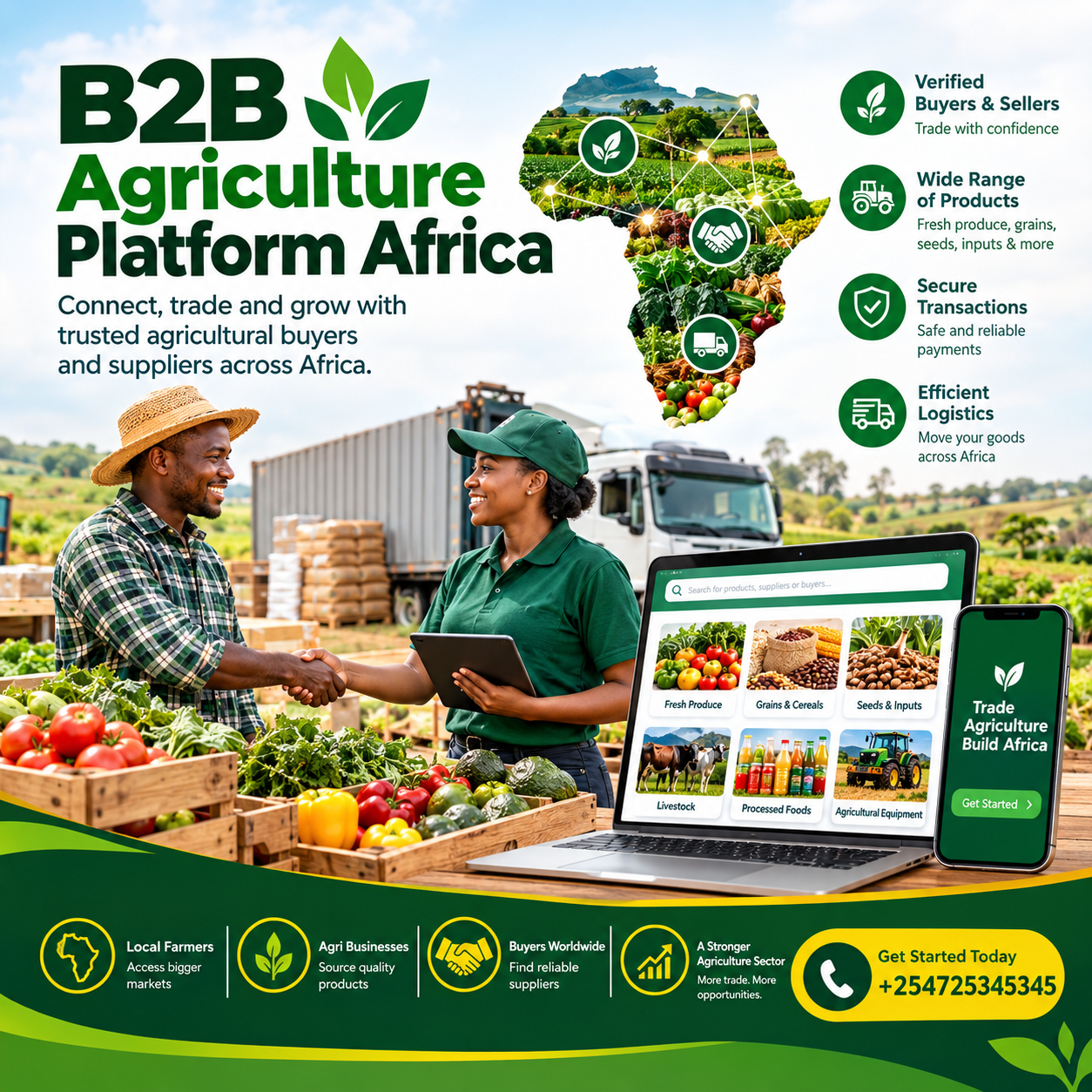
A B2B agriculture platform Africa can depend on is quietly reorganizing the continent’s food economy — not farm by farm, but business by business.
While consumer apps fight over grocery deliveries, the real money in African agriculture moves between businesses: farmers selling to aggregators, aggregators selling to processors, processors supplying manufacturers, and distributors feeding hotels, hospitals, schools, and supermarket chains.
These business-to-business transactions have always been enormous in volume and painfully inefficient in execution — arranged through phone calls, broker networks, handshake deals, and cash payments that leave no records and offer no protection.
A purpose-built B2B agriculture platform Africa replaces that fragility with structure: verified trading partners, documented agreements, secure payments, organized logistics, and data that makes every subsequent deal smarter than the last.
This guide is written for the businesses at the center of that transformation. Whether you run a commercial farm, manage a cooperative, operate a food processing plant, buy produce for a hotel group, distribute seed and fertilizer, or finance agricultural trade, you will learn exactly how a B2B agriculture platform Africa works, who uses it, what features actually matter, how the money flows, and how to get started.
The goal is practical clarity: by the end of this article, you should be able to evaluate any platform on the market and know precisely how it fits into your operation.
What Is a B2B Agriculture Platform Africa?
A B2B agriculture platform Africa relies on is a digital system where companies trade agricultural goods and services with other companies — in bulk, under contract, and with the compliance, credit, and logistics machinery that business trade demands.
The keyword here is business: the counterparties are not weekend shoppers but procurement managers, cooperative chairmen, agro-dealers, factory buyers, and export houses, each transacting in tonnes rather than kilograms and in contracts rather than carts.
What distinguishes this model from a simple listings website is depth of integration. A serious B2B agriculture platform Africa typically provides:
- Verified business accounts — company registration, licenses, and certifications checked before trading begins.
- Request-for-quotation (RFQ) tools that let a buyer describe exactly what it needs and receive structured offers from multiple suppliers.
- Contract management — agreed volumes, delivery schedules, pricing formulas, and quality specifications stored and enforced digitally.
- Bulk pricing and negotiation workflows designed for tonnes, truckloads, and season-long supply programs.
- Credit and payment instruments — escrow, trade credit, warehouse receipts, and financing partnerships.
- Logistics coordination — aggregation, transport booking, cold chain, and delivery confirmation inside the same system.
- Data and analytics — price histories, demand trends, and performance dashboards that turn every trade into intelligence.
For an agribusiness, adopting a B2B agriculture platform Africa offers is not a marketing experiment. It is a procurement and sales infrastructure decision — comparable to a manufacturer adopting ERP software — because it changes how the business finds partners, prices goods, manages risk, and proves its reliability to banks and bigger clients.
How a B2B Agriculture Platform Africa Differs from Consumer Marketplaces and Export Platforms
The African agri-digital space now includes consumer grocery apps, farmer-facing advisory services, and export marketplaces, so it is worth drawing the boundaries precisely.
A consumer marketplace sells small quantities to individuals, with same-day delivery and impulse pricing. A B2B agriculture platform Africa operates in a different universe: negotiated prices, repeat contracts, quality specifications, invoicing, and credit terms measured in weeks.
A restaurant group ordering two tonnes of potatoes weekly does not browse product pages; it runs an RFQ, compares verified suppliers, and locks a seasonal contract with delivery schedules.
An export marketplace, by contrast, specializes in cross-border and overseas trade — phytosanitary certificates, international freight, letters of credit.
A B2B agriculture platform Africa covers domestic and regional business trade, which is where the overwhelming majority of African agricultural volume actually moves: maize to millers, milk to processors, tomatoes to urban wholesalers, poultry to institutional kitchens. Export is the tip of the value chain; B2B domestic trade is the body of it.
The distinction matters because the mechanics differ. Domestic B2B trade runs on mobile money and bank transfer rather than letters of credit; on truck logistics and aggregation centers rather than airfreight; on business licenses and food-safety compliance rather than GlobalG.A.P. certification for every player.
A B2B agriculture platform Africa is engineered around those realities — which is precisely why it works where generic tools fail.
Who Uses a B2B Agriculture Platform Africa: The Full Cast of Players
The power of the model comes from the diversity of businesses it connects. Each participant type arrives with different needs, and a well-designed B2B agriculture platform Africa serves them all from one infrastructure.
Producers and cooperatives. Commercial farms and farmer groups use the platform to find buyers they would never reach through brokers, secure forward contracts before harvest, and build a documented sales history that unlocks financing. For a cooperative aggregating hundreds of smallholders, a B2B agriculture platform Africa account becomes the group’s storefront, contract book, and payment record in one.
Aggregators and traders. The middle of the chain — often vilified, always essential — gains the most operational discipline. Aggregators source from many farms, store, grade, and deliver to large buyers, and the platform gives them working-capital tools, transport booking, and a reputation system that converts their reliability into business.
Processors and manufacturers. Millers, dairies, juice plants, oil pressers, and animal-feed factories need raw material at predictable volumes and grades. Sourcing through a B2B agriculture platform Africa replaces dozens of weekly phone calls with structured procurement: publish requirements, receive offers, contract, receive, pay, and repeat.
Institutional buyers. Hotel groups, hospital networks, schools, catering companies, airlines, and supermarkets — collectively the largest stable demand in any food economy — use platforms to consolidate fragmented supply into accountable programs with documented food safety.
Input companies and agro-dealers. Seed, fertilizer, crop protection, veterinary products, and equipment all move B2B — from manufacturer to distributor to agro-dealer to cooperative. A B2B agriculture platform Africa increasingly carries this trade too, giving manufacturers channel visibility and giving dealers structured stock purchasing with credit.
Logistics and storage providers. Transporters, warehouse operators, and cold-chain companies list capacity and win return loads, turning the platform into a two-sided freight market alongside the produce market.
Financial institutions. Banks, microfinance institutions, and insurers plug in as service providers, reading transaction data to price working-capital loans, input credit, and cargo insurance far more accurately than any rural branch ever could.
Why Africa’s B2B Agricultural Middle Was Broken — and Why Digitization Fixes It
Every African economy runs on agriculture, yet the business layer connecting farms to food companies remains the least digitized, least documented, and least financed part of the chain. That is the gap a B2B agriculture platform Africa exists to close.
The traditional system fails in predictable ways. Information asymmetry means a processor in one city and a cooperative two hundred kilometers away have no idea of each other’s existence, so deals happen only where personal networks reach — and prices reflect negotiation power, not market reality.
Informality means most transactions generate no records, which makes trade finance impossible: a trader moving a hundred tonnes a month has no auditable history, so banks price him as a stranger. Fragmentation means institutional buyers spend enormous sums on procurement staff whose main job is chasing suppliers by phone, while quality disputes burn relationships because nothing was ever written down.
And risk asymmetry means one side usually carries all of it — the farmer who delivers and waits months for payment, or the buyer who pays deposits into the void.
A structured B2B agriculture platform Africa attacks each failure directly. Discovery becomes searchable rather than social. Transactions become documented by default, creating the data trail that credit is built on. Contracts, inspections, and delivery confirmations become system features rather than favors.
Payment becomes escrowed, scheduled, and enforced. None of this is exotic technology — it is disciplined commerce infrastructure, and its absence has been the single biggest tax on African agricultural trade.
Key Features of a Modern B2B Agriculture Platform Africa
Evaluating platforms requires knowing what genuinely matters. These are the capabilities that separate serious infrastructure from glorified noticeboards, and any B2B agriculture platform Africa worth adopting will offer most of them:
- Verified business onboarding. Company documents, TIN or tax registration, licenses, and facility photos checked before an account can trade. Verification is the platform’s core product; without it, everything else is decoration.
- Structured listings and RFQs. Sellers publish offers with grade, volume, location, and price; buyers publish requirements and receive comparable quotes. The RFQ is the workhorse of B2B trade, and a capable B2B agriculture platform Africa makes it effortless.
- Contract and order management. Seasonal supply agreements, delivery schedules, partial deliveries, and quality tolerances tracked digitally, so both sides always know exactly where a contract stands.
- Escrow and milestone payments. Funds locked at order and released on confirmed delivery — the mechanism that lets strangers trade like partners.
- Credit tools. Trade credit between verified parties, input financing for agro-dealers, and working-capital products underwritten by transaction history.
- Integrated logistics. Transport booking, aggregation point management, and proof-of-delivery built into the order flow.
- Quality grading standards. Shared definitions of Grade A versus Grade B so a buyer in Mombasa and a seller in Eldoret negotiate the same product.
- Analytics dashboards. Price trends, seasonal demand curves, and counterparty performance scores that sharpen every subsequent negotiation.
- API and ERP integration. For large buyers, procurement data flowing directly into their accounting systems — the feature that makes a B2B agriculture platform Africa part of the corporate stack rather than a side channel.
- Multichannel access. Web for managers, app for field staff, USSD for rural participants — because B2B trade in Africa crosses every kind of device.
How a B2B Agriculture Platform Africa Works: The Anatomy of a Trade
The transaction flow is built for volume and repetition. Here is how a typical deal executes on a mature B2B agriculture platform Africa:
- Onboarding and verification. Both businesses register with registration certificates, licenses, and references. Verification typically takes days, not weeks, and once complete it never needs repeating.
- Discovery. A buyer searching for 40 tonnes of Grade A maize filters by grade, volume, location, certification, and rating — or posts an RFQ and lets suppliers come to it. This is the step where a B2B agriculture platform Africa saves weeks of phone work.
- Negotiation. Price, volume, delivery schedule, quality tolerances, and payment terms are agreed inside the platform, in writing, with a full audit trail.
- Contracting. The deal converts into a digital contract with delivery milestones — one truckload this week, three next month — and agreed quality inspection points.
- Payment or credit. The buyer funds escrow, or the platform extends trade credit based on the buyer’s verified history. The seller ships knowing money is secured.
- Fulfillment. Produce is aggregated, transported, and delivered with digital proof at each handoff; quality is checked against the contract specification at agreed points.
- Settlement and rating. Escrow releases on confirmation, invoices reconcile automatically, and both parties rate each other. The completed trade becomes data — feeding credit scores, search ranking, and future negotiations on the B2B agriculture platform Africa.
Multiply that flow by hundreds of counterparties and repeat it monthly, and the platform’s compounding value becomes obvious: every trade makes the next one faster, cheaper, and safer.
Institutional Procurement: How Hotels, Hospitals, and Manufacturers Buy Through a B2B Agriculture Platform Africa
Institutional buyers are the demand anchor of the entire model, and their procurement pain is what makes platforms indispensable.
Consider a hotel chain with fifteen properties across a country. Each property buys vegetables, dairy, eggs, and fruit weekly; each currently negotiates with a tangle of local suppliers by phone; each keeps paper records that no finance department can audit cleanly.
Moving that procurement onto a B2B agriculture platform Africa transforms the function: standardized specifications across all properties, competitive quotes on every order, delivery confirmations that reconcile automatically with payments, supplier performance tracked by property and by product, and a food-safety paper trail that protects the brand. Procurement staff stop chasing trucks and start managing contracts.
Manufacturers feel an even sharper version of the same pain. A flour miller that needs 500 tonnes of wheat monthly cannot tolerate supply gaps, and quality variance directly hits production yield.
Through a B2B agriculture platform Africa, the miller contracts season-long supply programs with several verified aggregators, monitors delivery performance in real time, and switches volumes toward reliable suppliers without renegotiating from scratch — procurement as a managed portfolio rather than a crisis at every harvest.
Hospitals and school networks add a regulatory layer: documented sourcing is increasingly a compliance requirement, not a preference. The platform’s automatic records satisfy auditors with zero additional effort.
Across all these institutions, the pattern is identical — structured procurement reduces cost, risk, and managerial burden simultaneously, which is why institutional adoption is the strongest signal that a B2B agriculture platform Africa has reached genuine maturity.
Input Supply and Distribution: The Other Side of a B2B Agriculture Platform Africa
Agricultural trade flows in two directions, and the input side — seed, fertilizer, crop protection, veterinary products, equipment, and packaging — is as B2B as trade gets.
Today that channel is opaque and expensive. Manufacturers sell to national distributors, who sell to regional wholesalers, who sell to agro-dealers, who sell to farmers — four or five margins stacked on products that arrive with no guarantee of authenticity and no visibility for the manufacturer about who actually bought what. Counterfeit inputs, a chronic problem across the continent, thrive in exactly this darkness.
A B2B agriculture platform Africa carrying input trade changes the economics. Manufacturers list products at structured wholesale tiers; verified agro-dealers and cooperatives order directly with documented pricing; stock movements become visible channel data for the manufacturer; and batch numbers attached to every order give farmers a way to verify authenticity.
Add credit — dealers ordering stock on financing underwritten by their platform sales history — and the input channel stops being a liquidity trap for everyone except the manufacturer.
The synergy with the produce side is the quiet masterstroke: a cooperative that sells maize through the platform has a verified income history, which makes it exactly the kind of customer an input company can safely extend seed-and-fertilizer credit to, repayable at harvest from platform proceeds.
Each side of a well-run B2B agriculture platform Africa finances the other, and the platform sits at the center of the loop collecting the data that makes it all possible.
Contract Farming and Off-Take Agreements on a B2B Agriculture Platform Africa
The deepest form of B2B trade is the forward contract: buyer and producer agree today on volumes, grades, and prices for produce that will be delivered months from now. Contract farming has existed in Africa for decades — in sugar, tea, tobacco, and poultry — but it has always been expensive to administer and easy to break. Digital platforms are industrializing it.
On a B2B agriculture platform Africa, an off-take agreement becomes a living digital contract: acreage and expected volumes registered at planting, input credit disbursed against the contract, progress monitored through season, delivery schedules fixed before harvest, and payment released per delivery with escrow protection.
Side-selling — the farmer who breaches the contract when spot prices spike — is deterred not by legal threats but by platform economics: contract performance builds a score that determines access to credit, premium buyers, and better terms next season. Dishonesty stops paying.
For buyers, forward contracts through a B2B agriculture platform Africa mean supply certainty and hedgeable costs. For producers, they mean a guaranteed market before the first seed goes into the ground — which, for a smallholder deciding whether to invest in certified seed, is the difference between planting for hope and planting for a known buyer.
Financial institutions, meanwhile, will happily finance a contract-backed crop that they would never finance as an unsecured gamble. Contract farming digitization is arguably the single highest-value function of the entire platform category.
Embedded Finance: How a B2B Agriculture Platform Africa Unlocks Capital
Agricultural businesses are chronically underfinanced not because money is absent but because information is. Lenders cannot see the business, so they cannot price the risk, so they either refuse or charge prohibitive rates. The platform’s transaction data changes the equation completely.
The financial products that flow naturally from a mature B2B agriculture platform Africa include:
- Working-capital loans for traders and aggregators, sized by their verified monthly throughput.
- Input financing for producers, repaid from harvest sales through the platform.
- Invoice discounting, letting a supplier with a confirmed institutional order receive most of the cash immediately instead of waiting out the buyer’s payment cycle.
- Warehouse receipt financing, where stored, graded produce in a certified facility serves as loan collateral — allowing farmers to sell months after harvest instead of dumping everything at the seasonal price trough.
- Trade credit between verified counterparties, with the platform managing limits, terms, and collections.
- Insurance products — cargo, weather, and livestock — distributed through the same rails.
The decisive feature is underwriting quality: a lender looking at twelve months of platform history knows volumes, prices, counterparty reliability, and seasonal patterns — better information than most urban businesses can offer. This is why the platform-plus-finance combination is expanding fastest in markets where mobile money penetration is deepest, and why the most valuable B2B agriculture platform Africa assets are not their listings but their data.
Data, Analytics, and Supply Chain Visibility on a B2B Agriculture Platform Africa
Every trade generates information, and aggregated information becomes market intelligence nobody else possesses.
For sellers, platform analytics answer the questions that used to be guesswork: which grades move fastest, which buyers pay on time, which months demand peaks, and what prices similar volumes achieved last season. A cooperative planning its planting calendar with demand data from a B2B agriculture platform Africa is running agriculture as a business, not a lottery.
For buyers, dashboards reveal supplier concentration risk, price seasonality worth exploiting, and quality trends by source region. A processor that can see its entire supply base on one screen — volumes contracted, delivered, pending, and disputed — manages supply the way a finance department manages cash.
For the market as a whole, the platform becomes a price-discovery engine. Published transactions and transparent histories pull prices toward their true market level, draining the information premium that brokers have collected for generations.
Governments and development agencies increasingly tap this data for food-security monitoring and market policy — one more reason regulators have shifted from hostility toward the platform model to active encouragement of a well-run B2B agriculture platform Africa ecosystem.
Logistics and Aggregation: The Physical Layer of a B2B Agriculture Platform Africa
Software cannot move a truckload of potatoes, and every serious platform eventually confronts this truth. The physical layer — aggregation, transport, storage, and cold chain — is where digital B2B trade either delivers or disappoints.
Aggregation is the first pillar. Smallholder production is dispersed in quantities too small for efficient B2B movement, so platforms support aggregation centers in farming clusters where produce is collected, weighed, graded, and consolidated into truck-scale lots. On a B2B agriculture platform Africa, the aggregation center is often also the quality-inspection point where contract specifications are verified before goods move onward.
Transport is the second pillar. Platforms partner with transporter networks — from three-wheeler couriers for last-mile urban delivery to long-haul fleets for cross-border loads — and let users book capacity as part of the order. Return-load matching, where a truck that delivered maize northbound carries avocados southbound, cuts transport costs for everyone and makes the difference between profitable and unprofitable margins on low-value commodities.
Storage and cold chain form the third pillar. Certified warehouses enable warehouse-receipt financing; solar-powered cold rooms at aggregation points protect horticulture, dairy, and fish; and temperature logs attached to deliveries let buyers trust perishable claims made through a B2B agriculture platform Africa rather than gambling on them. Platforms that solve the physical layer win loyalty that no discount can buy — because the trade only works when the truck actually arrives.
Commodities Best Suited to a B2B Agriculture Platform Africa
Business trade concentrates in predictable categories, and each behaves differently on-platform.
Grains and oilseeds. Maize, wheat, rice, soybeans, sunflower, and groundnuts are the volume backbone of B2B trade: storable, gradeable, and consumed in bulk by millers and feed manufacturers. A single miller contract can sustain dozens of aggregator accounts on a B2B agriculture platform Africa for an entire season.
Horticulture. Tomatoes, onions, potatoes, cabbage, kale, and peppers are the high-frequency trade that keeps aggregation centers and urban distribution busy. Perishability makes speed of matching the decisive factor, and B2B volumes make every hour of delay expensive — ideal conditions for platform economics.
Dairy, poultry, and livestock. Milk moves daily on contract to processors; eggs and broilers move weekly to institutional kitchens and retailers; live animals trade with weight verification and health records attached. Platforms that solve inspection and cold chain in this category unlock some of the continent’s largest undocumented trade flows on a B2B agriculture platform Africa.
Roots, tubers, and pulses. Cassava, sweet potatoes, Irish potatoes, beans, and pigeon peas combine bulk volumes with moderate perishability — excellent onboarding categories for businesses new to digital trade.
Inputs and services. Seed, fertilizer, veterinary supplies, packaging, machinery, transport, and storage capacity all trade B2B, broadening the platform from a produce market into a full agribusiness exchange.
The common thread: any commodity with standardized grades, bulk volumes, and repeat institutional demand is natural platform territory, and the B2B agriculture platform Africa category expands every year as more of the chain digitizes.
The Regional Landscape: Where B2B Digitization Is Moving Fastest
Adoption varies across the continent, shaped by mobile money depth, infrastructure, and the structure of each region’s agricultural economy — and any ambitious B2B agriculture platform Africa tailors its model accordingly.
East Africa leads, powered by years of mobile money saturation and dense cooperative structures. Kenya’s horticulture and dairy sectors, Uganda’s grains and pulses, Tanzania’s maize surpluses, and Rwanda’s organized agriculture create constant B2B flows, and cross-border corridors between these markets give platforms a regional dimension from day one.
West Africa brings scale: Nigeria’s domestic demand alone can anchor a platform, while Ghana, Côte d’Ivoire, and Senegal add strong commodity depth in cocoa, cashew, groundnuts, and horticulture. The challenge is logistics across vast distances, so winning B2B agriculture platform Africa models anchor around Lagos, Accra, and Abidjan demand centers and expand along proven trade corridors.
Southern Africa pairs South Africa’s fully commercialized agriculture with emerging smallholder systems to the north, creating a natural B2B arbitrage — commercial surplus in one market meeting structural deficit in another. Platforms here compete on efficiency and data rather than basic access.
North Africa — Egypt, Morocco, Tunisia — combines intensive irrigation, strong processing sectors, and deep European trade links, with B2B digitization strongest in input distribution and processor procurement.
Intra-African trade under AfCFTA is the frontier: as customs procedures simplify, the platform that handles cross-border documentation, payments, and logistics will capture trade flows that historically died at borders.
How to Choose the Right B2B Agriculture Platform Africa
Platform selection is a business decision with season-long consequences. Run every candidate through this checklist before committing:
- Verification discipline. How rigorously are counterparties vetted? If anyone can register and trade instantly, disputes will eventually find you. A trustworthy B2B agriculture platform Africa checks businesses before money moves.
- Payment protection. Escrow, milestone releases, and documented dispute procedures should be defaults, not upgrades. Read the payment terms before your first trade, not after your first problem.
- Counterparty quality. Ask which major buyers and suppliers actively transact on the platform. Fifty verified, active businesses beat fifty thousand dormant accounts on any B2B agriculture platform Africa.
- Logistics reality. Can the platform actually book transport, arrange aggregation, and guarantee cold chain where you need it — today, not on a roadmap?
- Finance options. If your business needs credit, input financing, or invoice discounting, confirm the platform’s financial partnerships are live products, not press releases.
- Commodity and regional fit. The best platform for a grain trader may be wrong for a dairy processor; the best in one corridor may not serve another.
- Support quality. B2B trade runs on deadlines. Test response speed before you need it urgently — the truest measure of any B2B agriculture platform Africa.
How to Get Started: Onboarding Your Business Onto a B2B Agriculture Platform Africa
Adoption follows a short, disciplined path for both sides of the market.
For sellers and cooperatives:
- Organize your documents — registration certificate, licenses, and any quality certifications — before applying, so verification completes in days.
- Prepare product professionally. Graded, weighed, properly stored produce with clear photographs; buyers judging a B2B agriculture platform Africa listing are buying consistency, not charm.
- Start with one perfect order. A small, flawless first delivery builds the rating that unlocks bigger contracts.
- Convert one-off sales into contracts. Propose season-long supply to buyers who reorder — the repeat relationship is where the real revenue lives.
For buyers and institutions:
- Define specifications precisely — grades, volumes, delivery schedules, and inspection points — so RFQs return comparable offers.
- Onboard your procurement team properly, with ordering authority, approval limits, and reporting set up inside the platform.
- Pilot with one category before migrating all procurement; prove the savings on potatoes before betting the dairy program on a B2B agriculture platform Africa.
- Integrate and scale — connect the platform data to your accounting or ERP systems and expand category by category.
Businesses that treat onboarding seriously — rather than dabbling — typically see the payback within one or two procurement cycles.
Common Challenges — and How Platforms Solve Them
Honesty about friction is what makes the opportunity credible. These are the real obstacles and the working answers.
Digital literacy and change resistance. Procurement managers have habits; agro-dealers have decades of informal trading instincts. Leading platforms invest in field onboarding teams, training webinars, and patient support because adoption is earned one business at a time — a lesson institutionalized across every serious B2B agriculture platform Africa.
Trust deficits between strangers. Verification, escrow, ratings, and public dispute records are the answer — expensive to operate but constitutive of the product itself.
Payment defaults and side-selling. Escrow prevents the classic non-payment; performance scores, deposits, and premium access for reliable counterparties deter contract breaches. Every mature B2B agriculture platform Africa engineers loyalty to pay better than opportunism.
Infrastructure gaps. Roads, storage, and cold rooms do not appear because an app launched. Strong platforms concentrate on corridors where physical trade already flows and partner with existing logistics providers rather than promising coverage they cannot deliver.
Regulatory and tax friction. Formalization makes some businesses nervous about visibility. The sector’s response is demonstrating that documented trade wins financing and bigger contracts that informal trade can never access — value that outweighs visibility costs for serious operators.
Price volatility. Forward contracts, warehouse receipts, and transparent market data let businesses hedge and plan instead of gambling — turning volatility from a threat into a tradeable variable.
None of these challenges is unique to digital trade; the informal system suffers every one of them without data, escrow, or support. That comparison explains why adoption keeps compounding despite the friction.
The Future of the B2B Agriculture Platform Africa
The trajectory points toward deeper integration across the entire agricultural economy. Expect the average B2B agriculture platform Africa of the coming decade to function as a complete agribusiness operating system: procurement, sales, logistics, credit, insurance, certification, and advisory inside a single business account. Artificial intelligence will move from price forecasting to automated matching and personalized planning — telling a processor which regions will produce surplus next season and telling a cooperative which buyer to court. Warehouse receipt systems will mature into full commodity exchanges; carbon and sustainability premiums will attach to the same transaction data that documents shipments; and as AfCFTA implementation deepens, cross-border B2B trade will become routine rather than exceptional.
The structural math is what makes the story durable. Agriculture is the largest sector of most African economies and its business layer is the least digitized — precisely the combination that produces decade-long growth stories. The businesses that adopt early, build verified reputations, and accumulate transaction histories will hold advantages that latecomers cannot buy their way into, because on every B2B agriculture platform Africa, reputation compounds like interest.
Frequently Asked Questions
How is a B2B platform different from just using WhatsApp groups and brokers?
The difference is structure: verified counterparties, written contracts, escrow payments, delivery records, and dispute resolution. WhatsApp works until a deal goes wrong — at which point there is no evidence, no protection, and no recourse. A B2B agriculture platform Africa makes every trade documented and protected by default.
What size of business benefits most?
All sizes, differently. Small producers and cooperatives gain market access and credit histories; mid-size aggregators gain working capital and logistics; large institutions gain procurement efficiency and audit trails. The platform economy rewards every participant that brings reliability.
How long does verification take?
Typically a few days where business documents are in order. Once verified, an account’s reputation and history persist, so the one-time effort pays for years.
What fees should I expect?
Most platforms charge commission on completed transactions, with optional fees for logistics, featured listings, or financing products. Because commissions apply only to successful trades, the platform earns when you earn — a structure far friendlier to businesses than upfront subscription charges with no service behind them.
Can the platform help my business access a loan?
Yes — either directly through embedded finance partnerships or indirectly by giving banks a verified transaction history to underwrite against. For many agribusinesses, the data trail created on a B2B agriculture platform Africa is the first financial identity their business has ever had.
What happens if a delivered order is rejected for quality?
The platform’s dispute process compares the delivery against the contract specification — grades, weights, and inspection records are all documented in the system. Resolutions range from price adjustment to replacement to full refund of escrowed funds, depending on the evidence. The key advantage: both parties agreed to the specification in writing before the goods moved.
Do I need a smartphone and reliable internet?
A smartphone is strongly recommended for managing orders, but leading platforms offer USSD access for basic functions and support field agents who help less-connected businesses transact — so connectivity is a shrinking barrier rather than a wall.
Is cross-border trade supported?
Increasingly, yes. Platforms operating in trade corridors handle documentation, currency, and logistics across borders, and AfCFTA implementation is steadily widening these flows. For businesses with regional ambitions, choosing a B2B agriculture platform Africa with multi-country capability today avoids a painful migration tomorrow.