
African Agricultural Marketplace: The Buying and Selling Farm Produce Online in Africa
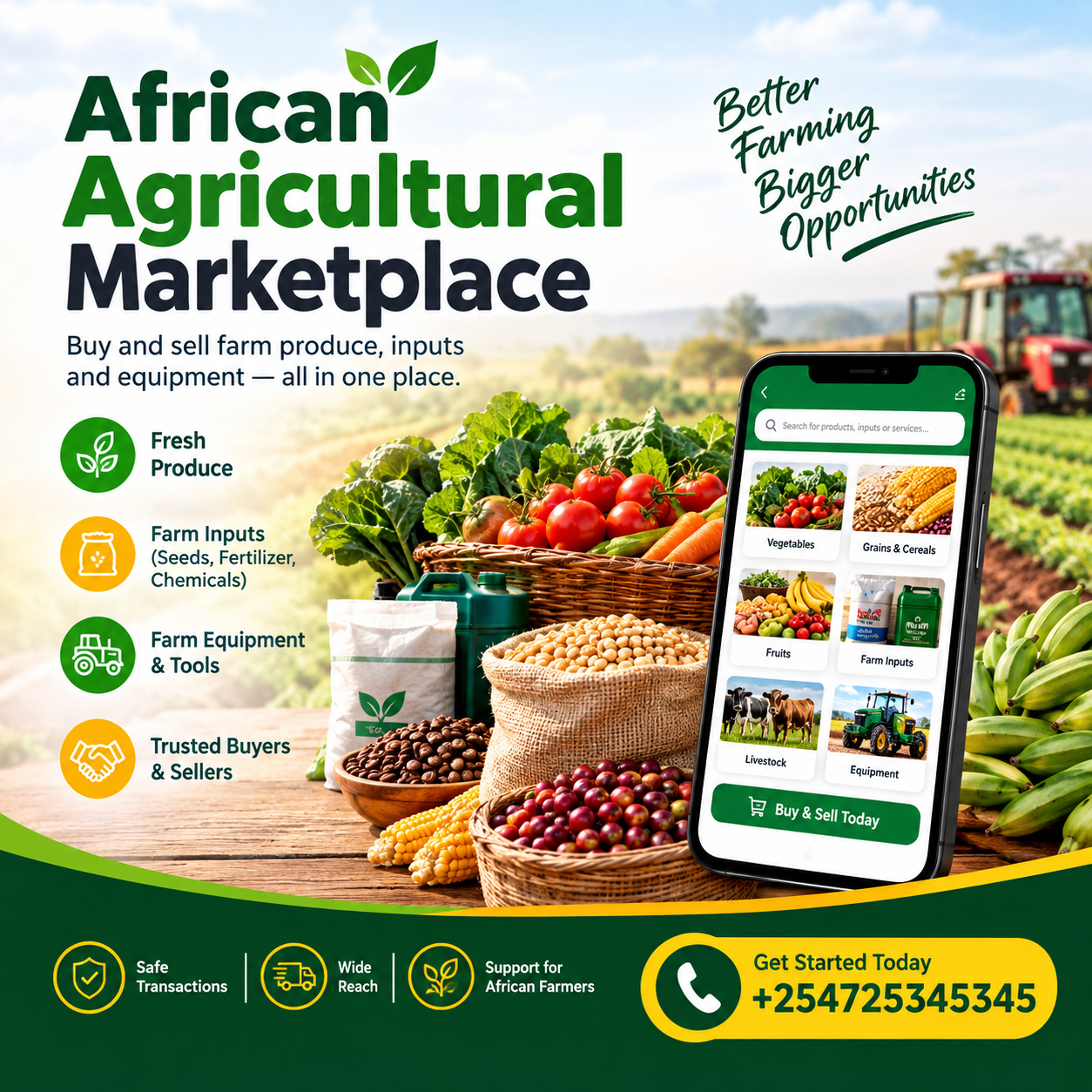
African agricultural marketplace platforms are transforming the way food is grown, priced, and moved across the continent. For generations, farmers have battled fragmented markets, opaque pricing, and long chains of middlemen who capture value that should belong to the people who actually grow the food.
The rapid spread of smartphones, affordable data bundles, and mobile money is finally rewriting that story. A well-designed African agricultural marketplace connects a maize farmer in Nakuru directly with a miller in Nairobi, a mango grower in Kilifi with an exporter in Mombasa, and a poultry keeper in Kisumu with hotels, schools, and hospitals that need a dependable weekly supply.
This guide takes a deep, practical look at how an African agricultural marketplace works, why it has become one of the most important innovations in modern African agriculture, and how farmers, traders, and agribusinesses can use one to grow their income. You will learn which features matter most, how payments and logistics are handled, which commodities perform best, how different regions compare, and exactly how to get started — all explained in plain language, with no jargon required.
What Is an African Agricultural Marketplace?
An African agricultural marketplace is a digital platform — typically a website, mobile app, or USSD service — where farmers, traders, cooperatives, processors, and end buyers meet to list, discover, negotiate, and pay for agricultural products and services.
Think of it as the digital version of a busy physical produce market, except that it never closes, it can be searched in seconds, and it is not limited by geography. A buyer in Addis Ababa can compare offers from suppliers in Arusha within minutes. A cooperative in Uganda can bid for a supply contract with a juice factory in Kenya. A restaurant group in Accra can source yams, peppers, and poultry from vetted producers without visiting a single farm.
What separates a serious African agricultural marketplace from a simple listings board is integration. The strongest platforms wrap the entire trade cycle into one system:
- Digital storefronts – every farmer, cooperative, or agribusiness gets a profile with photos, grading details, prices, and location.
- Price discovery – live and historical market prices help both sides agree on fair value before any money moves.
- Secure payments – mobile money, bank transfers, and escrow arrangements that release funds only when both parties are satisfied.
- Logistics coordination – transport, aggregation points, and cold chain options built directly into the ordering process.
- Trust tools – identity verification, quality grading, ratings, and reviews that make it safe to trade with someone you have never met.
- Value-added services – extension advice, quality inputs, micro-loans, and crop insurance layered on top of the core trade function.
For a modern farmer, an African agricultural marketplace is not just another sales channel. It is a complete business tool that replaces guesswork with data, broker dependency with direct relationships, and cash-at-the-farm-gate with secure, traceable digital payments.
Why Africa Needs a Digital African Agricultural Marketplace
Africa holds roughly 60 percent of the world’s uncultivated arable land, and agriculture employs more than half of the workforce in many countries. Yet the continent still spends billions of dollars every year importing food it could grow itself, while smallholder farmers — who produce the majority of Africa’s food — routinely pocket only a small fraction of the final retail price of their own produce.
The missing ingredient has never been production potential. It has been market structure, and that is exactly the problem an African agricultural marketplace is engineered to solve.
Consider how produce has traditionally moved. A farmer harvests tomatoes and sells them at the farm gate to a broker who quotes whatever price suits him, because the farmer has no way of knowing what tomatoes are fetching in the city that morning.
The broker sells to a trader, the trader sells to a wholesaler, the wholesaler sells to a retailer, and by the time the tomatoes reach the consumer the price may have tripled — while the farmer remains anchored to the bottom of the chain. Meanwhile, a large share of perishable harvests is lost to spoilage simply because farmers cannot reach buyers fast enough.
An African agricultural marketplace attacks each of these weaknesses head-on. Real-time pricing removes information asymmetry. Direct matching removes unnecessary middle layers. Built-in logistics shrink the gap between harvest and sale, which cuts post-harvest losses. Verified buyers and escrow payments remove the oldest fear of all — doing business with a stranger and never getting paid.
There is also a bigger macroeconomic story. The African Continental Free Trade Area is opening trade corridors that were previously clogged by paperwork and poor information. An African agricultural marketplace acts as the digital bridge across those corridors, helping surplus regions trade with deficit regions and converting local gluts into regional opportunities.
Key Features of a Modern African Agricultural Marketplace
Not all platforms are created equal, and the difference between a frustrating experience and a profitable one usually comes down to features. Here is what a competitive African agricultural marketplace should offer in today’s market:
- Verified profiles for every user. Farmers, buyers, and transporters should be identity-checked before they can trade. Verification is the foundation of trust on any African agricultural marketplace, and platforms that skip it eventually pay for it in disputes and refunds.
- Real-time price intelligence. Daily price updates from major markets allow sellers to price competitively and buyers to avoid being overcharged.
- Integrated mobile money and escrow. Payments should live inside the platform, with funds held securely until the buyer confirms delivery.
- Built-in logistics booking. The ability to arrange transport, aggregation, or cold storage at the click of a button is what turns a basic listing site into a genuine African agricultural marketplace.
- Standardized quality grading. Clear grades prevent disputes and make it possible to buy produce remotely with confidence.
- Multilingual and low-bandwidth access. Support for Swahili, French, Arabic, Amharic, Hausa, and USSD short codes ensures the platform works for everyone, not just smartphone owners in major cities.
- Data dashboards. Sales history, seasonal demand trends, and price forecasts help users plan the next season like a business rather than a gamble.
- Responsive human support. When a dispute arises, a good African agricultural marketplace offers real people who can mediate quickly — often the single biggest factor in whether farmers keep using the platform.
How an African Agricultural Marketplace Works: Step by Step
The day-to-day flow is far simpler than most people expect. Here is the typical journey of a transaction on an African agricultural marketplace:
- Register and get verified. A seller signs up with a phone number, uploads an ID or cooperative certificate, and receives a verified badge.
- List the produce. The seller creates a listing showing crop type, grade, quantity, asking price, photos, harvest date, and pickup location.
- Get discovered or matched. Buyers search and filter listings, or the platform’s matching engine pushes fresh listings to buyers whose previous purchases fit the profile — one of the biggest advantages an African agricultural marketplace has over a roadside stall.
- Negotiate and agree. Both parties communicate inside the platform and lock in quantity, grade, price, and delivery terms.
- Pay securely. The buyer pays by mobile money or bank transfer into escrow, so the seller can pack with confidence and the buyer can commit without fearing loss.
- Deliver and confirm. Produce moves through platform-arranged transport or the seller’s own logistics. The buyer inspects the goods, confirms receipt, and escrow releases the payment instantly.
- Rate and repeat. Both sides review each other. Strong ratings compound over time, turning a first-time seller into a preferred supplier — the reputation engine that keeps a healthy African agricultural marketplace running.
Top Benefits for Farmers Who Sell Through an Online Farm Marketplace
Farmers are the biggest winners when digital trade works well, and the gains show up in four distinct ways.
1. Better prices through direct market access. When a farmer can see city market prices on a phone and negotiate with buyers directly, the broker’s information advantage disappears. Selling through an African agricultural marketplace routinely lifts farm-gate incomes because the farmer is negotiating against real market prices rather than accepting whatever is quoted at the gate. Over a full season, that difference can be the margin between barely breaking even and actually banking a profit.
2. Less spoilage and more certainty. Perishable produce loses value by the hour. A platform that connects farmers to buyers before harvest, or matches a glut to a buyer within hours, converts what would have rotted into revenue. On an African agricultural marketplace, a farmer with 200 crates of ripe tomatoes is no longer hostage to one broker’s mood on one morning; the entire buyer network can see the listing the moment it goes live.
3. A digital path to credit. Most smallholders cannot access bank loans because they have no financial records. Every completed sale on an African agricultural marketplace creates a digital paper trail — volumes sold, prices achieved, buyers served — that lenders and input suppliers can use to extend credit, input financing, or asset loans. The platform’s transaction history becomes the farmer’s financial identity.
4. Knowledge, inputs, and better planning. Platforms increasingly bundle agronomic tips, weather alerts, and input ordering into the same app used for selling. That turns an African agricultural marketplace into a one-stop shop: the farmer learns what the market wants, plants accordingly, sources certified seed and fertilizer, sells at a fair price, and repays input credit from sales proceeds — a full commercial loop that simply did not exist in the informal system.
Benefits for Buyers, Traders, and Agribusinesses
The seller’s side of the story is only half the picture. Buyers gain just as much, which is what makes the model sustainable.
Reliable, aggregated supply. The hardest part of buying produce in Africa has always been assembling volume. A processor that needs five tonnes of groundnuts a week cannot call fifty small farms every Monday. On an African agricultural marketplace, aggregation happens digitally: listings from hundreds of farmers sit in one searchable inventory, and the buyer fills a weekly schedule in an afternoon.
Transparent pricing and grading. Standardized grades and published market prices mean procurement teams can compare offers like-for-like and defend their sourcing decisions to management. Negotiating on an African agricultural marketplace replaces haggling based on mood and relationships with negotiation based on data.
Lower procurement costs. Fewer intermediaries, fewer field trips, and less wasted time translate directly into lower landed costs. For a hotel chain, a school network, or a food manufacturer, sourcing through an African agricultural marketplace can cut procurement overheads significantly while improving consistency.
Traceability for quality-sensitive markets. Exporters and premium retailers increasingly need to prove where produce came from and how it was handled. Digital records on an African agricultural marketplace — who grew it, when it was harvested, how it moved — make traceability a byproduct of ordinary trading rather than an expensive add-on.
The Bigger Economic Picture
Scale the individual wins up to national level and the impact becomes strategic. Agriculture contributes a major share of GDP across most of the continent, yet it has remained the least digitized sector of many economies. Every functioning African agricultural marketplace pushes back against that by formalizing transactions that were previously invisible to the economy. Formalized trade means tax records, credit histories, and insurable businesses — the raw material of a modern agricultural economy.
Job creation is another quiet win. Platforms need field agents, quality inspectors, transport coordinators, warehouse staff, and customer support teams, many of them young people in rural towns where formal jobs are scarce. Each growing African agricultural marketplace becomes a rural employment engine in its own right, quite apart from the farm incomes it boosts.
Food security improves too. When price signals flow freely, farmers plant what the market actually needs, surpluses move to deficit areas instead of rotting, and consumer prices stabilize. Policymakers who once had to guess at food availability can see it in platform data. And because women make up a large share of African farmers and traders, digital platforms that require nothing more than a phone and a mobile money account have proven especially powerful at bringing women-led businesses into formal trade — a pattern now visible on virtually every successful African agricultural marketplace operating today.
The Technology Powering Digital Farm Trade
Behind the simple interfaces sits a stack of technologies that have matured at exactly the right moment.
Mobile money and USSD. Mobile money is the rail on which rural commerce now runs, and any African agricultural marketplace that ignores it is ignoring its own customers. Just as important is USSD support, which lets a farmer with a basic feature phone list produce, receive price alerts, and confirm payments without ever touching a smartphone.
Artificial intelligence and data science. Machine learning models now forecast prices, predict seasonal demand, flag suspicious listings, and match buyers with sellers automatically. The smartest African agricultural marketplace operators use these models to tell a farmer in February that French beans will be short in May — information worth far more than the commission on any single sale.
Satellites, drones, and IoT sensors. Remote sensing helps estimate yields before harvest, monitor crop health, and verify that a listed farm actually exists. Sensors in storage facilities track temperature and humidity, protecting the quality claims made on an African agricultural marketplace listing.
Blockchain and open APIs. For high-value export chains, immutable digital records of custody are becoming a market-access requirement rather than a novelty. At the same time, APIs let an African agricultural marketplace plug into logistics providers, insurers, credit bureaus, and government e-extension systems, so the platform becomes a hub for an entire service ecosystem rather than a lonely island.
The pattern across all of this is worth noting: technology is no longer the bottleneck. The ideas are proven and the tools are affordable. What separates winners from losers is execution — verification discipline, payment reliability, and logistics that actually show up.
Logistics, Cold Chains, and Getting Produce to the Buyer
Nothing kills a digital trade faster than a promise the platform cannot physically keep, which is why logistics is the make-or-break layer of every African agricultural marketplace. Moving produce from a smallholder’s field to a buyer’s warehouse involves aggregation, transport, handling, and timing — and any weak link destroys value instantly.
Progressive platforms solve this in layers. First, aggregation centers in farming clusters give dispersed smallholders a physical point where produce is collected, weighed, graded, and consolidated into truck-sized loads. Second, partnerships with transporters — from three-wheeler couriers for urban last-mile deliveries to long-haul truckers for cross-border loads — let an African agricultural marketplace quote and book delivery as part of the order itself, instead of leaving each party to figure it out alone.
Third, and most critically for horticulture, dairy, and fish, comes the cold chain. Electricity is unreliable and refrigeration is expensive across much of the continent, so solar-powered cold rooms at aggregation points have become the quiet heroes of the sector. A buyer paying a premium for Grade A produce listed on an African agricultural marketplace is, in effect, paying for that unglamorous infrastructure — and platforms that invest in it earn loyalty that discounting can never buy.
Timing matters as much as temperature. Good platforms synchronize harvest windows, transport departure times, and buyer receiving hours so produce moves in one smooth handoff. When logistics is designed into the platform rather than bolted on, the digital market finally matches the one promise that has always justified physical markets: you can see, agree on, and receive the goods in a single trip.
Payments, Financing, and Building Trust
Money is where agricultural trade has always broken down, and it is where digital platforms earn their keep.
The core innovation is separation of payment from delivery. Under an escrow model, the buyer’s funds are held by the platform when the order is placed and released only when the buyer confirms the goods arrived as described. This single mechanism neutralizes the two oldest fears in the trade: the farmer’s fear of not being paid and the buyer’s fear of paying for nothing. Every serious African agricultural marketplace treats escrow not as a feature but as the product itself.
On top of that foundation, platforms are layering financial services that were previously out of reach for rural users. Sales histories support working-capital loans for traders who need to buy stock before they sell it. Input financing lets a farmer receive seed and fertilizer at planting and repay at harvest from platform proceeds. Invoice discounting gives an institutional buyer’s supply contract immediate cash value. A well-run African agricultural marketplace becomes, in effect, a rural bank with perfect information about its customers’ businesses.
Trust is built through a thousand small signals: verified badges, dispute statistics, response-time scores, and public reviews. Platforms that publish dispute rates and enforce consequences for bad actors create virtuous cycles, because honest traders attract more business and dishonest ones are pushed out. The lesson from every mature African agricultural marketplace is the same — trust is expensive to build and cheap to destroy, so it must be engineered into daily operations rather than promised in marketing copy.
Commodities and Sectors You Can Trade
Different commodities behave very differently on digital platforms, and knowing where the model fits best helps both sellers and buyers set realistic expectations.
Grains and cereals
Maize, rice, wheat, sorghum, and millet are the volume anchors of any African agricultural marketplace. They store well, transport cheaply, and trade in standardized grades, which makes them ideal for escrow-based remote transactions. Millers and institutional buyers are the demand engine here, and a single contract can keep a cooperative busy for a whole season.
Horticulture
Tomatoes, onions, kale, cabbage, avocado, mango, and French beans are the high-frequency heartbeat of the platform economy. They are perishable, which is precisely why they benefit most from fast digital matching — the difference between selling today and selling in three days is often the difference between profit and loss. Wholesale buyers using an African agricultural marketplace for horticulture typically care most about grading consistency and delivery punctuality.
Livestock and dairy
Cattle, goats, poultry, eggs, and milk trade well when platforms support weight verification, health certificates, and cold chain options. Livestock buyers in particular value being able to see animals, weights, and vaccination records remotely before committing to a long trip. An African agricultural marketplace that solves remote inspection for livestock unlocks one of the largest and least digitized trade flows on the continent.
Cash crops
Coffee, tea, cocoa, cashew, macadamia, and cotton move through more regulated channels, but digital platforms increasingly serve the cooperative-to-processor segment, where transparent grading and fast payment matter enormously to farmer groups. For these chains, an African agricultural marketplace often wins by guaranteeing payment speed — a chronic pain point with traditional cash-crop marketing.
Fisheries and aquaculture
Fish spoils faster than almost anything else traded in volume, so platforms serving this sector combine ice plants, insulated transport, and same-day matching. Where that combination exists, an African agricultural marketplace can transform fishing communities by replacing middlemen who historically paid pennies at the beach.
The Regional Landscape Across Africa
Digital farm trade is developing at different speeds across the continent, shaped by infrastructure, policy, and mobile money penetration.
East Africa
East Africa is the proving ground, largely because mobile money reached critical mass here years before anywhere else. Kenya, Uganda, Tanzania, and Rwanda combine high mobile penetration with dense horticulture and dairy sectors, making the region the natural home for nearly every serious African agricultural marketplace launch. Cross-border corridors such as the Northern Corridor add a regional dimension, with surplus maize, eggs, and bananas moving between neighboring markets.
West Africa
West Africa brings scale. Nigeria’s enormous domestic demand, Ghana’s and Côte d’Ivoire’s cash-crop dominance, and the region’s cassava, yam, and poultry industries create deep liquidity for digital trade. The challenge is logistics across vast distances and congested ports, so the winning African agricultural marketplace models here tend to anchor themselves around urban demand centers like Lagos and Accra and work outward from there.
Southern Africa
South Africa’s highly commercialized agriculture contrasts with smallholder systems further north, and platforms in the region often focus on connecting commercial surplus in one country with deficits in another — maize from Zambia, for instance. Because the region already has mature wholesale systems, the opportunity for an African agricultural marketplace lies in efficiency and transparency rather than basic access.
North Africa
Egypt and Morocco combine intensive irrigation, strong export orientation, and improving digital infrastructure. Citrus, tomatoes, and potatoes dominate, and platforms increasingly serve export compliance — traceability, certification, and documentation — as much as domestic trade. An African agricultural marketplace operating here competes on sophistication, serving exporters who need digital paperwork as much as digital buyers.
How to Choose the Right Platform
With more platforms launching every year, choosing where to invest your time matters. Use this checklist before committing your produce or your money.
1. Verification standards. Ask how the platform vets users. If anyone can register and trade instantly, walk away — the disputes will eventually find you. A trustworthy African agricultural marketplace verifies identity before money ever moves.
2. Payment protection. Confirm that escrow or a documented payment-release process exists, and read the dispute policy before your first transaction, not after your first problem. The payment flow is the heart of any African agricultural marketplace, and vague answers here are a red flag.
3. Real logistics. Ask who transports the produce, what happens if a truck does not arrive, and whether cold storage is available for perishables. A platform without answers is a listings board, not a true African agricultural marketplace.
4. Fees versus value. Commissions are normal, but compare them against what you receive: price data, payment protection, logistics, and support often return several times their cost.
5. Crop and buyer fit. Some platforms specialize in horticulture, others in grains or livestock. The best platform for a dairy farmer in Nyandarua may be the wrong one for a cashew cooperative in Kilifi.
6. Human support. Test the customer service before you need it urgently. Response speed under pressure is the truest measure of a platform’s professionalism.
How to Start Selling in Simple Steps
If you are a farmer or trader ready to move online, the path is short. Follow these steps and you can be trading within days.
Step 1: Prepare your produce like a business. Sort, grade, clean, and weigh before you photograph anything. Buyers pay premiums for uniformity, and every successful seller on an African agricultural marketplace will tell you that presentation starts in the store, not on the screen.
Step 2: Create honest, detailed listings. Use clear photos in natural light, state exact weights, grades, and prices, and include harvest dates. Accuracy at this stage determines your dispute rate for the rest of your selling life on an African agricultural marketplace.
Step 3: Price with the market, not against it. Check the platform’s price data and position yourself sensibly. Being the cheapest is not a strategy; being fair, reliable, and fast to respond is.
Step 4: Respond quickly and communicate clearly. Buyers reward sellers who answer within minutes and confirm all details in writing inside the platform chat — which also protects you if a dispute ever arises on an African agricultural marketplace.
Step 5: Build your reputation deliberately. Complete every order, ask satisfied buyers to leave reviews, and keep your ratings clean. On most platforms, a five-star history is worth more than any advertisement you could ever buy.
Step 6: Scale with what the data tells you. Watch which products, grades, and volumes move fastest, then plant and stock accordingly next season. That feedback loop — sell, learn, adjust, replant — is the quiet superpower of selling through a digital farm marketplace.
Common Challenges and How Platforms Overcome Them
Honesty about the obstacles makes the opportunity more credible, so here are the real challenges and how the sector is answering them.
Connectivity and digital literacy. Rural coverage is improving but still uneven, and many first-time users have never transacted online. Leading platforms respond with USSD versions, offline-capable apps, field agents who onboard farmers in person, and voice menus in local languages. The platforms that grow fastest treat farmer education as part of the product, not an afterthought — a lesson now standard across every serious African agricultural marketplace.
Trust deficits and fraud. Any marketplace attracts bad actors, and agriculture is no exception. The countermeasures are verification, escrow, staged payment releases, inspection at aggregation centers, and swift public enforcement. These mechanisms cost money to run, but they are the entire reason a African agricultural marketplace can intermediate between strangers at scale.
Logistics gaps. Roads, trucks, and cold rooms do not appear because an app exists. The strongest platforms partner with transport networks, invest in aggregation infrastructure, and concentrate on corridors where physical trade already flows, rather than promising nationwide coverage they cannot deliver.
Seasonality and side-selling. Farmers may abandon agreements when spot prices spike elsewhere. Platforms fight this with deposits, pre-agreed premiums for reliability, and repeat-purchase incentives that make loyalty more profitable than opportunism.
Regulatory friction. Cross-border trade involves permits, standards, and sometimes unpredictable policy. Mature platforms build compliance teams that handle documentation for users, converting a bureaucratic burden into a competitive advantage.
None of these challenges is trivial, but none is unique to digital trade either — the informal system suffers every one of them, only without data, escrow, or support. That comparison is exactly why adoption keeps climbing despite the friction.
The Future of Online Farm Trade in Africa
The next decade will deepen and widen what platforms can do. Intra-African trade under the continental free trade agreement will make cross-border produce flows routine, and the platforms that master customs documentation, currency handling, and multi-country logistics will capture that growth. Expect the average African agricultural marketplace of 2030 to look less like a listings site and more like a full-stack agricultural operating system: trade, transport, credit, insurance, advisory, and certification inside one account.
Artificial intelligence will move from price forecasting to personalized agronomy — telling each individual farmer what to plant, when, and for which buyer. Warehouse receipt systems will let farmers sell stored produce months after harvest at better prices. Carbon and sustainability markets may pay farmers for regenerative practices verified by the same digital records that document their sales. And as generational change takes hold, a new cohort of digitally native young farmers will treat online trading as the default rather than the innovation.
The direction of travel is unambiguous. Agriculture is the largest sector of most African economies and the least digitized — precisely the combination that produces decade-long growth stories.
Frequently Asked Questions
How much does it cost to sell on a digital farm platform?
Most platforms are free to join and charge a commission per completed transaction, typically a small percentage of the sale value. Some add optional fees for logistics, featured listings, or premium verification. Because commissions are only charged on successful sales, the model aligns the platform’s income with the seller’s — a structure that has proven far more farmer-friendly than upfront listing fees.
Can I participate without a smartphone?
Yes. Leading platforms offer USSD codes that work on any mobile phone, letting you list produce, receive price alerts, and confirm payments without internet access. Field agents in many regions also help farmers create and manage listings, so digital literacy is a hurdle that shrinks every year.
How are prices determined?
Sellers set asking prices, guided by the platform’s live market data, and buyers negotiate or accept. Because everyone can see the prevailing market rates, prices on a digital platform tend to sit much closer to true market value than farm-gate offers from brokers — that transparency is one of the core reasons an African agricultural marketplace delivers better outcomes for both sides of the trade.
What happens if the buyer and seller disagree?
The platform’s dispute process steps in: evidence from the listing, chat records, and delivery notes is reviewed, and escrow funds are released according to the outcome. This is far safer than informal trade, where a disagreement usually means one party simply absorbs the loss.
Can smallholders with tiny volumes join, or is it for big traders only?
Both are welcome. Many platforms let smallholders join aggregation groups so their combined volumes meet buyer minimums. Over time, reliable small sellers grow into regular suppliers — the platform economy rewards consistency as much as size.
Which payment methods are supported?
Mobile money is the standard across most of the continent, with bank transfers and card payments common for larger institutional buyers. Escrow protection applies regardless of the method used.